
Method for preparing 7-amino-3-sulfotetrazolthiomethylcephalosporanic acid
A technology of sulfotetrazolium thiomethyl cephalosporanic acid and sulfotetrazolium thiomethyl cephalosporan, which is applied to the preparation of 7-amino-3-sulfotetrazolium thiomethyl cephalosporanic acid It can achieve the effect of solving expensive, mild and simple reaction conditions, and reducing potential safety hazards
Patent Information
- Authority / Receiving Office
- CN · China
- Patent Type
- Applications(China)
- Current Assignee / Owner
- Publication Date
- 2010-08-04
- Estimated Expiration
- Not applicable · inactive patent
Smart Images
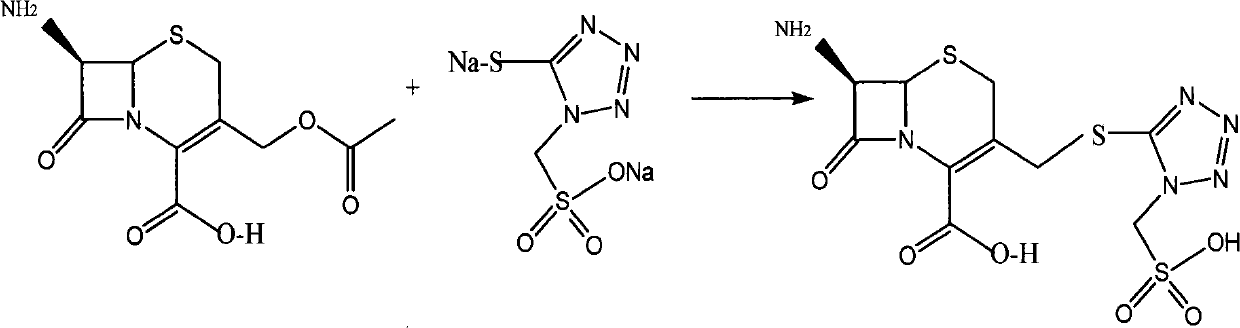
Figure 1
Abstract
Description
technical field
[0001] The present invention relates to the synthesis of the important intermediate of cephalosporins second-generation broad-spectrum, long-acting antibiotic cefnixin sodium, i.e. 7-amino-3-sulfonic acid tetrazolethiomethyl cephalosporanic acid (abbreviated 7-ACA- 3-SMT) preparation method. Background technique
[0002] At present, at home and abroad, the intermediate of preparing cefnixin sodium, namely the method of 7-amino-3-sulfonic acid tetrazolium thiomethyl cephalosporanic acid is mainly by using 7-amino cephalosporanic acid (hereinafter referred to as 7-ACA) As the starting material, it is formed by condensation reaction with 5-mercapto-1 sulfonic acid methyl tetrazolium disodium salt under the catalysis of the catalyst. The reaction conditions have the following situations: 1. Use boron trifluoride (BF 3 )-acetonitrile or boron trifluoride-ether solution as a catalyst reaction; 2. Add a weak base, such as sodium bicarbonate, to react; 3. Use a hexa...
Examples
Embodiment 1
[0020] a. adding 230kg boron trifluoride concentration in 250kg dimethyl carbonate solvent is 35% dimethyl carbonate solution, after stirring evenly, add 45kg of 7-ACA and 43kg of 5-mercapto-1 sulfonic acid Methyl tetrazolium disodium salt, then reacted at 21°C under stirring;
[0021] b. Stop the reaction when the 7-ACA residue in the above reaction is ≤0.5%, then add 60kg of purified water, and continue the reaction at 25°C;
[0022] c. After the above reaction was carried out for 0.5 to 1 hour, the temperature was lowered to 12°C, and after stirring for 30 minutes, the crude product of 7-amino-3-sulfonic acid tetrazolium thiomethyl cephalosporanic acid crystals was obtained by filtering and washing;
[0023] d. After adding the crude crystalline product above to 200kg of purified water to dissolve, add 15kg of acetone solvent at room temperature 20-25°C, adjust the pH value of the reaction solution to 1.9 with sodium bicarbonate solution or ammonia solution and fully stir i...
Embodiment 2
[0025] Embodiment 2: the difference between this embodiment and embodiment 1 is that
[0026] a. Add 100kg boron trifluoride concentration in 350kg dimethyl carbonate solvent and be 18% dimethyl carbonate solution, after stirring evenly, add 20kg of 7-ACA and 19kg of 5-mercapto-1 sulfonic acid Methyl tetrazolium disodium salt, then reacted at 12°C under stirring;
[0027] b. Stop the reaction when the 7-ACA residue in the above reaction is ≤0.5%, then add 30kg of purified water and continue the reaction at 40°C;
[0028] c. After the above reaction was carried out for 0.5 to 1 hour, the temperature was lowered to 5° C., and after stirring for 30 minutes, filtered and washed to obtain the crude 7-amino-3-sulfonic acid tetrazolium thiomethyl cephalosporanic acid crystal;
[0029] d. After dissolving the crude crystalline product above in 350kg of purified water, add 10kg of tetrahydrofuran solvent at room temperature 20-25°C, adjust the pH value of the reaction solution to 0.9 ...
Embodiment 3
[0031] Embodiment 3: the difference between this embodiment and embodiment 1 is,
[0032] a. in 500kg dimethyl carbonate solvent, add the weight percent concentration of 250kg boron trifluoride to be 50% dimethyl carbonate solution, after stirring, add successively 5-mercapto-1 sulfonic acid of 50kg of 7-ACA and 47kg Methyl tetrazolium disodium salt, then react at 40°C under stirring;
[0033] b. Stop the reaction when the 7-ACA residue in the above reaction is ≤0.5%, then add 60kg of purified water and continue the reaction at 30°C;
[0034] c. After the above reaction was carried out for 0.5 to 1 hour, the temperature was lowered to 15° C., stirred for 30 minutes, filtered and washed to obtain the crude 7-amino-3-sulfonic acid tetrazolium thiomethyl cephalosporanic acid crystal;
[0035] d. After adding the crude crystalline product above to 500kg of purified water for dissolution, add 30kg of isopropanol solvent at room temperature 20-25°C, adjust the pH value of the react...