
Method for refining prolinamide
A technology of proline amide and proline ester, which is applied in the direction of organic chemistry, can solve the problems of product titration content decline, etc., and achieve the effects of not easy racemization, high optical purity and simple method
Patent Information
- Authority / Receiving Office
- CN · China
- Patent Type
- Applications(China)
- Current Assignee / Owner
- Publication Date
- 2011-09-14
Smart Images
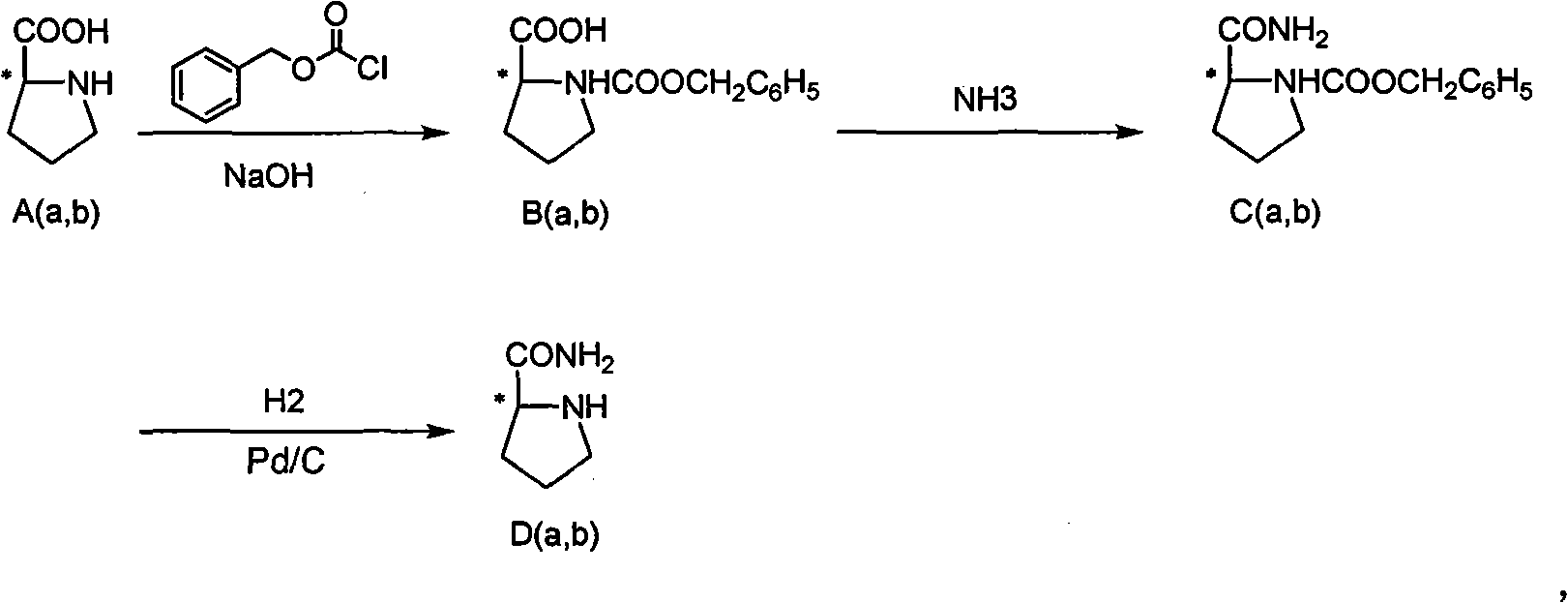
Figure 1 
Figure 2 
Figure 3
Abstract
Description
field of invention
[0001] The invention relates to a method for refining prolineamide. Background technique
[0002] Both L-prolinamide and D-prolinamide are important optically active pyrrole derivatives with excellent asymmetry source properties, and have been more and more widely used in the synthesis of end groups of polypeptide compounds. For example, L-prolineamide can be used as a key intermediate in the synthesis of vildagliptin, a drug for treating diabetes, and D-prolineamide can be used in the synthesis of antitumor drugs such as platinum compound (CDDP) and neuroleptic. In addition, these two compounds are often used as resolving agents and chiral reagents. Therefore, prolinamide, as a fine organic chemical intermediate of optically active pyrrole derivatives, is widely used in the fields of medicine, pesticide, chemical industry and the like.
[0003] At present, there are two main routes for the synthesis of prolineamide:
[0004] Route 1: Kazumi et al. (Jou...
Examples
Embodiment 1
[0029] Embodiment 1: Preparation of L-proline methyl ester hydrochloride.
[0030] Pump 500L of methanol into the reactor, and drop in 100 kg of L-proline. Stir and cool to 0~-10°C, and add 136 kg of thionyl chloride dropwise under temperature control. After dropping, the temperature was raised to reflux for 1 to 2 hours. Methanol was concentrated under reduced pressure to obtain a yellow oil.
Embodiment 2
[0031] Embodiment 2: Preparation of D-proline methyl ester hydrochloride.
[0032] Pump 500L of methanol into the reactor, and drop in 100 kg of D-proline. Stir and cool to 0~-10°C, and add 136 kg of thionyl chloride dropwise under temperature control. After dropping, the temperature was raised to reflux for 1 to 2 hours. Methanol was concentrated under reduced pressure to obtain a yellow oil.
Embodiment 3
[0033] Embodiment 3: Preparation of D-proline ethyl ester hydrochloride.
[0034] Pump 500L of ethanol into the reactor, and drop in 100 kg of D-proline. Stir and cool to 0~-10°C, and add 136 kg of thionyl chloride dropwise under temperature control. After dropping, the temperature was raised to reflux for 1 to 2 hours. Ethanol was concentrated under reduced pressure to obtain a yellow oil.
[0035] step 2
[0036]