
Bioflocculant fermentation method with mycelium pellet as vector
A technology of fermented organisms and mycelium balls, which is applied in the field of fermented biological flocculants, can solve the problems of being unsuitable for large-scale industrial fermentation production, low production efficiency, and high production costs, so as to reduce the chance of bacterial contamination, improve production efficiency, and flocculate The effect of rate stabilization
Patent Information
- Authority / Receiving Office
- CN · China
- Patent Type
- Applications(China)
- Current Assignee / Owner
- Publication Date
- 2011-11-30
- Estimated Expiration
- Not applicable · inactive patent
Smart Images
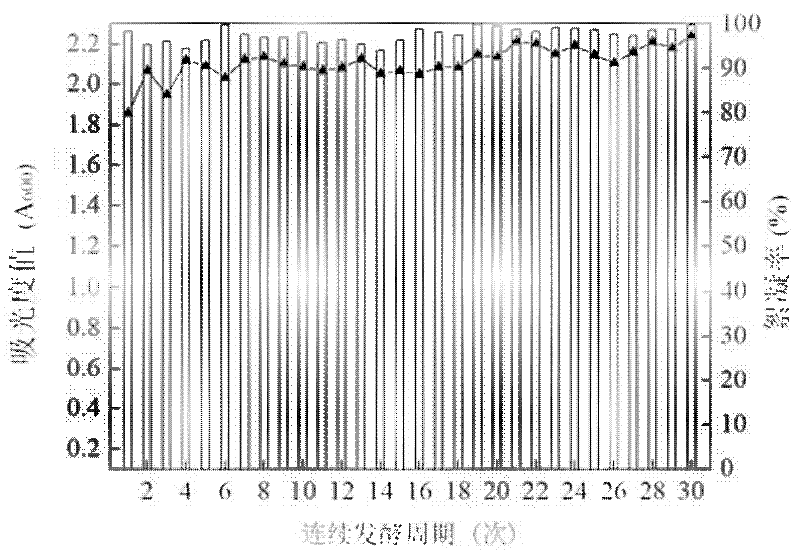
Figure 1 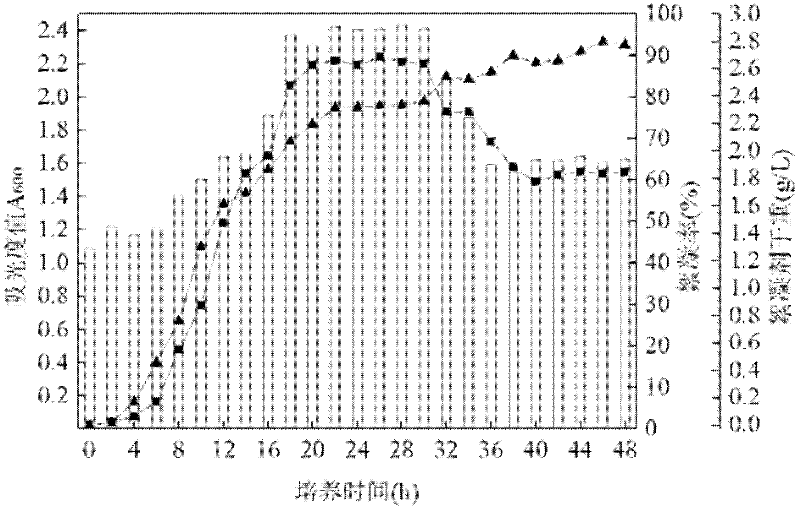
Figure 2 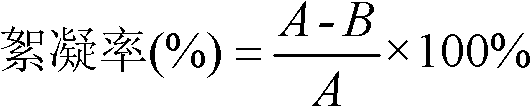
Figure 3
Abstract
Description
Technical field
[0001] The invention relates to a method for fermenting a biological flocculant. Background technique
[0002] Bioflocculant (BF) is a kind of natural biopolymer produced by microorganisms, which has flocculation and sedimentation functions for bacteria, cells, solid particles, colloidal particles and other suspended matter in liquid. Compared with chemical flocculants, biological flocculants have many advantages, such as high efficiency, non-toxicity, low fermentation cost, no secondary pollution, biodegradability, harmless degradation products, easy solid-liquid separation of products, etc., new environmentally friendly biological flocculation It meets the requirements of today's sustainable development and has important practical significance for human health and environmental protection. It has become one of the important directions of flocculant research and development, and it is a new type of green water purifying agent.
[0003] The current research on biol...
Examples
specific Embodiment approach 1
[0009] Specific embodiment 1: The method of fermenting biological flocculant with mycelium pellets in this embodiment is carried out in the following steps: 1. Rhizobium radiata and Bacillus sphaericus are mixed in a volume ratio of 1:1 and then inoculated into 100 mL of flocculant. Culture culture medium in a 250mL Erlenmeyer flask, placed in a shaker with a temperature of 20~30℃ and a rotating speed of 120~160r / min for 18~30 hours to obtain a seed solution of flocculent fungus; 2. The spore suspension of Aspergillus niger Inoculate into a 250 mL Erlenmeyer flask containing 100 mL of mycelial pellet culture medium, and place it in a shaker at a temperature of 28-32°C and a rotation speed of 140r / min for 1-7 days to obtain mature hyphae; The mycelium pellets were rinsed with sterilized phosphate solution and added to a 250 mL Erlenmeyer flask containing 100 mL of flocculent culture medium, and then added the flocculent seed liquid at a volume ratio of 1% to 10%, and placed at a ...
specific Embodiment approach 2
[0015] Specific embodiment two: this embodiment is different from specific embodiment one in that in step one, it is placed in a shaker with a temperature of 20° C. and a rotation speed of 160 r / min for 30 hours to obtain a seed solution of flocculent bacteria. Other steps and parameters are the same as in the first embodiment.
specific Embodiment approach 3
[0016] Specific embodiment three: This embodiment is different from specific embodiment one in that in step one, it is placed in a shaker with a temperature of 30° C. and a rotating speed of 120 r / min for 18 hours to obtain a seed liquid of flocculent bacteria. Other steps and parameters are the same as in the first embodiment.