
Evodiamine compounds, preparation method thereof and application thereof
A technology of evodiamine and its compounds, applied in the field of evodiamine compounds and their medicinal salts, can solve the problems of high toxicity and poor water solubility, and achieve good anti-tumor activity
Patent Information
- Authority / Receiving Office
- CN · China
- Patent Type
- Applications(China)
- Current Assignee / Owner
- Publication Date
- 2012-01-11
- Estimated Expiration
- Not applicable · inactive patent
Smart Images
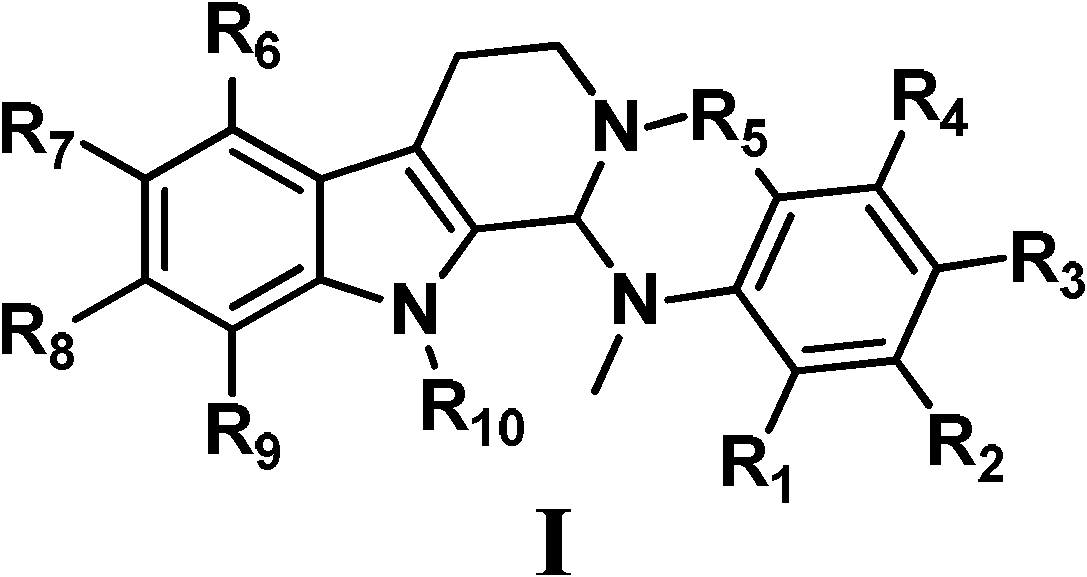
Figure 1 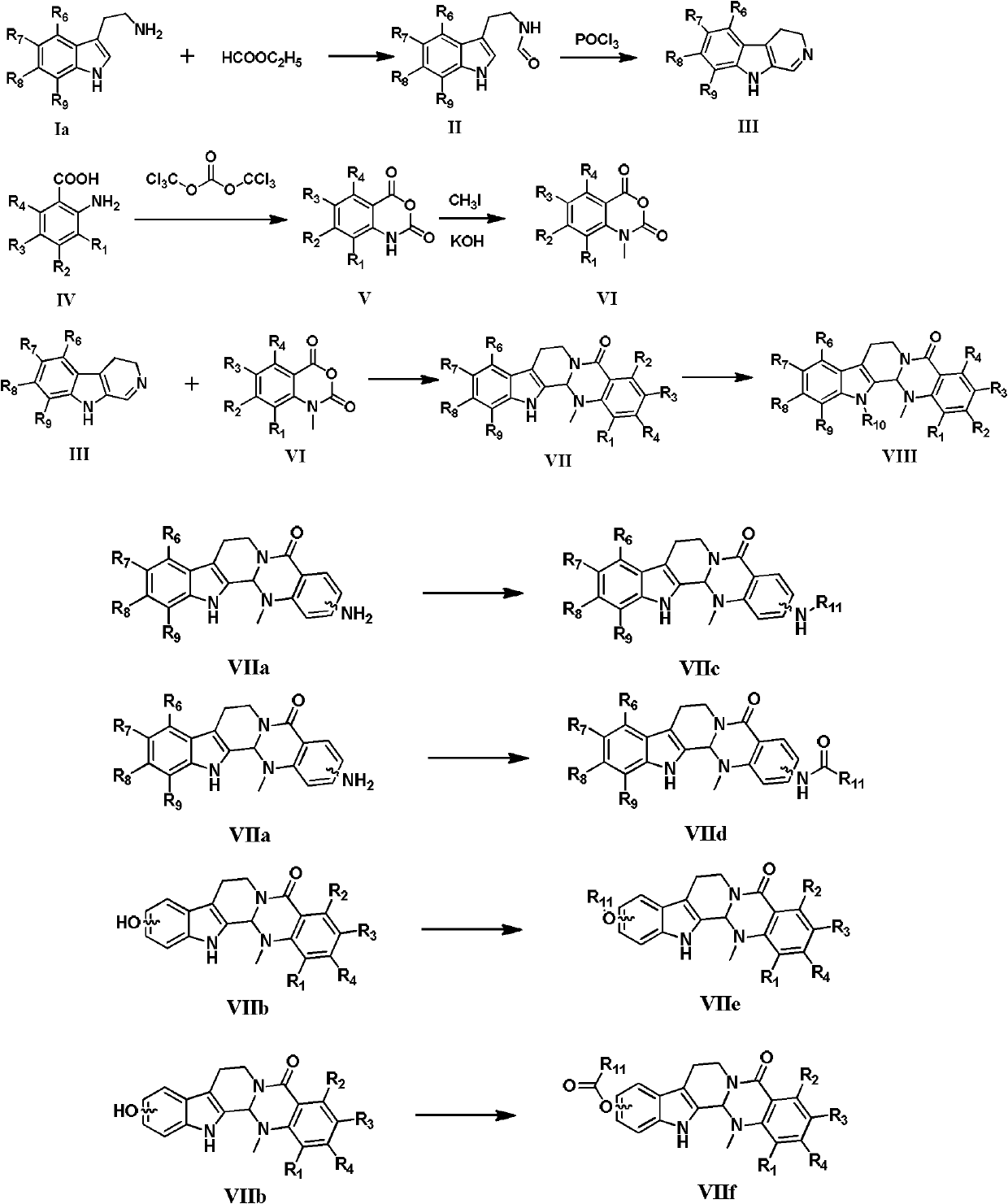
Figure 2 
Figure 3
Abstract
Description
technical field
[0001] The invention relates to the technical field of medicine, in particular to evodiamine compounds and their medicinal salts, their preparation methods and applications. Background technique
[0002] DNA topoisomerase I (topoisomerase I, TopoI) is an essential enzyme for cell DNA replication, transcription, recombination and repair, and the content of TopoI in tumor cells, especially colon cancer, cervical cancer, ovarian cancer, etc. is much higher than that in normal tissues , so this type of drug has high selectivity for tumor cells. Inhibitors of this enzyme have been listed as one of the six major categories of anti-tumor drugs by the US NCI.
[0003] Camptothecin is a classic topoisomerase I inhibitor. At present, three camptothecin compounds have entered clinical use, namely Irinotecan, Topotecan and Belotecan. . However, the lactone structure necessary for the activity of this type of compound is hydrolyzed too quickly in the human body into an...
Examples
Embodiment 1
[0060] Embodiment 1: the synthesis of 1-methyl evodiamine
[0061] A. Preparation of N-formyltryptamine
[0062] In a 50ml three-necked bottle, add 8g (50mmol) of tryptamine and 25g of ethyl formate, and reflux at 80°C for 12 hours. After the reaction, the solvent is evaporated to dryness to obtain a brown oil, which is left at room temperature for 2-3 days, and crystals slowly appear. Suction filtration obtained 7.3 g of the product with a yield of 87.1%.
[0063] B. Preparation of 3,4-dihydro-β-carboline
[0064] In a 100ml three-neck flask, add 50ml of dichloromethane, under stirring conditions, add 5g (26mmol) N-formyl tryptamine, cool to about 5°C in an ice-water bath, then slowly add 12.5ml of phosphorus oxychloride, ice React in the bath for 2 hours, and then react at room temperature for 2 hours. After the reaction, dichloromethane and unreacted phosphorus oxychloride were recovered by distillation under reduced pressure, and the residual solid was extracted three ti...
Embodiment 2
[0071] Example 2: Synthesis of 4-fluoroevodiamine
[0072] According to the method of Example 1, in step C, 6-fluoroanthranilic acid is used instead of 3-methylanthranilic acid to obtain 5-fluoropyridine red acid anhydride, and in step D, 5-fluoropyridine red acid anhydride is used instead of 8- Methylidine red anhydride to get N-methyl-5-fluoropyridine red anhydride, replace N-methyl-8-methylpyridine red anhydride with N-methyl-5-fluoropyridine red anhydride in step E to get gray powder 0.47g of 4-fluoroevodiamine, the total yield is 36.5%.
Embodiment 3
[0073] Embodiment 3: the synthesis of 4-chloroevodiamine
[0074] According to the method of Example 1, in step C, 3-methylanthranilic acid is replaced with 6-chloroanthranilic acid to obtain 5-chloropyridine red acid anhydride, and in step D, 5-chlororidine red acid anhydride is used to replace 8- Methylidine red anhydride to get N-methyl-5-chloropyridine red anhydride, in step E replace N-methyl-8-methylpyridine red anhydride with N-methyl-5-chlororidine red anhydride to get gray powder 0.64g of 4-chloroevodiamine, with a total yield of 47.5%.