
Dual-mode terminal ability information processing method, dual-mode terminal and network side device
An information processing method and network-side device technology, applied in network data management, wireless communication, electrical components, etc., can solve problems such as misunderstanding, capability error, and terminal function failure
Patent Information
- Authority / Receiving Office
- CN · China
- Current Assignee / Owner
- Publication Date
- 2012-07-04
Smart Images
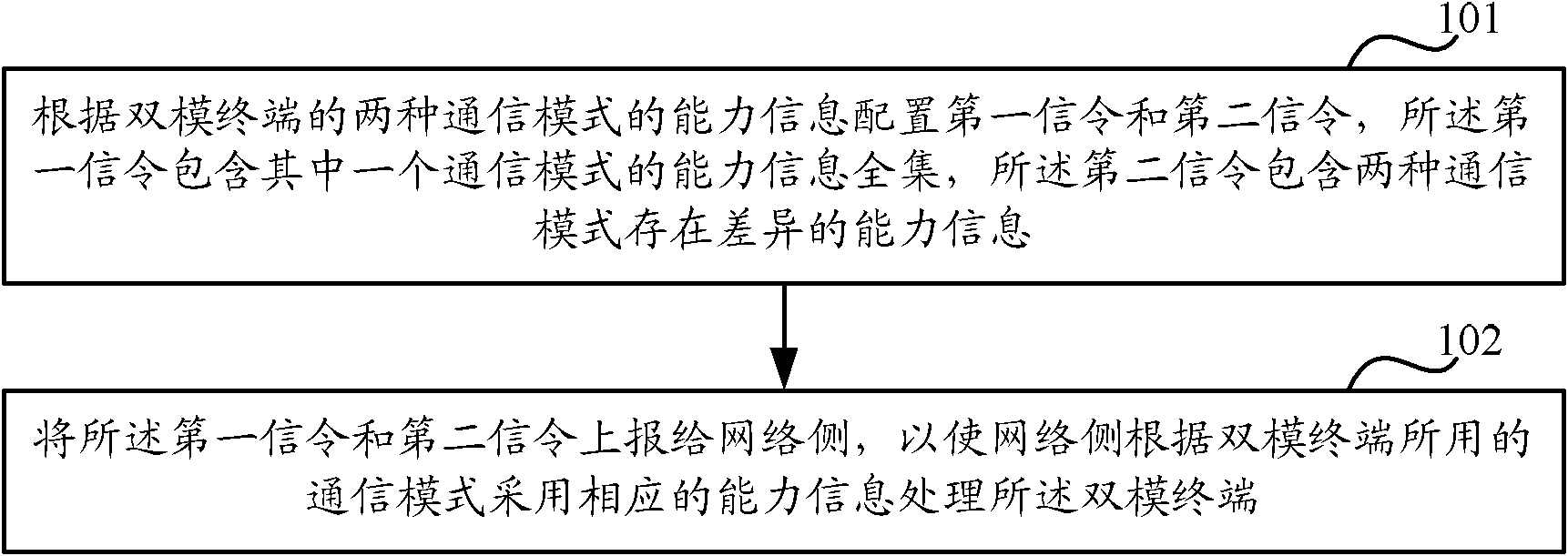
Figure 1 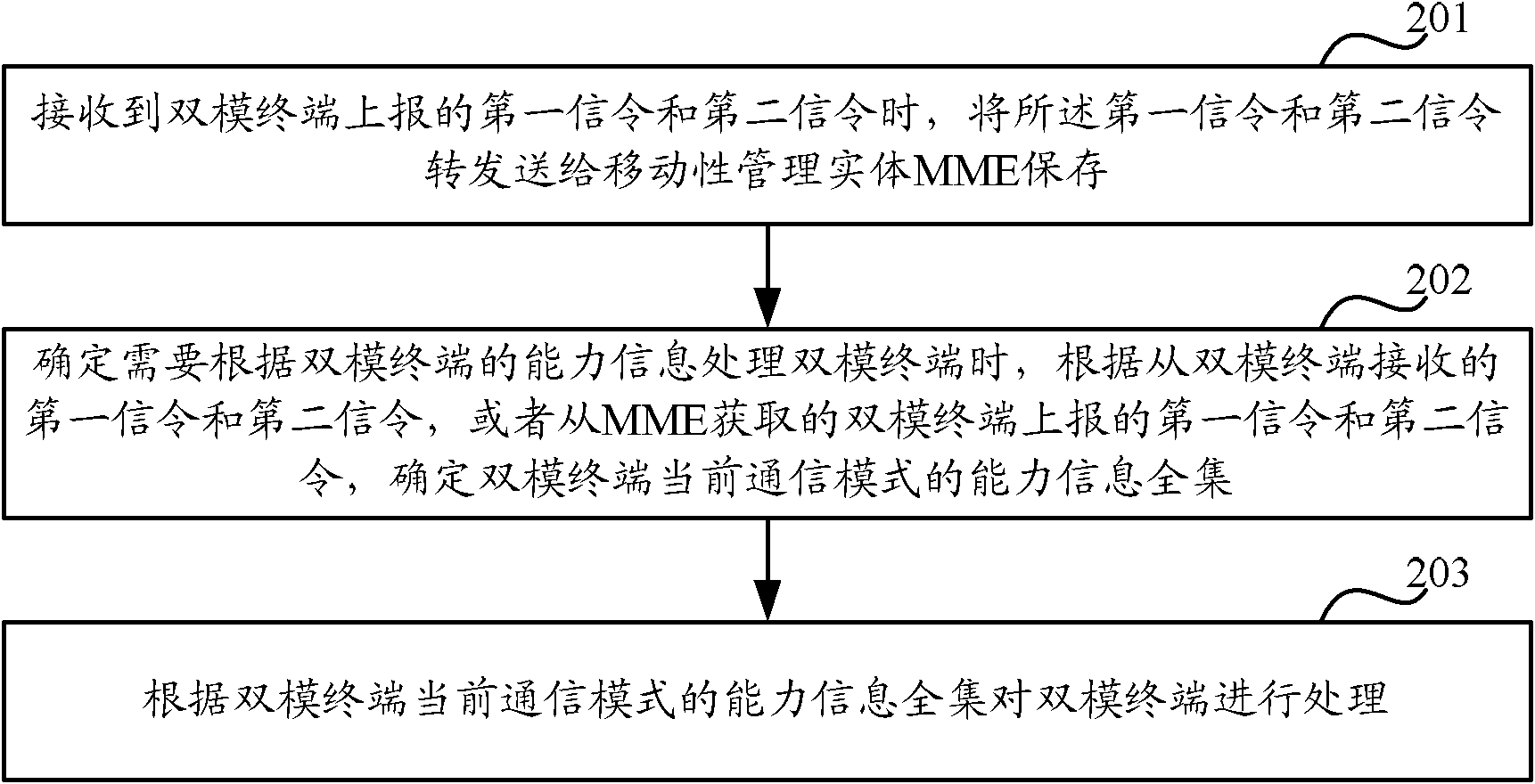
Figure 2 
Figure 3
Abstract
Description
technical field
[0001] The present invention relates to the technical field of wireless communication, and in particular to a dual-mode terminal capability information processing method, a dual-mode terminal and a network side device. Background technique
[0002] In an LTE (Long Term Evolution, long-term evolution) system, reporting of capability information of a UE (User Equipment, user equipment) is involved in two scenarios.
[0003] In one scenario, the base station requests the capability information of the UE from the MME (Mobility Management Entity, mobility management entity) when the UE accesses, and the MME forwards the saved capability information of the UE to the base station. If the MME does not have the capability information of the UE, the base station sends a capability query message to the UE to request the UE to report the capability information. After receiving the capability query message, the UE reports its capability information to the base station thr...
Examples
Embodiment 1
[0078] The dual-mode terminal currently resides in a cell in the FDD mode, and the network is a single-mode network that only supports the FDD mode. When the dual-mode terminal reports the capability information, it fills in all the capabilities of FDD in the original signaling, and reports the capability information of the allowable difference between FDD and TDD in the extended signaling. After receiving it, the base station on the network side only recognizes the FDD capability information in the original signaling, and processes the dual-mode terminal according to the identifiable capability information, and processes it as a single-mode FDD terminal.
Embodiment 2
[0080]The dual-mode terminal currently resides in a cell in FDD mode, and the network is a dual-mode network that supports mobility between FDD and TDD. When the dual-mode terminal reports the capability information, it fills in all the capabilities of FDD in the original signaling, and reports the capability information of the allowable difference between FDD and TDD in the extended signaling. After the network receives it, it saves all the capability information of the dual-mode terminal. In FDD mode, it is processed according to the FDD mode capability. When the dual-mode terminal switches to the TDD mode, the network determines the FDD and TDD common capability information set in the original signaling, and combines the common capability information set and the TDD mode difference capability information in the extended signaling as the dual-mode terminal TDD mode capability for subsequent processing.
[0081] According to the definition of capability information, capabil...
Embodiment 3
[0083] The dual-mode terminal currently resides in a cell in FDD mode, and the network is a dual-mode network that supports mobility between FDD and TDD. The MME on the network side has stored the dual-mode capability information of the dual-mode terminal. Then, after the base station obtains the capability information from the MME, it needs to extract the capability information according to the mode of the serving cell where the current terminal is located (assumed to be a TDD mode). Taking the example in Embodiment 2 as an example, the base station can combine the common capability sets C1, C2, and C3 in the original signaling and the capability information C4, C5, and C7 of the TDD mode in the extended signaling as the TDD mode of the terminal Ability.