
Synthesis method of 5-methyl-2-isopropyl chlorocyclohexane
A technology of propyl chlorocyclohexane and a synthesis method, which is applied in chemical instruments and methods, preparation of halogenated hydrocarbons, organic chemistry, etc., can solve problems such as environmental pollution, and achieves environmental safety and friendliness, easy availability of raw materials, and yield of products. high rate effect
Patent Information
- Authority / Receiving Office
- CN · China
- Patent Type
- Applications(China)
- Current Assignee / Owner
- Publication Date
- 2013-09-18
Smart Images
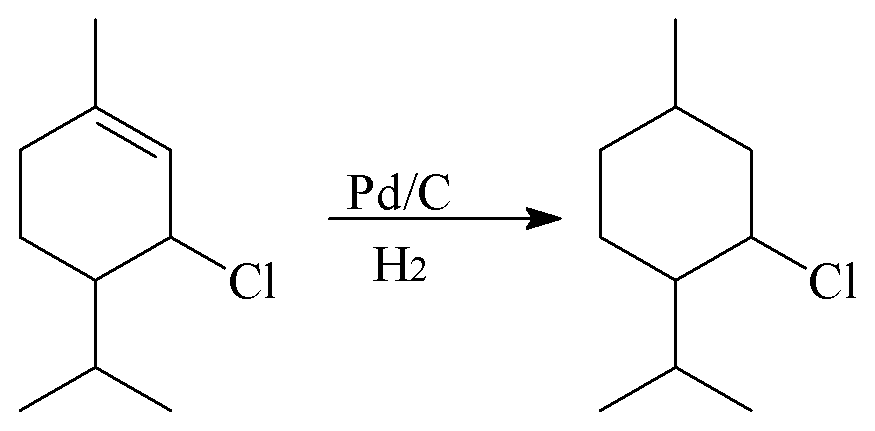
Figure 1 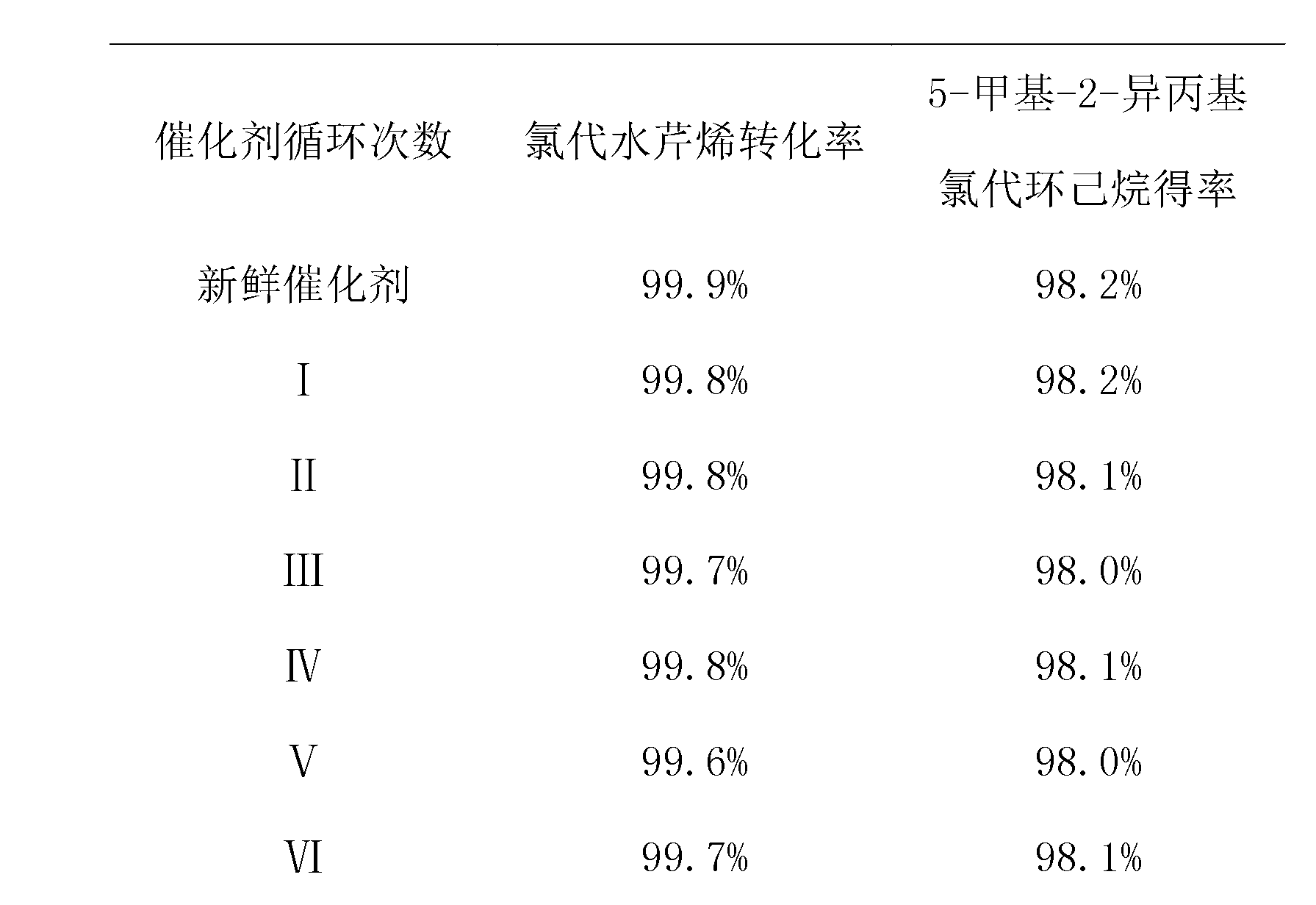
Figure 2
Abstract
Description
technical field
[0001] The invention relates to the technical field of chemical industry, in particular to a method for synthesizing 5-methyl-2-isopropylchlorocyclohexane. Background technique
[0002] 5-methyl-2-isopropylcyclohexane chloride is an important intermediate for preparing cooling agents such as N-ethyl-5-methyl-2-isopropylcyclohexanecarboxamide. N-ethyl-5-methyl-2-isopropylcyclohexanecarboxamide is an important menthol derivative with longer lasting cool taste and no or weak aroma The disadvantage of high temperature resistance can be widely used in medicine, candy, chewing gum, toothpaste and other cosmetics.
[0003] The common synthetic method of 5-methyl-2-isopropyl chlorocyclohexane at present, as Marx, Thomas and Breitmaier, Eberhard take menthol as raw material and Lucas reagent to carry out chlorination reaction and obtain 5-methyl-2 -Isopropyl chlorocyclohexane (see Liebigs Annalen der Chemie, (3), 183-5; 1992); Chen Dongchen et al. used menthol as ra...
Examples
Embodiment 1
[0022] In a 500mL hydrogenation reaction vessel, add 345g of chlorinated phellandrene and 3.45g of 5% palladium carbon catalyst, control the stirring speed to 220r / min, heat to a temperature of 80°C and start feeding hydrogen, control the hydrogen pressure to 0.2Mpa, After the hydrogen absorption is completed, keep the reaction for 2 hours. Gas chromatography analysis raw material content is below 0.5%, and reaction finishes. Cool to 20-25°C, filter out the solid catalyst with a Buchner funnel, wash the filtrate with 500mL deionized water, let it stand and separate into two layers, discard the lower water layer, and the upper oil layer is 5-formazan Base-2-isopropylchlorocyclohexane crude oil. Distill the obtained 5-methyl-2-isopropylchlorocyclohexane crude oil under reduced pressure, the first section is 55~65℃ / 0.8kpa head 2g, the second section is 65~67℃ / 0.8kpa The finished product 5-methyl-2-isopropylchlorocyclohexane 343.1g, (gas chromatography analysis content is 98.0%)...
Embodiment 2
[0024] In the hydrogenation reaction vessel, add 345g of chlorinated phellandrene and 3.45g of 5% platinum carbon catalyst, control the stirring speed to 220r / min, heat to 80°C and start feeding hydrogen, control the hydrogen pressure to 0.2Mpa, absorb After the hydrogen is completed, keep the reaction for 2 hours. Gas chromatographic analysis of the raw material content is below 0.5%. After the reaction is over, cool to 20-25°C and filter out the solid catalyst with a Buchner funnel. The lower water layer and the upper oil layer are 5-methyl-2-isopropylchlorocyclohexane crude oil. Distill the obtained 5-methyl-2-isopropylchlorocyclohexane crude oil under reduced pressure, the first section is 55~65℃ / 0.8kpa head 2g, the second section is 65~67℃ / 0.8kpa The finished product 5-methyl-2-isopropylchlorocyclohexane 342.8g, (gas chromatography analysis content is 98.1%), the reaction yield is 98.2%.
[0025] The catalyst recovered by filtration of the present invention can be recyc...