

Production technique of pharmaceutical gelatin
A production process and process technology, applied in the production process field of medicinal gelatin, can solve the problems of high viscosity drop rate, low product viscosity and high production cost, and achieve the effects of reducing waste and contamination, improving gelatin color and saving energy.
Patent Information
- Authority / Receiving Office
- CN · China
- Current Assignee / Owner
- Publication Date
- 2015-02-25
Smart Images
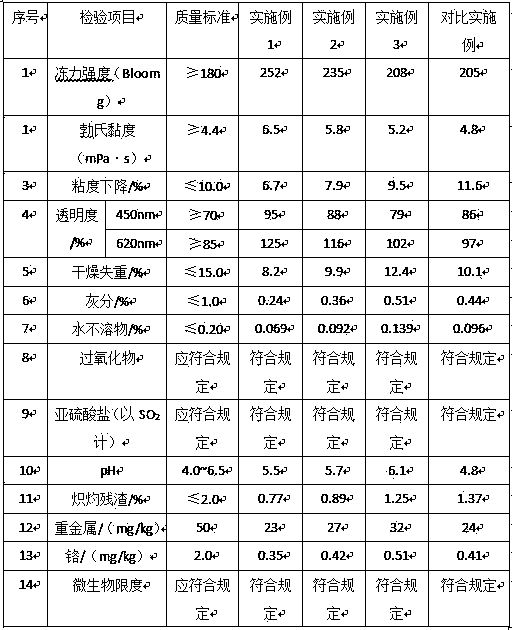
Figure 1
Abstract
Description
technical field
[0001] The invention relates to a production method of gelatin, in particular to a production process of medicinal gelatin. Background technique
[0002] Generally speaking, gelatin can be divided into two categories: animal glue and leather glue. Among them, animal glue refers to the glue made from collagen-containing tissues such as animal skin, bone, tendon, horn core, and scale after purification and primary hydrolysis. It can be derived from traditional pigs, cattle, fish, It can also be derived from other mammals such as sheep, horses, and camels. Moreover, the quality of the gelatin produced from the skin corners of different animal sources and different parts of the same animal source is not the same. Therefore, gelatin can be divided into industrial gelatin, edible gelatin, medicinal gelatin and photographic gelatin. kind.
[0003] The main composition of gelatin is a mixture of 18 amino acid polypeptide molecules with the same composition and a w...
Examples
Embodiment 1
[0031] In this embodiment, 1 kg of pigskin (the collagen content of which is measured to be 256.4 g) is used for processing through the pretreatment process of the present invention, including the following steps:
[0032] (a) Skin cutting: use a leather cutter to cut the leather into strips, and transfer it to the washing tank with a delivery pump;
[0033] (b) Alkali treatment: add water to the leather, add 1.0% liquid caustic soda sodium hydroxide, and soak for 2 hours;
[0034] (c) Hydrogen peroxide pretreatment: add hydrogen peroxide with a concentration of 10% to the lye in (b) to treat the raw skin,
[0035] Soak at room temperature for 6 days;
[0036] (d) Separation: Use a separation system to separate skin water and recover liquid alkali;
[0037] (e) Water washing: wash the leather in the washing tank until the pH value of the solution is 6.5;
[0038] (f) Pickling: Add sulfuric acid to make the pH of the solution reach 2.1, and the soaking time is 18 hours;
[...
Embodiment 2
[0052] In this embodiment, 1 kg of cowhide (278.2 g of collagen content was measured) was used to carry out the process through the pretreatment process of the present invention.
[0053] row processing, including the following steps:
[0054] (a) Skin cutting: use a leather cutter to cut the leather into strips, and transfer it to the washing tank with a delivery pump;
[0055] (b) Alkali treatment: Add water to the leather, add 0.8% liquid caustic soda sodium hydroxide, and soak for 2 hours;
[0056] (c) Hydrogen peroxide pretreatment: add hydrogen peroxide with a concentration of 5% to the lye in (b) to treat the raw skin,
[0057] Soak at room temperature for 8 days;
[0058] (d) Separation: Use a separation system to separate skin water and recover liquid alkali;
[0059] (e) Water washing: wash the leather in the washing tank until the pH value of the solution is 7.2;
[0060] (f) Pickling: add sulfuric acid to make the pH of the solution reach 2.4, and the soaking t...
Embodiment 3
[0067] In this embodiment, 1 kg of cowhide (278.2 g of collagen content was measured) was used to carry out the process through the pretreatment process of the present invention.
[0068] row processing, including the following steps:
[0069] (a) Skin cutting: use a leather cutter to cut the leather into strips, and transfer it to the washing tank with a delivery pump;
[0070] (b) Alkali treatment: add water to the leather, add 0.9% liquid caustic soda sodium hydroxide, and soak for 2 hours;
[0071] (c) Hydrogen peroxide pretreatment: add hydrogen peroxide with a concentration of 20% to the lye in (b) to treat the raw skin,
[0072] Soak for 5 days at room temperature;
[0073] (d) Separation: Use a separation system to separate skin water and recover liquid alkali;
[0074] (e) Water washing: wash the leather in the washing tank until the pH value of the solution is 6.8;
[0075] (f) Pickling: Add sulfuric acid to make the pH of the solution reach 1.8, and the soaking ...