
Method for synthesizing 2-chloro-benzo [9,10] phenanthrene
A benzo, triphenylene technology, applied in the field of organic chemical synthesis, can solve problems such as time-consuming, environmental pollution, complex synthesis process and the like
Patent Information
- Authority / Receiving Office
- CN · China
- Current Assignee / Owner
- Publication Date
- 2015-03-25
- Estimated Expiration
- Not applicable · inactive patent
Smart Images
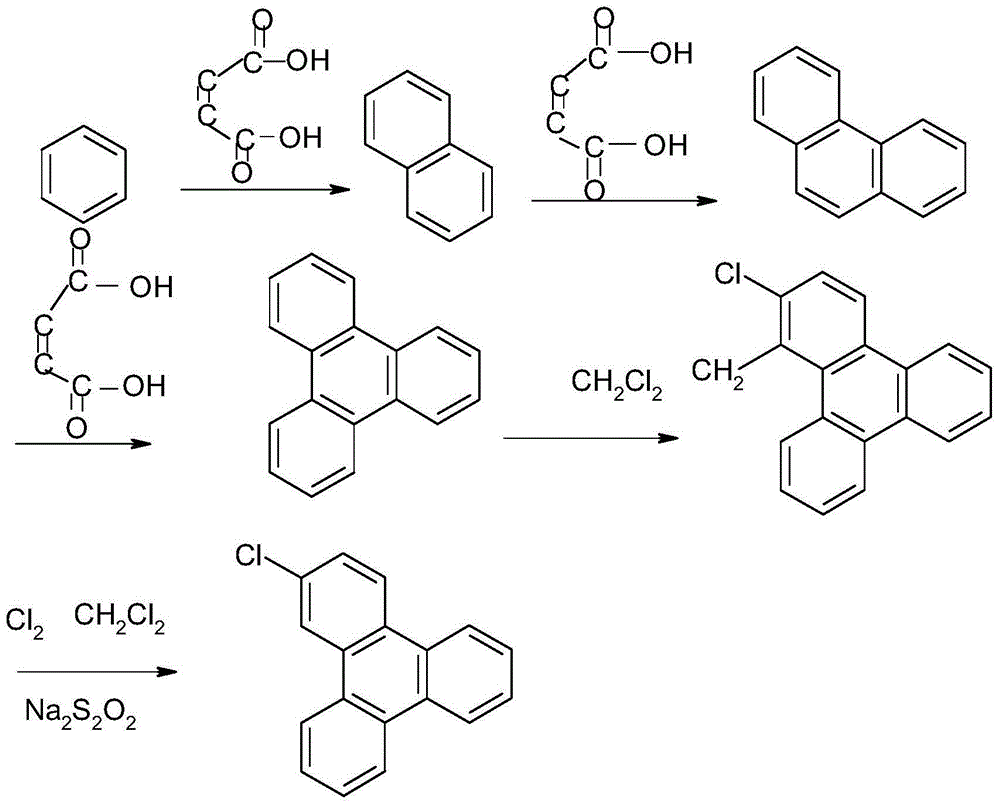
Figure 1
Abstract
Description
Technical field
[0001] The present invention belongs to the field of organic chemistry synthesis, and relates to a method for synthesizing triphenylene, in particular to a method for synthesizing 2-chlorobenzo[9,10]phenanthrene. Background technique
[0002] In 1924, Sehultz extracted "triphenylene" from aromatic hydrocarbon cracking for the first time. In 1960, Buess and Lawsons first reported on the synthesis of triphenylene compounds, and they determined that they have special liquid crystal properties and photoelectric functions. Triphenylene is a typical columnar phase discotic liquid crystal composed of three benzene rings. Its derivatives are chemically and thermally stable and can exhibit different liquid crystal phases. Since the 1960s, the research on triphenylene has attracted the attention of scientists. . The triphenylene molecule has an 18-π-electron plane delocalization system. Because the triphenylene derivatives have a variety of different types of liquid cryst...
Examples
example 1
[0019] First add 10 grams of benzene and 85ml of butadienoic acid to a 500ml four-necked flask to fully dissolve it to obtain 8.45g of naphthalene. Then add 54ml of butadienoic acid to the four-necked flask to fully dissolve it to obtain 8.05g of phenanthrene. Add 38ml of butadienoic acid once to obtain 7.68g of triphenylene after being fully dissolved, add 200ml of dichloromethane, stir to dissolve, and cool to -8°C with ice cubes. Take 2 mol of chlorine gas into 100 mL of dichloromethane solution, and then slowly drip into the reaction flask while stirring. After the addition was completed, the reaction mixture was stirred for 1.5 hours. After the reaction, add 1.5-3% sodium sulfite aqueous solution dropwise to the reaction flask, then stand still for layering, wash the lower organic layer with water, dry with anhydrous sodium sulfate, and filter. The solvent was removed under reduced pressure, and then the remaining product was separated through a silica gel chromatography ...
example 2
[0021] First add 10 grams of benzene and 85ml of butadienoic acid to a 500ml four-necked flask to fully dissolve it to obtain 8.45g of naphthalene. Then add 54ml of butadienoic acid to the four-necked flask to fully dissolve it to obtain 8.05g of phenanthrene. Add 38ml of butadienoic acid once to obtain 7.68g of triphenylene after being fully dissolved, add 200ml of dichloromethane, stir to dissolve, and cool to -8°C with ice cubes. Take 2 mol of chlorine gas into 100 mL of dichloromethane solution, and then slowly drip into the reaction flask while stirring. After the addition was completed, the reaction mixture was stirred for 1.5 hours. After the completion of the reaction, a 2.5% sodium sulfite aqueous solution was added dropwise to the reaction flask, and then left to stand for separation. The lower organic layer was washed with water, dried with anhydrous sodium sulfate, and filtered. The solvent was removed under reduced pressure, and then the remaining product was sepa...
example 3
[0023] First add 10 grams of benzene and 85ml of butadienoic acid to a 500ml four-necked flask to fully dissolve it to obtain 8.45g of naphthalene. Then add 54ml of butadienoic acid to the four-necked flask to fully dissolve it to obtain 8.05g of phenanthrene. Add 38ml of butadienoic acid once to obtain 7.68g of triphenylene after being fully dissolved, add 200ml of dichloromethane, stir to dissolve, and cool to -8°C with ice cubes. Take 2 mol of chlorine gas into 100 mL of dichloromethane solution, and then slowly drip into the reaction flask while stirring. After the addition was completed, the reaction mixture was stirred for 1.5 hours. After the completion of the reaction, a 3% aqueous solution of sodium sulfite was added dropwise to the reaction flask, and then left to stand for layering. The lower organic layer was washed with water, dried with anhydrous sodium sulfate, and filtered. The solvent was removed under reduced pressure, and then the remaining product was separ...