
Rain-harvesting and drought-resistant cultivation method of forest trees in arid and semi-arid regions
A drought-resistant cultivation and semi-drought technology, applied in the field of forestry engineering, can solve problems such as numerous operation steps, uneven distribution of rainwater, small water collection surface, etc., and achieve the effects of high flow collection efficiency, shortening the period of nursery out, and small earthwork volume
Patent Information
- Authority / Receiving Office
- CN · China
- Patent Type
- Patents(China)
- Current Assignee / Owner
- Publication Date
- 2017-12-19
- Estimated Expiration
- Not applicable · inactive patent
Smart Images
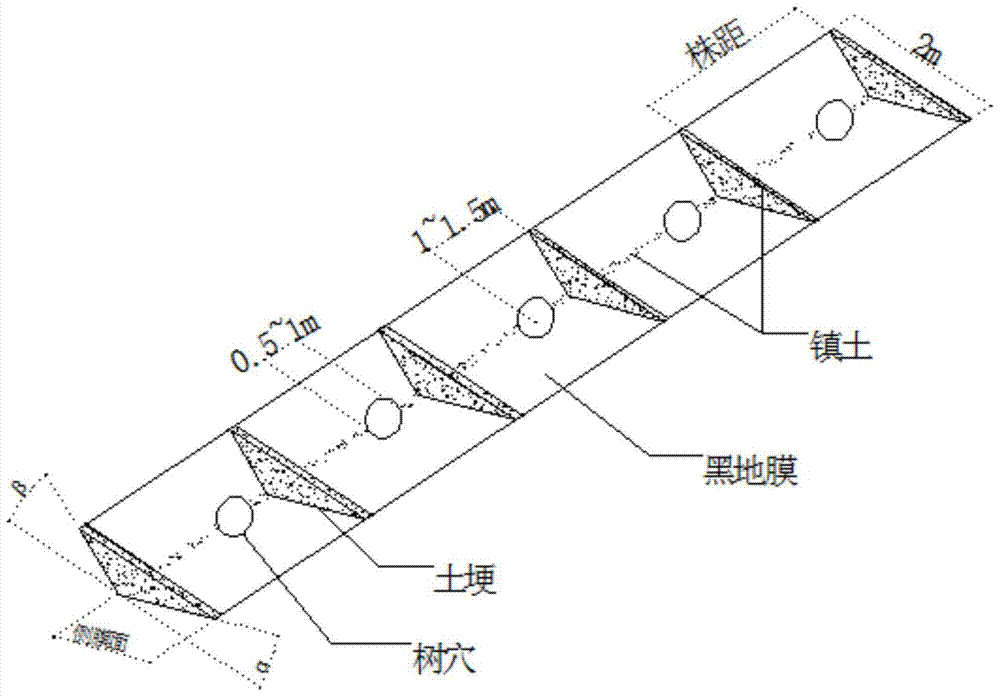
Figure 1
Abstract
Description
technical field
[0001] The invention belongs to the technical field of forestry engineering, and relates to a drought-resistant cultivation method for trees in arid and semi-arid areas for collecting rain and preserving moisture. Background technique
[0002] The arid and semi-arid areas in our country account for 2 / 3 of the total land area. Drought and water shortage have not only seriously affected the development of agriculture in our country, but also affected the development of the ecological environment and forestry. Reasonable water collection and moisture conservation technology is the key link to improve forest water efficiency. Water saving is already an inevitable choice for the country's sustainable development. Therefore, the construction of a conservation-oriented society has become China's current and even long-term goal in the future. In the thousands of years of agricultural development in my country, we have been exploring rainwater storage and utilization...
Examples
Embodiment 1
[0018] On the flat land where the soil quality is sandy and the distance between plants and rows is 4m×5m, the rain-collecting ditch is horizontally excavated along the tree line and along the contour line, and the ditch width is 2m. The two sides of the ditch are flattened in a "V" shape, and the slopes of both sides of the ditch are 10°. The ditch is divided into bamboo-shaped segmental ditches with soil according to the length of the plant spacing. At 1m, excavate a circular planting hole with a diameter of 0.5m and a depth of 10cm, and plant a walnut grafted seedling in each hole; use a black and white double-sided plastic film with a thickness of 0.008mm and a width of 1.2m, and the double-film butt joint longitudinally covers the bamboo joints In the “V”-shaped rain-collecting ditch area, the joints are tightly compacted with soil, and the plastic film is suppressed with soil on the horizontal bamboo-shaped separation ridge, and a small seepage hole with a diameter of 1cm...
Embodiment 2
[0020] On the 3-year-old juvenile apple grafted seedling cultivation ground with loamy soil, plot slope of 25°, and row spacing of 4m×4m, horizontally excavate the rainwater collection ditch along the tree row and along the contour line, the ditch width is 2m, and the tree planting row On the center line of the ditch, level the two sides of the ditch to form a "V" shape. The slope of the upper side of the ditch is 25°, and the slope of the lower side is 10°. For the section ditch, excavate a circular planting hole with a diameter of 0.8m and a depth of 10cm at the 1.5m place where the distance between each section of the ditch area is closer, and plant a grafted apple seedling in each hole; 1.2m black and white striped film, the double-film butt joint longitudinally covers the bamboo-shaped "V"-shaped rain-collecting ditch area, the butt joint is tightly suppressed with soil, and the horizontal bamboo-shaped separation ridge is used to suppress the film with soil, and the film ...
Embodiment 3
[0022] On the 2-year-old walnut grafted seedling cultivation land with loamy soil, slope of 30°, and annual precipitation of 435mm, the distance between plants and rows is 4m×5m. The planting line is on the center line of the ditch, and the two sides of the ditch are leveled to form a "V" shape. The slope of the upper side of the ditch is 30°, and the slope of the lower side is 10°. According to the length of the distance between plants, the ditch is separated into bamboo joints with soil. In the section-shaped ditch, excavate a circular planting hole with a diameter of 1m and a depth of 10cm at the distance of 1.2m from the closer separation ridge in each section of the ditch, and plant a walnut grafted seedling in the hole; 1.5m black mulch, the double-membrane butt joint longitudinally covers the bamboo-shaped "V"-shaped ditch area, the joint is suppressed with soil, and the two sides of the horizontal bamboo-shaped separation ridge are suppressed with soil, and 3 circles ar...