
Preparation method of 2-methoxy-5-acetamidoaniline
A technology of acetamidoaniline and methoxy group, applied in the field of preparation of 2-methoxy-5-acetamidoaniline, can solve the problems of poor environmental protection, difficult catalyst or solvent recovery, low yield and the like
Patent Information
- Authority / Receiving Office
- CN · China
- Patent Type
- Applications(China)
- Current Assignee / Owner
- Publication Date
- 2017-10-24
- Estimated Expiration
- Not applicable · inactive patent
Smart Images
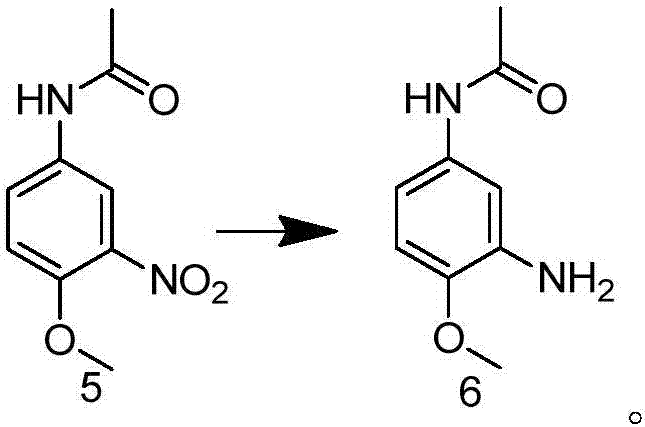
Figure 1 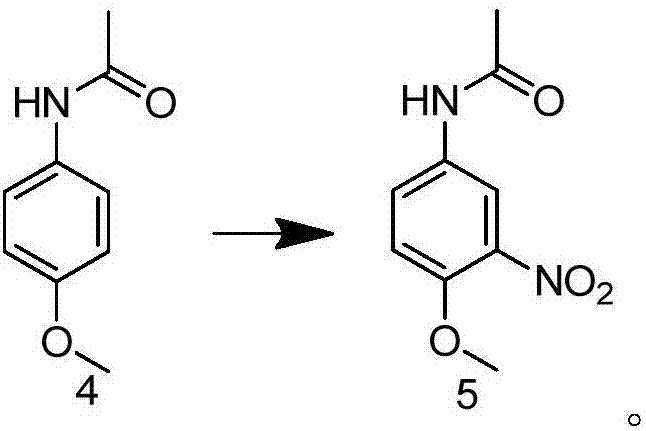
Figure 2 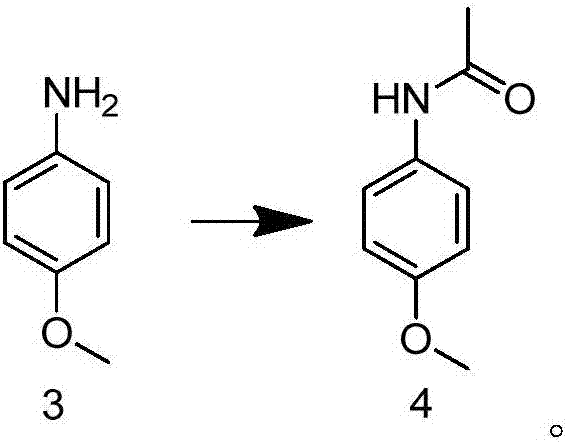
Figure 3
Abstract
Description
technical field
[0001] In particular, the present invention relates to a process for the preparation of 2-methoxy-5-acetamidoaniline. Background technique
[0002] 2-Methoxy-5-acetamidoaniline is an important intermediate in the production of dyes and medicines. It can be used in the synthesis of various disperse dyes such as C.I. Disperse Blue 79 and C.I. Disperse Blue 301, and occupies an important position in the dye industry.
[0003] The traditional process of synthesizing 2-methoxy-5-acetamidoaniline such as:
[0004] 1. In [3-amino-4-methoxyacetanilide new synthesis process, Dyestuff Industry, 2001, 38(5): 28-29], 2,4-dinitrochlorobenzene was used as raw material and treated with methoxy 2,4-Dinitroanisole is obtained by hydrogenation, then catalytic hydrogenation, and finally acetylation; this synthesis route has two amino groups in the product after hydrogenation reduction, and it can be acetylated in one step in the acetylation reaction The sites are difficult to...
Examples
Embodiment 1
[0078] The preparation of embodiment 1 p-nitroanisole
[0079] Add 50 grams of sodium hydroxide and 60 grams of methanol to a 1000ml three-necked bottle, stir and heat up to 55°C, keep warm for 30 minutes to dissolve all the sodium hydroxide, then add 2 grams of tetrabutylammonium bromide, and control the temperature not to exceed 60°C Next, add 50 grams of p-chloronitrobenzene in batches, after the addition is complete, keep warm at 55-60°C for 1 hour, then raise the temperature to 60-70°C and keep warm for 4-5 hours, and control in HPLC until the raw material is less than 0.3%, which is the end of the reaction. Recover part of methanol (30 g under normal pressure), add 200 g of ice water under stirring, a large amount of yellow solid precipitates, filter, wash with water until neutral, and obtain 45 g of p-nitroanisole, yield 92.6%, GC purity 99.0%. The melting point is 53-54°C.
Embodiment 2
[0080] The preparation of embodiment 2 p-nitroanisole
[0081]In a 1000ml three-necked flask, add 40 grams of sodium hydroxide and 60 grams of methanol, stir and heat up to 55°C, keep warm for 30 minutes to dissolve all the sodium hydroxide, then add 2 grams of tetrabutylammonium bromide, and control the temperature not to exceed 60°C Next, add 50 grams of p-chloronitrobenzene in batches, after the addition is complete, keep warm at 55-60°C for 1 hour, then raise the temperature to 60-70°C and keep warm for 4-5 hours, and control in HPLC until the raw material is less than 0.3%, which is the end of the reaction. Recover part of methanol (30 g under normal pressure), add 200 g of ice water under stirring, a large amount of yellow solid precipitates, filter, wash with water until neutral, and obtain 45 g of p-nitroanisole, yield 91%, GC purity 98.9.0%. The melting point is 53-54°C.
[0082] Other experimental conditions and results are shown in the following table: Among them,...
Embodiment 3
[0084] The preparation of embodiment 3 p-nitroanisole
[0085] In a 1000mL three-necked flask, add 50g of sodium hydroxide and 30g of methanol recovered from Example 1 and 30g of new methanol and stir to raise the temperature to 55°C and keep it warm for 30 minutes to completely dissolve the sodium hydroxide, then add 2g of tetrabutylammonium bromide , under the condition that the temperature does not exceed 60°C, add 50 grams of p-chloronitrobenzene in batches, after the addition, keep it at 55-60°C for 1 hour, then raise the temperature to 60-70°C and keep it for 4-5 hours, and control the raw material in HPLC Less than 0.3% is the end point of the reaction. Recover 30 grams under normal pressure, add 200 grams of ice water under stirring, a large amount of yellow solid precipitates, filter, wash with water until neutral, and obtain 44.8 grams of p-nitroanisole, with a yield of 92.4% . Melting point 53-54°C, GC purity 99.1%.