
A kind of ferric oxide and manganese dioxide composite Fenton catalyst and preparation method thereof
A technology of ferroferric oxide and composite catalysts, applied in metal/metal oxide/metal hydroxide catalysts, physical/chemical process catalysts, chemical instruments and methods, etc., can solve the problem of easy formation of soft aggregates or even hard aggregates , Poor dispersion, difficult to disperse and other problems, to achieve excellent recycling performance, enhance dispersion performance, and inhibit agglomeration
Patent Information
- Authority / Receiving Office
- CN · China
- Patent Type
- Patents(China)
- Current Assignee / Owner
- Publication Date
- 2020-06-05
Smart Images
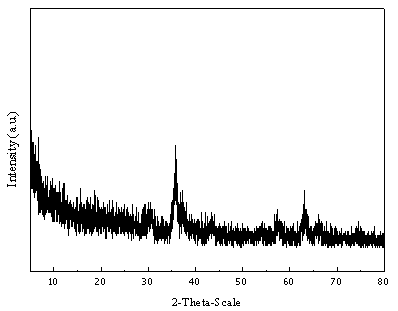
Figure 1 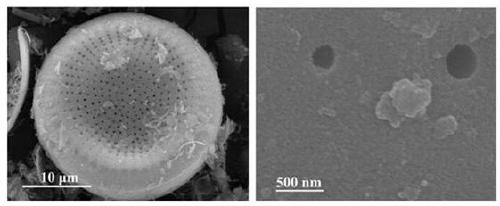
Figure 2 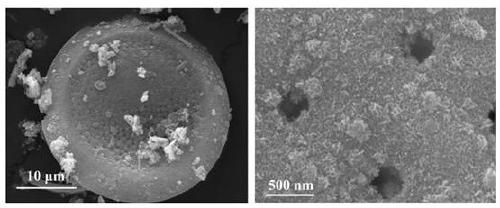
Figure 3
Abstract
Description
technical field
[0001] The invention belongs to the technical field of preparation of environmental protection functional materials, nanometer materials and catalytic materials, and specifically relates to a novel composite Fenton-like catalyst utilizing natural diatomite to support nano-ferric oxide and manganese dioxide and a preparation method thereof. Background technique
[0002] Fenton technology (Fenton) is an important method for degrading organic wastewater in industrial production, which uses ferrous ions (Fe 2 + ) catalyst with hydrogen peroxide (H 2 o 2 ) to produce strong oxidizing hydroxyl radicals (·OH) to completely mineralize and degrade organic pollutants. It has the remarkable characteristics of low equipment investment, high efficiency and simple operation process. However, the Fenton technology needs to be carried out in a low pH environment (pH=3~4), and there are also problems such as the easy production of a large amount of red mud and other by-pro...
Examples
Embodiment 1
[0033] Weigh 10 g of natural diatomaceous earth and completely disperse it in 0.60 L of triethylene glycol under vigorous stirring to form a uniform suspension. Weighing 20.00 g of iron acetylacetonate was added to the above suspension, and kept stirring until it was completely dissolved to obtain a primary suspension. The above-mentioned primary suspension was heated to 250° C. at a heating rate of 3° C. / min under the protection of nitrogen, and kept for 30 minutes. After the reaction was over, it was naturally cooled to room temperature. The reacted suspension was separated from solid to liquid, and the obtained solid product was washed with water for 3 times. Add the washed solid product and 18.2 g of potassium permanganate into 0.50 L of water under stirring, and keep stirring for 10 min to obtain a secondary suspension. The secondary suspension was transferred into an autoclave, and the temperature was raised to 150° C. for 6 hours. After the reaction is finished, cool...
Embodiment 2
[0035] Weigh 10 g of natural diatomaceous earth, and completely disperse it in 0.80 L of octadecene under vigorous stirring to form a uniform suspension. 14.00 g of iron acetylacetonate was weighed and added to the above suspension, and stirred continuously until it was completely dissolved to obtain a primary suspension. The primary suspension was heated to 270° C. at a heating rate of 4° C. / min under the protection of argon, and kept for 40 minutes. After the reaction was over, it was naturally cooled to room temperature. The reacted suspension was separated from solid to liquid, and the obtained solid product was washed with water for 3 times. Add the washed solid product and 22 g of potassium permanganate into 0.60 L of water under stirring, and keep stirring for 10 min to obtain a secondary suspension. The secondary suspension was transferred into an autoclave, and the temperature was raised to 120° C. for 8 hours. After the reaction is finished, cool naturally to room...
Embodiment 3
[0037] Weigh 10 g of natural diatomaceous earth and completely disperse it in 1 L of glycerin under vigorous stirring to form a uniform suspension. Weighing 21.00 g of iron acetylacetonate was added to the above suspension, and kept stirring until it was completely dissolved to obtain a primary suspension. The primary suspension was heated to 265° C. at a heating rate of 5° C. / min under the protection of argon, and kept for 35 minutes. After the reaction was over, it was naturally cooled to room temperature. The reacted suspension was separated from solid to liquid, and the obtained solid product was washed with water for 3 times. Add the washed solid product and 28 g of potassium permanganate into 0.5 L of water under stirring, and keep stirring for 10 min to obtain a secondary suspension. The secondary suspension was transferred into an autoclave, and the temperature was raised to 160° C. for 6 hours. After the reaction is finished, cool naturally to room temperature, sep...