
Cobweb-like graphene coated beta-FeOOH nano-rod aggregate lithium ion battery negative electrode material preparation method
A graphene-wrapped, lithium-ion battery technology, applied in the field of electrochemistry, can solve problems such as poor conductivity, and achieve the effects of improving conductivity, inhibiting volume expansion, and improving cycle stability.
Patent Information
- Authority / Receiving Office
- CN · China
- Patent Type
- Applications(China)
- Current Assignee / Owner
- Publication Date
- 2018-02-23
Smart Images
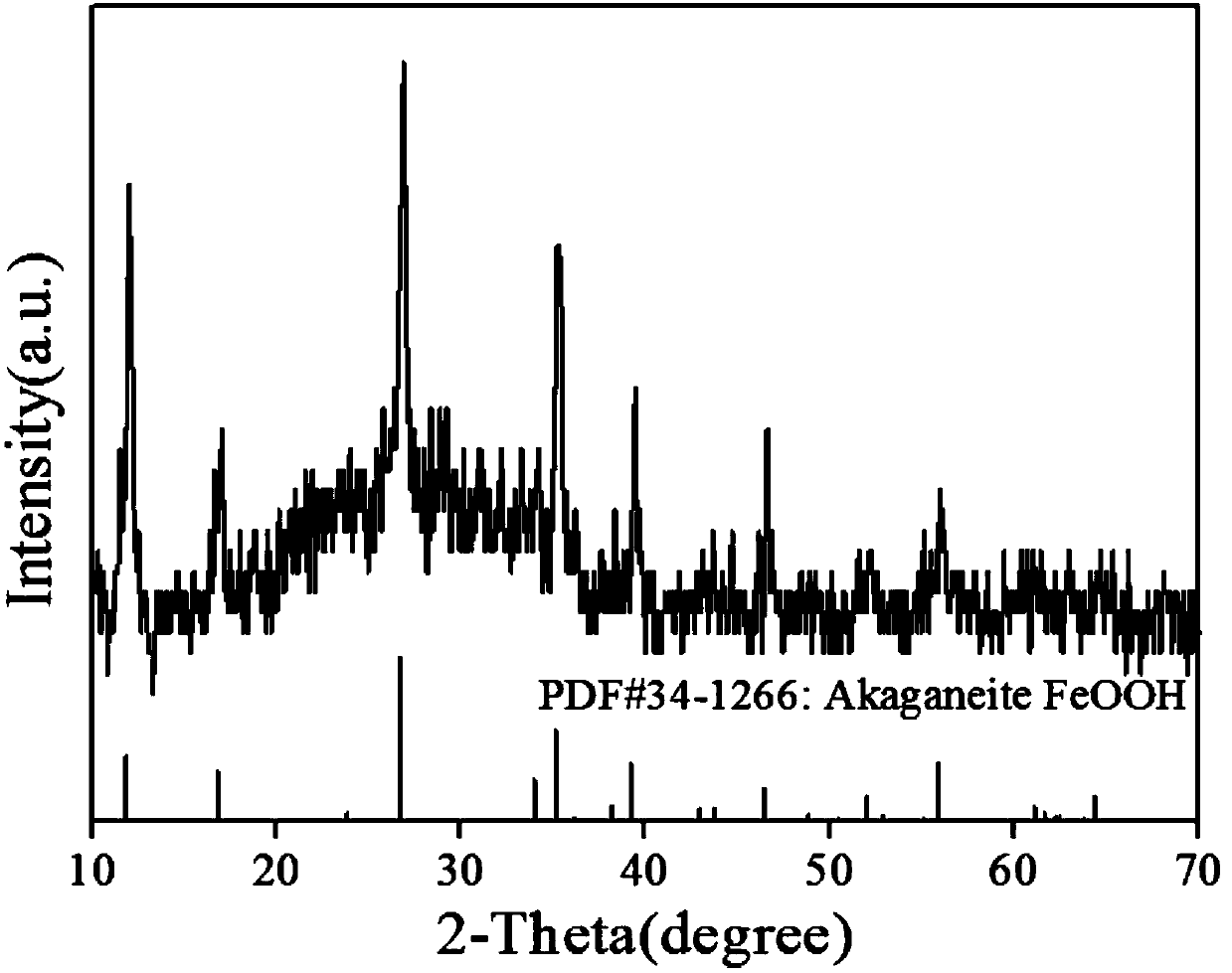
Figure 1 
Figure 2 
Figure 3
Abstract
Description
technical field
[0001] The invention belongs to the technical field of electrochemistry, and in particular relates to a method for preparing a lithium-ion battery negative electrode material wrapped in spiderweb graphene-wrapped β-FeOOH nanorod aggregates. technical background
[0002] Transition metal oxides / hydroxides have become a research hotspot in recent years because of their high specific capacity (>1000mAh / g). The hydroxide FeOOH in the transition metal is a very potential lithium ion negative electrode material, and there are many crystal forms: α, β, γ, etc. Among them, the β-FeOOH anions are arranged in a body-centered cubic (bcc) array, and the structure is not as dense as that of α, γ-FeOOH, which is more conducive to the diffusion of Li+. In addition, the capacity of β-FeOOH is higher or even exceeds that of other iron oxides. However, like most oxide electrodes, β-FeOOH has poor conductivity, and the volume expansion is obvious during charge and discharg...
Examples
Embodiment 1
[0018] 1) Disperse commercially available graphene oxide in 25 mL of deionized water to form a solution with a graphene oxide concentration of 1 mg / mL, and then use an ultrasonic generator to form a uniformly dispersed graphene oxide suspension A;
[0019] 2) The analytically pure FeCl 3 ·6H 2 O and NaNO 3 Add it into 25mL deionized water, stir to make it fully dissolve, and then add it to suspension A to form a mixed solution of iron salt and graphene oxide, wherein the concentration of iron salt is 0.05mol / L, and the concentration of sodium salt is 0.05mol / L. 2 / 3 of the salt concentration, and then disperse the mixed solution with an ultrasonic generator to obtain a suspension B;
[0020] 3) Pour the suspension B prepared above into a homogeneous hydrothermal reaction kettle, control the filling degree to 30%, then seal the reaction kettle, and put it into a homogeneous hydrothermal reactor at 50°C for hydrothermal reaction , naturally cooled to room temperature after the...
Embodiment 2
[0027] 1) Disperse commercially available graphene oxide in 30mL deionized water to form a solution with a graphene oxide concentration of 2mg / mL, and then use an ultrasonic generator to form a uniformly dispersed graphene oxide suspension A;
[0028] 2) The analytically pure FeCl 3 ·6H 2 O and NaNO 3 Add it into 20mL deionized water, stir it to fully dissolve, then add it into suspension A, and configure it as a mixed solution of iron salt and graphene oxide, wherein the concentration of iron salt is 0.3mol / L, and the concentration of sodium salt is 0.3mol / L. 2 / 3 of the salt concentration, and then disperse the mixed solution with an ultrasonic generator to obtain a suspension B;
[0029] 3) Pour the suspension B prepared above into a homogeneous hydrothermal reaction kettle, control the filling degree to 80%, then seal the reaction kettle, put it into a homogeneous hydrothermal reactor at 70°C for hydrothermal reaction , naturally cooled to room temperature after the reac...
Embodiment 3
[0033] 1) Disperse commercially available graphene oxide in 35mL deionized water to form a solution with a graphene oxide concentration of 5mg / mL, and then use an ultrasonic generator to form a uniformly dispersed graphene oxide suspension A;
[0034] 2) The analytically pure FeCl 3 ·6H 2 O and NaNO 3 Add it into 15mL deionized water, stir to make it fully dissolve, and then add it to suspension A to form a mixed solution of iron salt and graphene oxide, wherein the concentration of iron salt is 0.5mol / L, and the concentration of sodium salt is 0.5mol / L. 2 / 3 of the salt concentration, and then disperse the mixed solution with an ultrasonic generator to obtain a suspension B;
[0035] 3) Pour the suspension B prepared above into a homogeneous hydrothermal reactor, control the filling degree to 60%, then seal the reactor, put it into a homogeneous hydrothermal reactor at 150°C for hydrothermal reaction , naturally cooled to room temperature after the reaction to obtain produc...