

Amphiphilic polymer fluorescent material (PAF-G) and synthesis method thereof
A technology of amphiphilic polymers and fluorescent materials, applied in the field of water-soluble near-infrared fluorescent materials, amphiphilic polymer fluorescent materials and their synthesis, can solve the problems of limited use, insufficient stability of luminescent materials, etc., and achieve contrast high effect
Patent Information
- Authority / Receiving Office
- CN · China
- Patent Type
- Applications(China)
- Current Assignee / Owner
- Publication Date
- 2018-05-15
- Estimated Expiration
- Not applicable · inactive patent
Smart Images
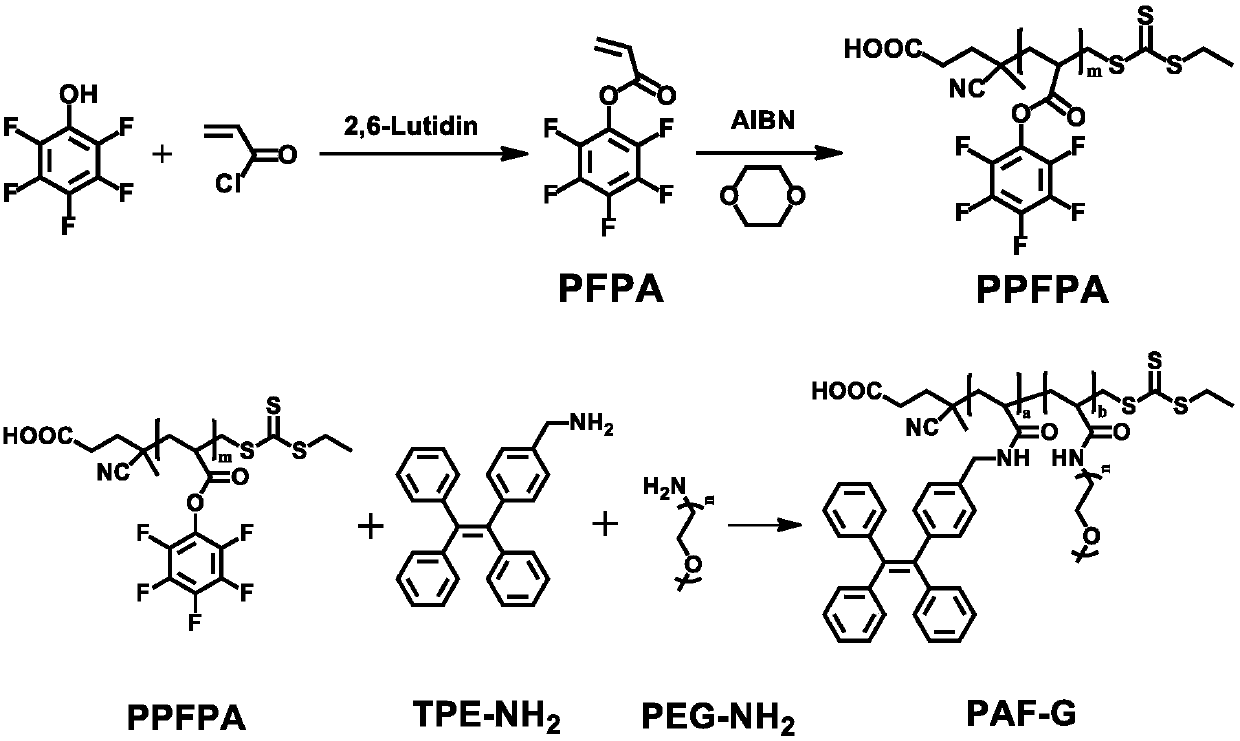
Figure 1 
Figure 2 
Figure 3
Abstract
Description
technical field
[0001] The invention relates to an amphiphilic polymer fluorescent material and a synthesis method thereof, in particular to a preparation method of a fluorescent dye and a water-soluble near-infrared fluorescent material with high fluorescence quantum yield and which can be used for biological imaging, belonging to chemical synthesis technology field. Background technique
[0002] Fluorescent materials that achieve the purpose of detection or imaging by marking biomolecules or cells are called fluorescent probe materials. Organic fluorescent materials have the advantages of flexible and diverse structures, adjustable luminescence position and intensity, and easy modification. They have become the preferred objects of fluorescent probe materials and have been widely studied. Organic aromatic fluorescent molecules usually show good fluorescence properties, but because most molecules have poor water solubility, it is particularly important to seek a simple and...
Examples
Embodiment 1
[0047] In this example, based on the methods of step 1 and step 2 of the present invention, alfa-amino polyethylene glycol with a chain length of 3 was used to synthesize and prepare the target molecule.
[0048] figure 1 The present invention relates to a synthetic route of PAF-G in an amphiphilic polymer fluorescent material and a synthetic method thereof.
[0049] In a round-bottomed flask, dissolve 2.5g of pentafluorophenol and 1.46g of 2,6-lutidine in dichloromethane, add 1.23g of acryloyl chloride to the mixture in an ice-water bath, and stir the reaction in an ice-water bath 3 hours, remove the ice-water bath and react at room temperature for 12 hours to obtain the crude product, filter with suction, save the filtrate, extract the filtrate with water twice, and use anhydrous MgSO 4 Carry out drying, remove solvent under reduced pressure, obtain crude product, use silica gel chromatography to crude product purification, obtain pentafluorophenol acryloyl chloride (PFPA),...
Embodiment 2
[0051] In this example, based on the methods of step 1 and step 2 of the present invention, alfa-amino polyethylene glycol with a chain length of 5 was used to synthesize and prepare the target molecule.
[0052] In a round-bottomed flask, dissolve 2.5g of pentafluorophenol and 2.91g of 2,6-lutidine in dichloromethane, add 3.69g of acryloyl chloride to the mixture in an ice-water bath, and stir the reaction in an ice-water bath After 5 hours, remove the ice-water bath and react at room temperature for 24 hours to obtain the crude product, filter it with suction, save the filtrate, extract the filtrate twice with water, and use anhydrous MgSO 4 Carry out drying, remove solvent under reduced pressure, obtain crude product, use silica gel chromatography to crude product purification, obtain PFPA, get 2.38g PFPA solution and 16.42mg azobisisobutyronitrile and 5.27mg4-cyano-4-(sulfur Benzoyl) valeric acid was mixed, the above reaction solution was freeze-thawed three times, and the...
Embodiment 3
[0055] In this example, based on the methods of step 1 and step 2 of the present invention, alfa-amino polyethylene glycol with a chain length of 9 was used to synthesize and prepare the target molecule.
[0056] In a round-bottomed flask, dissolve 2.5g of pentafluorophenol and 4.37g of 2,6-lutidine in dichloromethane, add 6.15g of acryloyl chloride to the above mixture, stir and react in an ice-water bath for 10 hours, remove React in an ice-water bath at room temperature for 48 hours to obtain a crude product, filter it with suction, save the filtrate, extract the filtrate twice with water, and use anhydrous MgSO 4 Carry out drying, remove solvent under reduced pressure, obtain crude product, use silica gel chromatography to crude product purification, obtain PFPA, get 2.38g PFPA solution and 32.84mg azobisisobutyronitrile and 26.34mg4-cyano-4-(sulfur Benzoyl) valeric acid was mixed, the above reaction solution was freeze-thawed three times, and the reactant was placed in an...