
Composition and preparation method thereof
A composition and solution technology, applied in the field of biomedical engineering, can solve the problems of limited curative effect and cannot prevent disease progression, etc., and achieve the effects of convenient acquisition, inhibition of inflammation, and repair of damaged tissue
Patent Information
- Authority / Receiving Office
- CN · China
- Current Assignee / Owner
- Publication Date
- 2018-06-08
- Estimated Expiration
- Not applicable · inactive patent
Smart Images
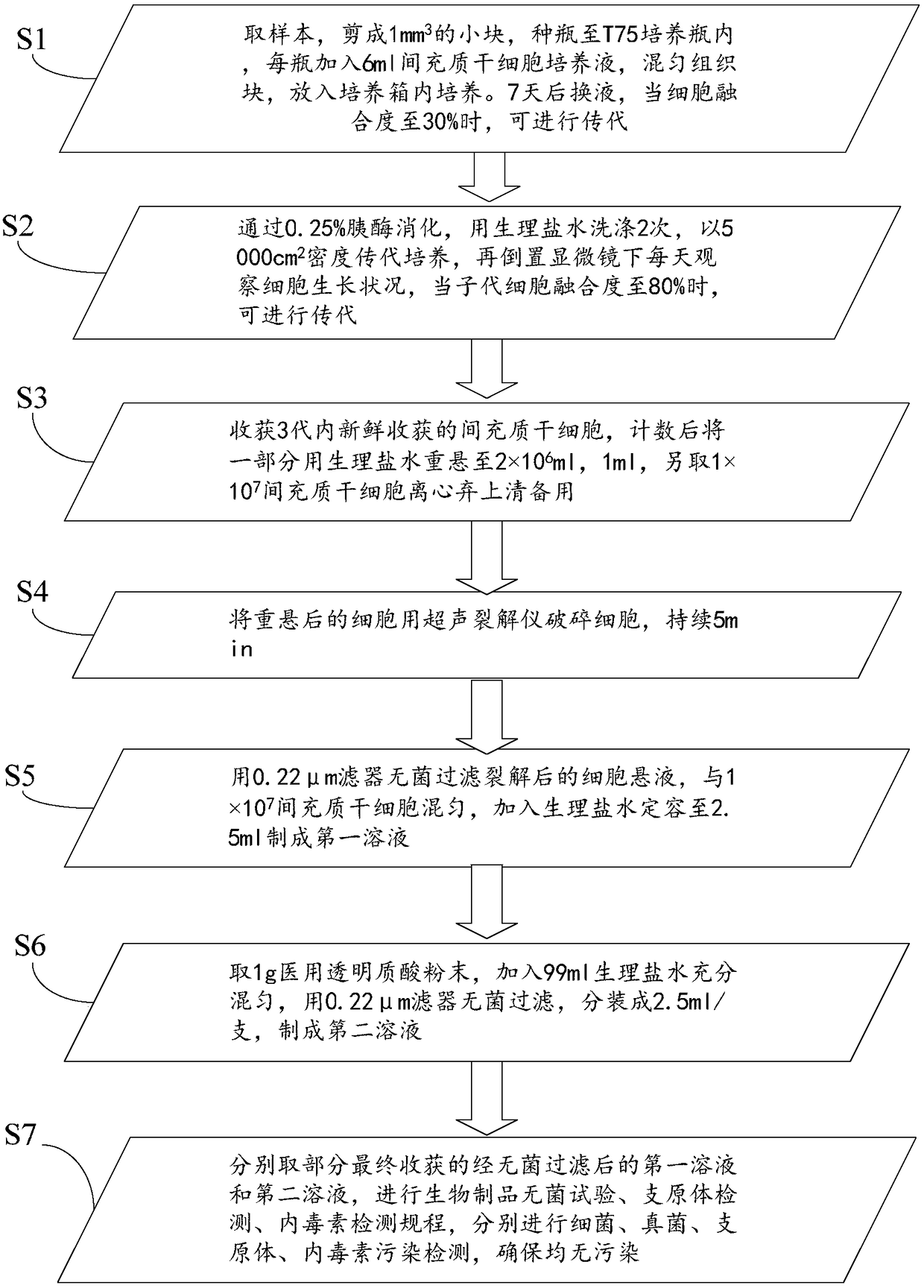
Figure 1
Abstract
Description
technical field
[0001] The invention relates to the field of biomedical engineering, which relates to a composition of drugs for treating and / or preventing osteoarthritis, in particular to a composition and a preparation method thereof. Background technique
[0002] Osteoarthritis, the most common form of arthritis, is characterized by a slow degenerative process of articular cartilage, subchondral bone, with marginal osteophyte formation and low-grade inflammation. The chronic form of osteoarthritis is believed to affect 15% of the population. Of these, a quarter were severely disabled. The cause of most cases of osteoarthritis is unknown and is referred to as "primary osteoarthritis". When the cause of osteoarthritis is known, it is called "secondary osteoarthritis". Secondary osteoarthritis is caused by another disease or condition. Conditions that can lead to secondary osteoarthritis include repeated injury or surgery of joint structures, joint abnormalities at birth...
Examples
preparation example Construction
[0043] Such as figure 1 Shown, the present invention also provides a kind of preparation method of composition, comprises the steps:
[0044] S1. Take a sample and cut it into 1mm 3 The small pieces of the tissue were planted in a T75 culture bottle, and 6ml of mesenchymal stem cell culture medium was added to each bottle, the tissue pieces were mixed, and cultured in an incubator. Change the medium after 7 days, and when the cell confluency reaches 30%, it can be subcultured. In S1, mesenchymal stem cells are derived from the mesoderm, a type of cell with multidirectional differentiation potential, which exist in human bone marrow, adipose tissue, umbilical cord of newborns, placenta and other tissues. It has the potential to differentiate into cartilage, fat and myoblasts, and also has the potential to differentiate into neurons. Because it has the advantages of convenient acquisition, abundant sources, easy expansion, low immunogenicity and multi-directional differentiat...
Embodiment 1
[0055] S1. Take a sample and cut it into 1mm 3 The small pieces of the tissue were planted in a T75 culture bottle, and 6ml of mesenchymal stem cell culture medium was added to each bottle, the tissue pieces were mixed, and cultured in an incubator. Change the medium after 7 days, and when the cell confluency reaches 30%, it can be subcultured. In S1, mesenchymal stem cells are derived from the umbilical cord of newborns. Mesenchymal stem cells not only have the potential to differentiate into bone, cartilage, fat, and myoblasts, but also have the potential to differentiate into neurons. Because it has the advantages of convenient acquisition, abundant sources, easy expansion, low immunogenicity and multi-directional differentiation potential. The samples were stripped of Wharton's jelly in a biological safety cabinet, and in the culture bottle, 1g of Wharton's jelly was added to each bottle, and the incubator was CO 2 an incubator, and the mesenchymal stem cells are primary...
Embodiment 2
[0068] S1. Take a sample and cut it into 1mm 3 The small pieces of the tissue were planted in a T75 culture bottle, and 6ml of mesenchymal stem cell culture medium was added to each bottle, the tissue pieces were mixed, and cultured in an incubator. Change the medium after 7 days, and when the cell confluency reaches 30%, it can be subcultured. In S1, mesenchymal stem cells are derived from the mesoderm, a type of cell with multidirectional differentiation potential, which exist in human bone marrow, adipose tissue, umbilical cord of newborns, placenta and other tissues. It has the potential to differentiate into cartilage, fat and myoblasts, and also has the potential to differentiate into neurons. Because it has the advantages of convenient acquisition, abundant sources, easy expansion, low immunogenicity and multi-directional differentiation potential. The samples were stripped of Wharton's jelly in a biological safety cabinet, and in the culture bottle, 1g of Wharton's j...