
Hot event detection method for social network based on multiple data stream calculation
A hot event, multi-data stream technology, applied in the field of social network hot event detection, can solve the problem of different importance of event detection without considering data correlation, affecting the effect of detection, etc.
Patent Information
- Authority / Receiving Office
- CN · China
- Patent Type
- Applications(China)
- Current Assignee / Owner
- Publication Date
- 2018-09-11
Smart Images
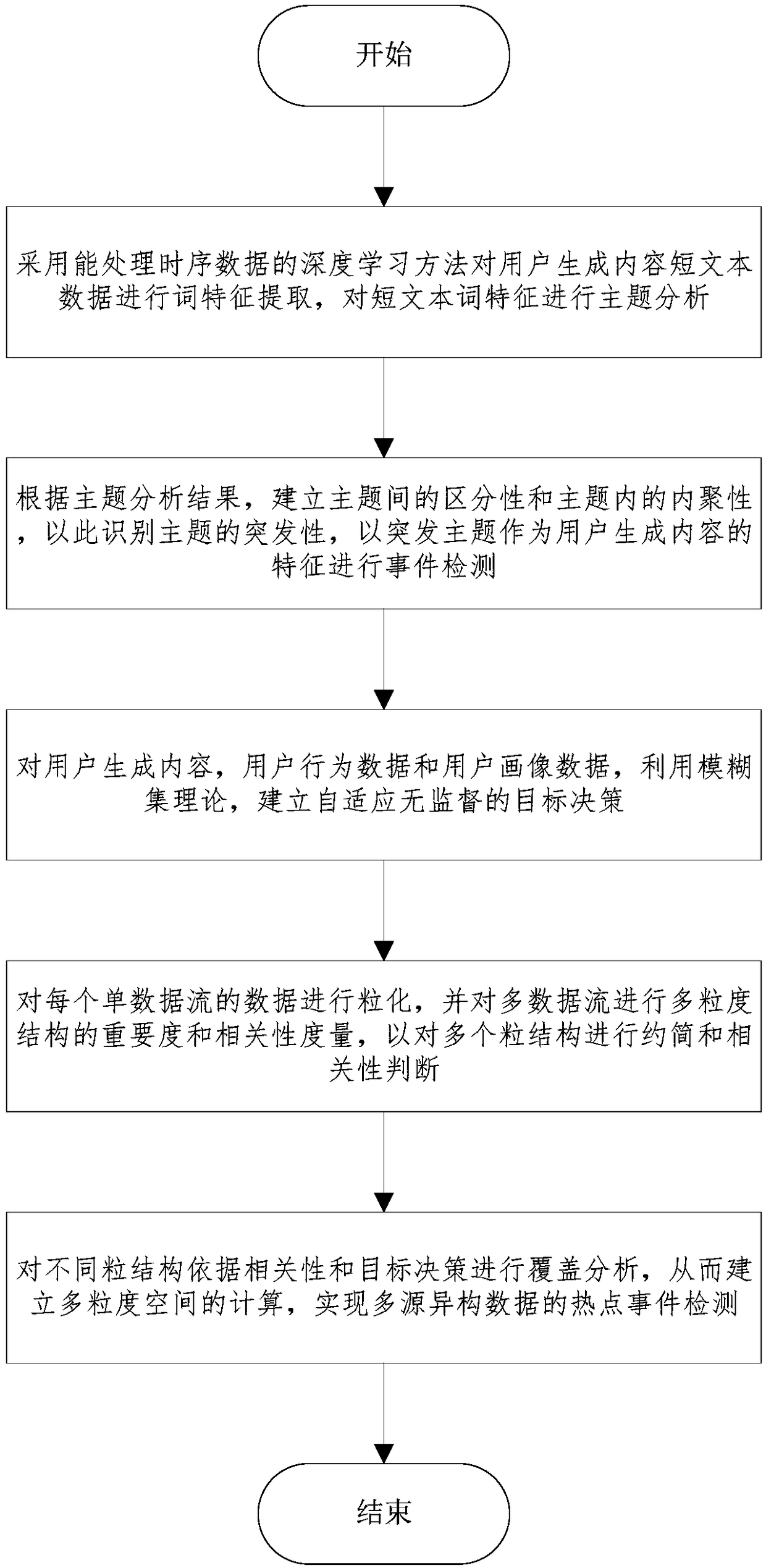
Figure 1 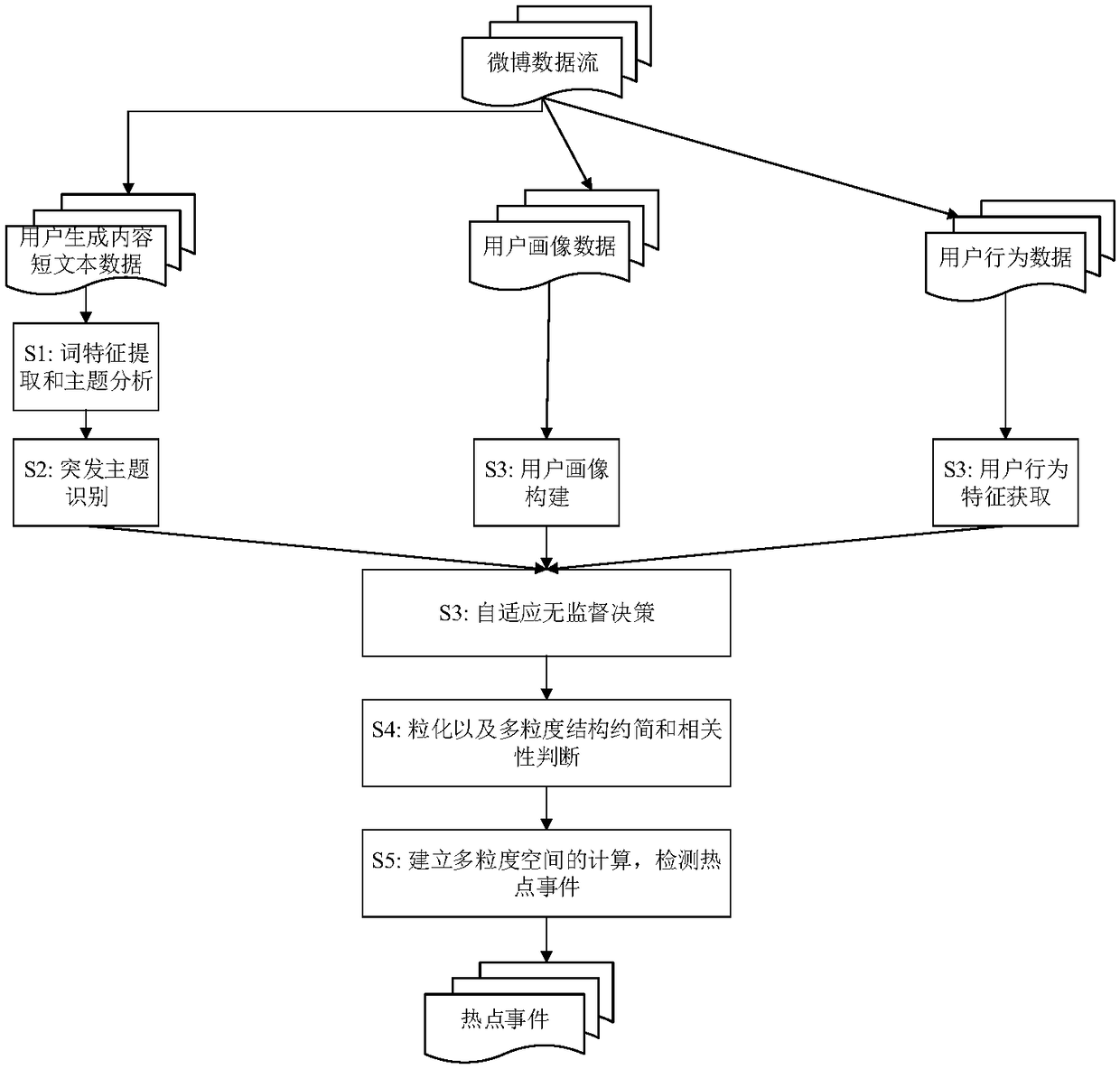
Figure 2 
Figure 3
Abstract
Description
technical field
[0001] The invention relates to the fields of natural language processing and text mining, in particular to a method for detecting social network hotspot events based on multi-data stream calculation. Background technique
[0002] Hotspot events have the characteristics of "widespread concern", "uncertainty" and "hazardousness", and have far-reaching impacts. Hot event detection in social networks is particularly important. Hot event detection is not only the theoretical support and challenge of topic detection, public opinion analysis, sentiment analysis, etc., but also the core content of important applications such as social network analysis, network public opinion monitoring, e-commerce platform business analysis, and financial information analysis. For example, in social network analysis, by analyzing the social network communication situation, user behavior, etc., to analyze public sentiment and user influence, and to identify opinion leaders and seed ...
Examples
Embodiment
[0075] Such as figure 1 and figure 2 As shown, a social network hotspot event detection method based on multi-data stream computing includes the following steps:
[0076] S1. Use the deep learning method for processing time series data to extract word features from user-generated content short text data, and perform topic analysis on short text word features;
[0077] Described deep learning method is Long Short-Term Memory (LSTM), for keeping the sequentiality of word in short text, adopts LSTM to extract global word feature;
[0078] The user-generated content short text word feature F is divided into a global word feature and a local word feature, and its expression is: Among them, g i Is the global word feature, G is the global word feature vector; ne j is a named entity, NE is a named entity vector;
[0079] The topic analysis refers to using the document topic generation model LatentDirichlet Allocation (LDA) to identify the topic information hidden in the short t...