

A kind of synthetic method of nitrogen heterocyclic substituted p-quinone skeleton spiro compound
A technology of spiro compound and synthesis method, which is applied in the field of synthesis of nitrogen heterocyclic substituted p-quinone skeleton spiro compound, can solve the problem of hindering dearomatization of hydrogen migration/cyclization reaction, unable to realize dearomatization of condensed ring aromatics, and not It is suitable for the efficient synthesis of quinone compounds and other problems, and achieves the effect of complete conversion of raw materials, convenient separation of products, and high yield
Patent Information
- Authority / Receiving Office
- CN · China
- Patent Type
- Patents(China)
- Current Assignee / Owner
- Publication Date
- 2020-05-19
Smart Images
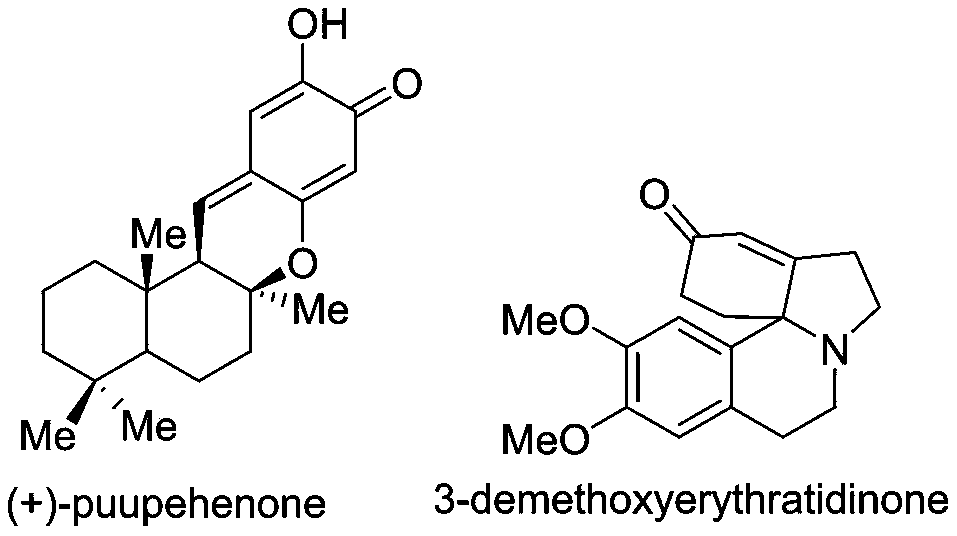
Figure 1 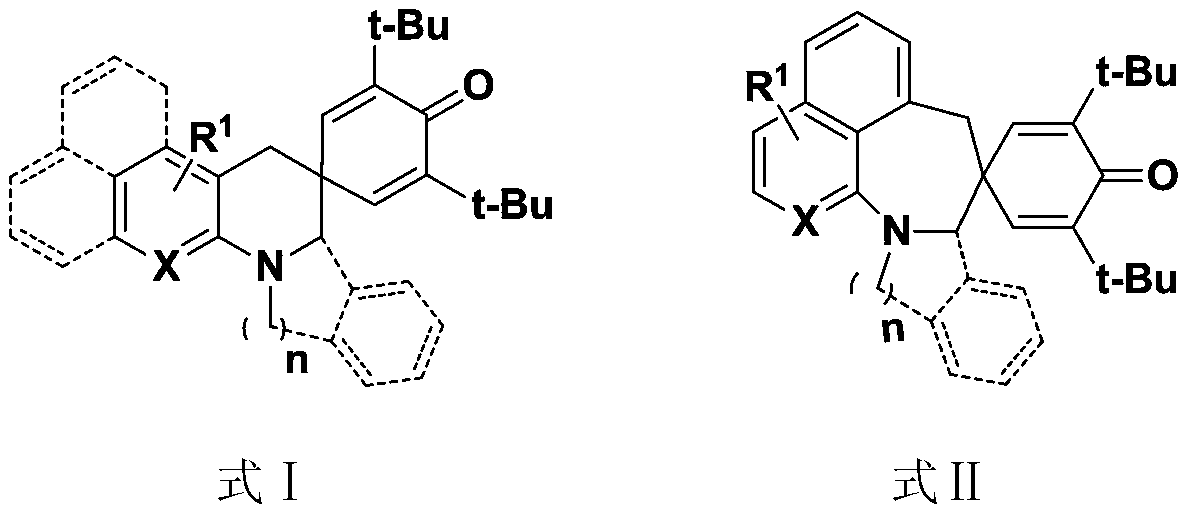
Figure 2 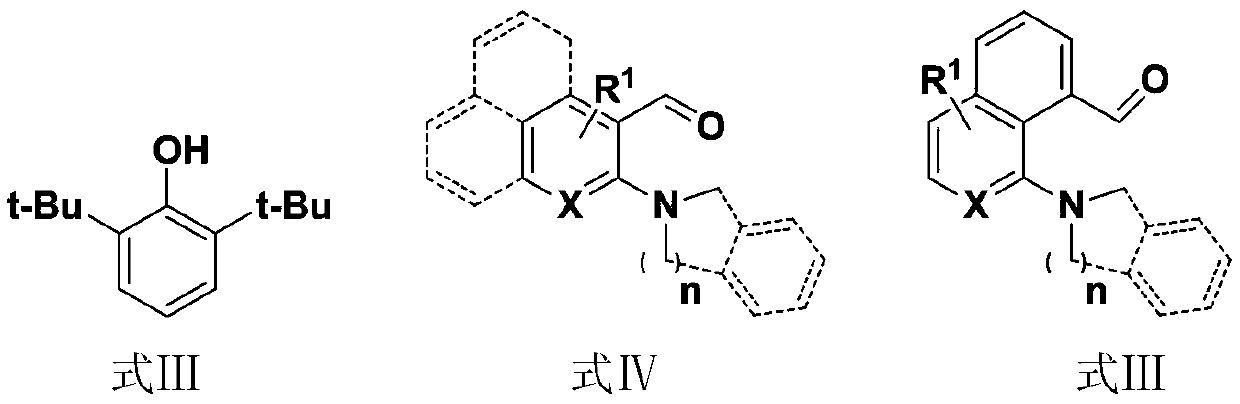
Figure 3
Abstract
Description
technical field
[0001] The invention belongs to the technical field of chemical synthesis, and in particular relates to a synthesis method of a nitrogen heterocyclic substituted p-quinone skeleton spiro compound. Background technique
[0002] There are a large number of p-quinones in various natural and non-natural products with biological activity. Their artificial synthesis and functional transformation have attracted extensive attention from researchers in organic synthesis, pharmaceuticals and other industries.
[0003]
[0004] In the organic synthesis strategy of substituted p-quinones, through the catalytic dearomatization reaction of phenols and anilines, the efficient functional transformation of p-quinones can be realized, and many compounds containing quaternary carbon centers, spiro rings or bridged rings can be synthesized. three-dimensional structure of compounds. For example, the above two natural molecules have been synthesized by catalytic dearomatizatio...
Examples
Embodiment 1
[0039]
[0040] take compound A 1 (2,6-di-tert-butylphenol) 0.13mmol, Compound B 1 (2-Pyrrolidinylbenzaldehyde) 0.1mmol and piperidine 0.2mmol in a reaction flask, add 1mL of toluene, stir and react at 120°C for 12h, then cool to room temperature;
[0041] Subsequently, 1 mL of hexafluoroisopropanol HFIP was added to the reaction system, and stirred at 25° C. for 10 min. After the reaction was completed, the reaction product was concentrated by rotary evaporation, and purified and separated on a silica gel column.
[0042] The isolated product was detected and analyzed, and the results of the analyzed data were as follows, the obtained product was the target product, and the yield was 60%.
[0043] Chemical formula: C 25 h 33 NO
[0044] Exact molecular weight: 363.2562
[0045] Molecular weight: 363.5450
[0046] Structural formula:
[0047] Yield: 60%
[0048] 1 H NMR (500MHz, CDCl 3 )δ7.14(t, J=7.7Hz, 1H), 6.99(d, J=7.4Hz, 1H), 6.62(t, J=7.3Hz, 1H), 6.51(d, J...
Embodiment 2
[0050] take compound A 1 (2,6-di-tert-butylphenol) 0.13mmol, compound B 1 (2-Pyrrolidinylbenzaldehyde) 0.1mmol and piperidine 0.2mmol were placed in a reaction flask, 1mL of toluene was added, and the reaction was stirred at 120°C for 12h, then cooled to room temperature, and the reaction intermediate was separated and purified;
[0051] The reaction intermediate was added into 2 mL of hexafluoroisopropanol HFIP, and stirred at 25° C. for 10 min. After the reaction was completed, the reaction product was concentrated by rotary evaporation, and purified and separated on a silica gel column.
[0052] Detection and analysis were carried out on the isolated product, and the results of the analysis data were as follows, the obtained product was the target product, and the yield was 90%.
[0053] Chemical formula: C 25 h 33 NO
[0054] Exact molecular weight: 363.2562
[0055] Molecular weight: 363.5450
[0056] Structural formula:
[0057] Yield: 90%
[0058] 1 H NMR (50...
Embodiment 3
[0061] Raw materials: 4-bromo-2-pyrrolidinylbenzaldehyde, 2,6-di-tert-butylphenol
[0062] Product: Chemical formula: C 25 h 32 BrNO
[0063] Exact molecular weight: 441.1667
[0064] Molecular weight: 442.4410
[0065] Structural formula:
[0066] Yield: 50%
[0067] 1 H NMR (500MHz, CDCl 3 )δ6.83(d, J=7.8Hz, 1H), 6.72(dd, J=7.9, 1.9Hz, 1H), 6.61(d, J=1.9Hz, 1H), 6.33(d, J=2.9Hz, 1H), 6.24(d, J=2.9Hz, 1H), 3.61(dd, J=9.5, 6.0Hz, 1H), 3.43(td, J=8.8, 3.2Hz, 1H), 3.20(dd, J=16.4 ,8.7Hz,1H),3.08(dd,J=15.8,0.8Hz,1H),2.51(d,J=15.8Hz,1H),1.98–1.84(m,2H),1.79(dtd,J=10.0, 6.4,3.2Hz,1H),1.29–1.23(m,11H),1.13(s,10H); 13 C NMR (126MHz, CDCl 3 )δ186.7, 149.4, 148.5, 144.5, 143.7, 138.7, 130.2, 121.3, 118.5, 117.5, 113.1, 77.3, 77.0, 76.8, 64.1, 47.5, 39.5, 38.0, 35.0, 34.9, 29.5, 29.5, 27 Resolution mass spectrometry (ESI): calcd.forC 25 h 32 BrNO[M+H] + :442.1667, actual value: 442.1677.