
Alloy roll ring for hot-rolled seamless steel pipe production and production method thereof
A technology of alloy roll ring and seamless steel pipe, which is applied in the field of metallurgy, can solve problems such as difficult bonding, large radial force, uneven stress of different material layers, etc., and achieve the effect of reducing production cost and improving service life
Patent Information
- Authority / Receiving Office
- CN · China
- Patent Type
- Patents(China)
- Current Assignee / Owner
- Publication Date
- 2019-09-10
Smart Images
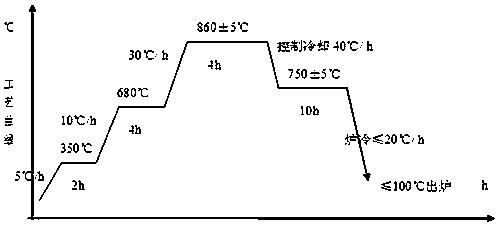
Figure 1 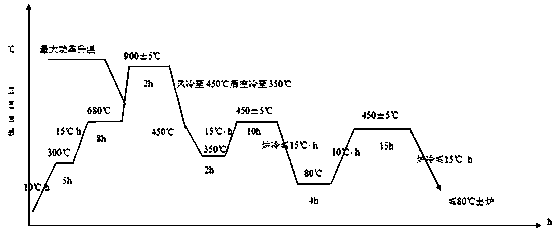
Figure 2 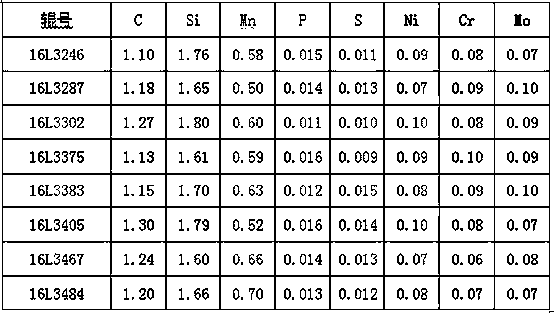
Figure 3
Abstract
Description
technical field
[0001] The invention belongs to the technical field of metallurgy, and in particular relates to a method for producing an alloy roll ring for hot-rolled seamless steel pipe production. Background technique
[0002] With the expansion of the market scale of hot-rolled seamless steel pipes and the increasingly fierce competition in the industry, the requirements for the roll rings used in rolling mills are also increasing, especially to increase the life of the roll rings without increasing the cost Reduce the amount of steel and reduce the number of roller ring replacements, thereby reducing production costs. At present, pearlite and bainite roll rings are widely used in hot-rolled seamless steel pipe production lines, but the ordinary pearlite and bainite materials used can no longer meet the high-paced needs of seamless steel pipe production due to their short service life. Therefore, it has become a trend in the development of the industry to develop a low...
Examples
Embodiment 1
[0037] In this embodiment, the specification of the centrifugal composite roller ring is Φ280*157, and the roller number is 16L3246. The percentage content is shown in Table 1 and Table 2.
[0038] The production process of the centrifugal composite roller ring in this embodiment also includes the following process steps:
[0039] (1) Iron and molten steel modification process: 1.5t and 1t intermediate frequency induction furnaces are used to smelt the outer layer of molten iron and inner layer of molten steel.
[0040] After the outer metal material is completely melted, add broken glass on the molten iron surface to prevent oxidation. The amount added is 5.3kg per ton of molten metal. 10 minutes before tapping, add ferrovanadium with a molten iron content of 0.4% in the furnace, with a particle size of 10mm. Add 1.0% ferrochromium nitride in 7 minutes, particle size 24mm;
[0041] Add 0.28% of silicon-zirconium alloy and 0.4% of modification treatment agent into the pourin...
Embodiment 2
[0048] The specification of the alloy roll ring in this embodiment is Φ280*157, the roll number is 16L3287, and the structure is a two-layer centrifugal composite structure. The outer layer is made of high manganese molybdenum cast iron, and the inner layer is made of graphite steel. See Table 1 and Table 2 for their content.
[0049] The production process of the alloy roller ring in this embodiment includes iron and molten steel metamorphism treatment, centrifugal casting, and heat treatment processes. The specific process steps are as follows:
[0050] (1) Iron and molten steel modification process: 1.5t and 1t intermediate frequency induction furnaces are used to smelt the outer layer of molten iron and inner layer of molten steel.
[0051] After the outer metal material is completely melted, add broken glass on the molten iron surface to prevent oxidation. The amount added is 5kg per ton of molten metal. 8 minutes before tapping, add ferrovanadium with a molten iron conte...
Embodiment 3
[0059] The specification of the alloy roll ring in this embodiment is Φ280*157, the roll number is 16L3302, and the structure is a two-layer centrifugal composite structure. See Table 1 and Table 2 for their content.
[0060] The production process of the alloy roller ring in this embodiment includes iron and molten steel metamorphism treatment, centrifugal casting, and heat treatment processes. The specific process steps are as follows:
[0061] (1) Iron and molten steel modification process: 1.5t and 1t intermediate frequency induction furnaces are used to smelt the outer layer of molten iron and inner layer of molten steel.
[0062] After the outer metal material is completely melted, add broken glass on the molten iron surface to prevent oxidation. The amount added is 5.7kg per ton of molten metal. 9 minutes before tapping, add ferrovanadium with 0.5% molten iron in the furnace, with a particle size of 18mm. Add 1.0% ferrochrome nitride in 6 minutes, particle size 27mm; ...