
A kind of molybdenum/titanium alloy film etchant composition and application thereof
An etching solution and composition technology, applied in the field of titanium alloy thin film etching solution composition, can solve the problems of non-standard display quality, molybdenum residue, increased side corrosion, etc., and achieve the effect of avoiding excessive side corrosion
Patent Information
- Authority / Receiving Office
- CN · China
- Patent Type
- Patents(China)
- Current Assignee / Owner
- Publication Date
- 2021-10-15
Smart Images
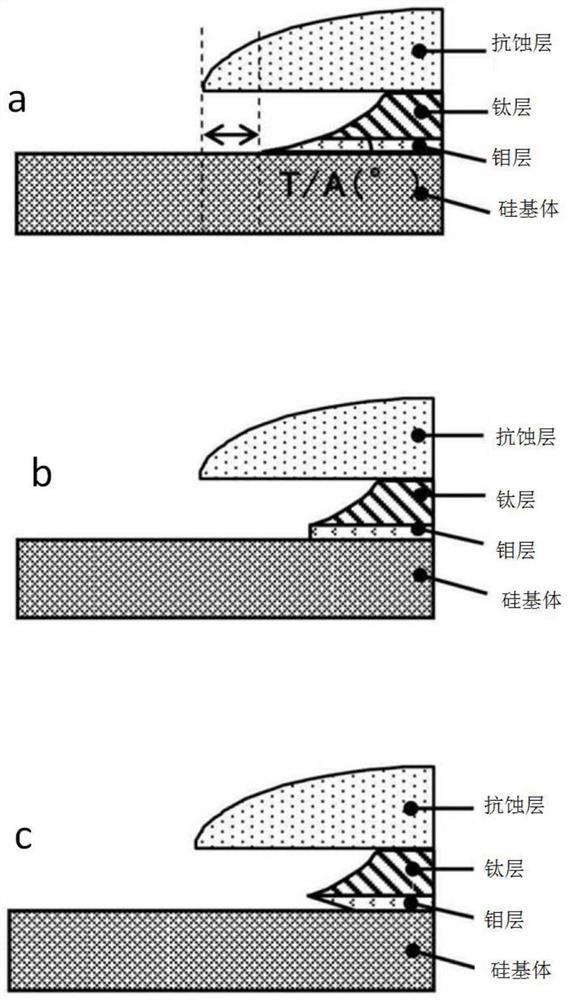
Figure 1 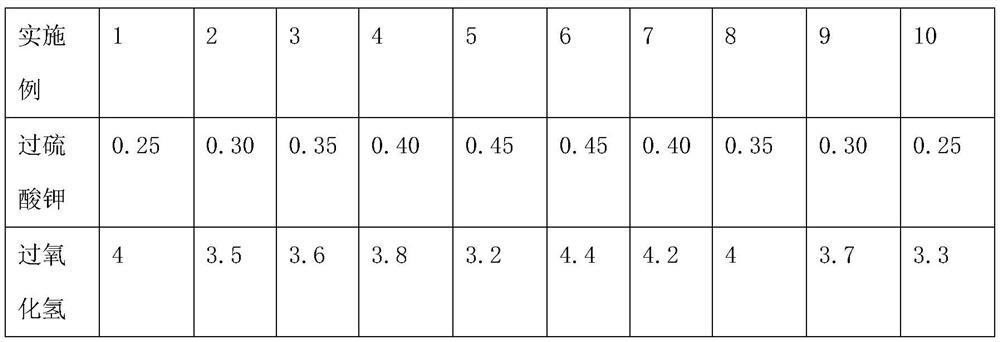
Figure 2 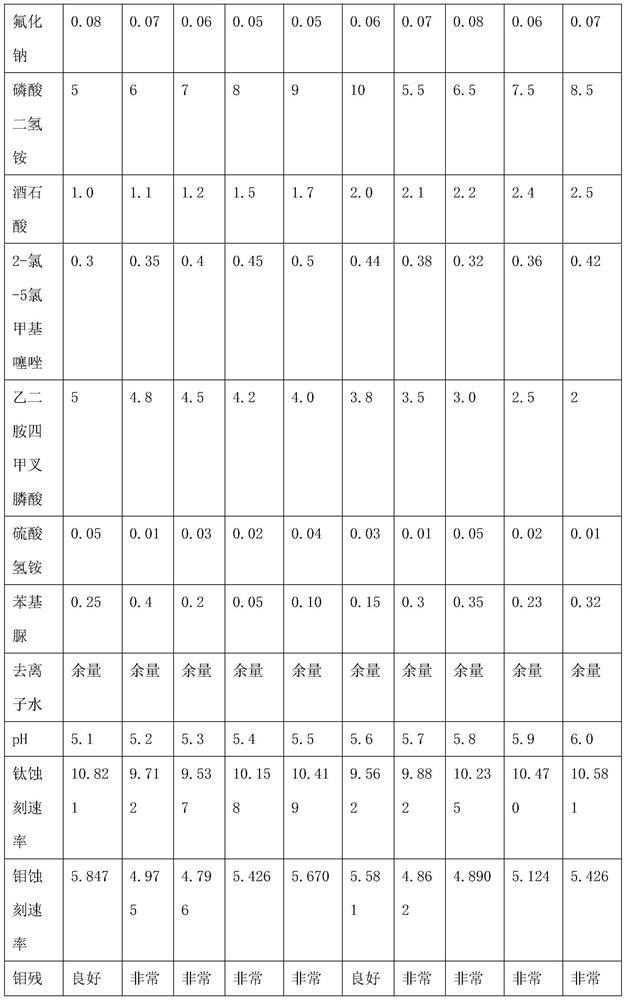
Figure 3
Abstract
Description
technical field
[0001] The invention relates to an etchant composition and application thereof, in particular to a molybdenum / titanium alloy film etchant composition and application thereof on a thin film transistor (TFT) array substrate. Background technique
[0002] The thin-film transistor (TFT) array substrate is an important component of the display. The metal layer used for the gate wire and the data wire is usually formed as a thin film on the substrate, and the subsequent process needs to etch the metal thin film. Copper has poor adhesion to glass substrates and insulating films and is easy to diffuse into silicon oxide films, so titanium, molybdenum, etc. are usually used as barrier films.
[0003] Extensive research has been done in the prior art on the etching of copper and / or molybdenum thin films, copper and / or titanium thin films. Chinese Laid-Open Patent No. 106995920A discloses an etchant composition for use in lamination of metals including a layer formed o...
Examples
preparation example Construction
[0024] Fabrication of Bilayer Thin Films Containing Titanium and Molybdenum Layers
[0025] Using 1.0cm×1.0cm silicon as the substrate, a layer of molybdenum is magnetron sputtered on its surface to form a barrier layer, and then a layer of titanium is magnetron sputtered to obtain a silicon / molybdenum / titanium double-layer metal film layer. for subsequent etching experiments. Here, in order to better illustrate the technical effect of the present invention, the thickness of the molybdenum film layer is 50 μm, and the thickness of the titanium film layer is 800 μm.
Embodiment 1-10
[0027] The etching liquid composition shown in Table 1 was put into each reaction container, and the temperature was stabilized in the thermostat kept at 45 degreeC. While stirring the etching solution composition by a stirrer, the prepared molybdenum / titanium substrate was etched for 120s, washed with water and dried, and the etching rate (μm / min) was calculated by the weight loss method:
[0028] μ(Ti)=Δm(Ti) / (1.0cm×1.0cm×4.5g / cm 3 ×120 / 60)×10 -3 ,
[0029] μ(Mo)=Δm(Mo) / (1.0cm×1.0cm×10.28g / cm 3 ×120 / 60)×10 -3 .
[0030] Confirm the cross-sectional shape by SEM, and evaluate various indicators such as the amount of side corrosion, taper angle, molybdenum residue, molybdenum undercut, and CD Loss. The indicators are shown in Table 1. The molybdenum residues in the table are divided into very good, good and poor. The situation of molybdenum undercut in the table is divided into very good, good and bad, corresponding to the figure 1 a, b, c in.
[0031] A CD Loss (=a×2)...