
Synthesis method of 6-methoxy-1-tetralone
A synthetic method, methoxyl technology, applied to the preparation of carbon-based compounds, chemical instruments and methods, condensation to prepare carbonyl compounds, etc., can solve the problems of low overall yield, large pollution, and many reaction steps, and achieve easy raw materials The effect of high product purity
Patent Information
- Authority / Receiving Office
- CN · China
- Patent Type
- Applications(China)
- Current Assignee / Owner
- Publication Date
- 2020-06-26
Smart Images
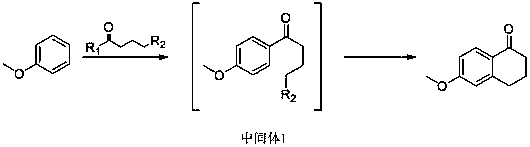
Figure 1
Abstract
Description
technical field
[0001] The invention relates to the technical field of organic synthesis, in particular to a method for synthesizing 6-methoxyl-1-tetralone. Background technique
[0002] The discovery and successful synthesis of steroid drugs is one of the most striking achievements in the pharmaceutical industry in the past half century, and steroid drugs have become the second largest class of drugs after antibiotics. Since the discovery of diosgenin in Mexico in the 1950s, except for some special hormone products that need to be extracted from animals, most steroidal drugs are produced with diosgenin as the starting material. Diosgenin and its derivatives Synthetic technology has become the main technology in this industry. In the mid-1970s, as the price of diosgenin began to rise, some multinational pharmaceutical companies turned to develop new methods for the total synthesis of steroid drugs.
[0003] Therefore, using 6-methoxy-1-tetralone as a raw material to react ...
Examples
Embodiment 1
[0037] In a 1000ml three-necked reaction flask, add 500ml of dichloroethane and 100g of anisole successively to cool down to about 0°C, slowly add 300g of aluminum trichloride, and stir for 30 minutes. Slowly add 150 g of 4-chlorobutyryl chloride dropwise, and the dropwise addition is completed in about 2-2.5 hours.
[0038] After the dropwise addition, the reaction was incubated for 1 hour. The temperature was raised again to 80-90° C. for 6-8 hours.
[0039] After the reaction was completed, the temperature was lowered to room temperature, and the reaction mixture was slowly poured into a beaker with 1000 ml of ice water, and stirred while pouring. The mixture was allowed to stand still, and the water layer was separated. The water layer was extracted once with 200ml of dichloroethane, and the dichloroethane layers were combined and analyzed once with 200ml of water. Dichloroethane was evaporated to dryness under reduced pressure, dissolved in 100ml of ethyl acetate, then ...
Embodiment 2
[0041] In a 1000ml three-necked reaction flask, add 500ml of dichloroethane and 100g of anisole successively to cool down to about 0°C, slowly add 300g of aluminum trichloride, and stir for 30 minutes. Add 150 g of 4-chlorobutyryl chloride directly, and complete the addition within about 10 minutes.
[0042] After the dropwise addition, the reaction was incubated for 1 hour. The temperature was raised again to 80-90° C. for 6-8 hours.
[0043] After the reaction was completed, the temperature was lowered to room temperature, and the reaction mixture was slowly poured into a beaker with 1000 ml of ice water, and stirred while pouring. The mixture was allowed to stand still, and the water layer was separated. The water layer was extracted once with 200ml of dichloroethane, and the dichloroethane layers were combined and analyzed once with 200ml of water. Dichloroethane was evaporated to dryness under reduced pressure, dissolved in 100ml of ethyl acetate, then 100ml of petroleu...
Embodiment 3
[0046] Add 500ml of dichloroethane and 100g of anisole successively to a 2000ml three-necked reaction flask and cool down to about 0°C, slowly add 300g of aluminum trichloride, and stir for 30 minutes. Slowly add 200 g of 4-bromobutyryl chloride dropwise, and the dropwise addition is completed in about 2-2.5 hours.
[0047] After the dropwise addition, the reaction was incubated for 1 hour. The temperature was raised again to 80-90° C. for 6-8 hours.
[0048] After the reaction was completed, the temperature was lowered to room temperature, and the reaction mixture was slowly poured into a beaker with 1000 ml of ice water, and stirred while pouring. The mixture was allowed to stand still, and the water layer was separated. The water layer was extracted once with 200ml of dichloroethane, and the dichloroethane layers were combined and analyzed once with 200ml of water. Dichloroethane was evaporated to dryness under reduced pressure, dissolved in 100ml of ethyl acetate, then 100...