
A Method for Determining Frequency Points of Comb Spectrum Interfering Signals in Multiple Limited Bandwidths
A technology of interference signal and limited bandwidth, which is applied in the direction of transmission monitoring, communication channel monitoring, electrical components, etc., can solve the problems of affecting accuracy, lack, conflict of working bandwidth range, etc., and achieve the effect of avoiding conflicts
Patent Information
- Authority / Receiving Office
- CN · China
- Patent Type
- Patents(China)
- Current Assignee / Owner
- Publication Date
- 2022-06-07
Smart Images
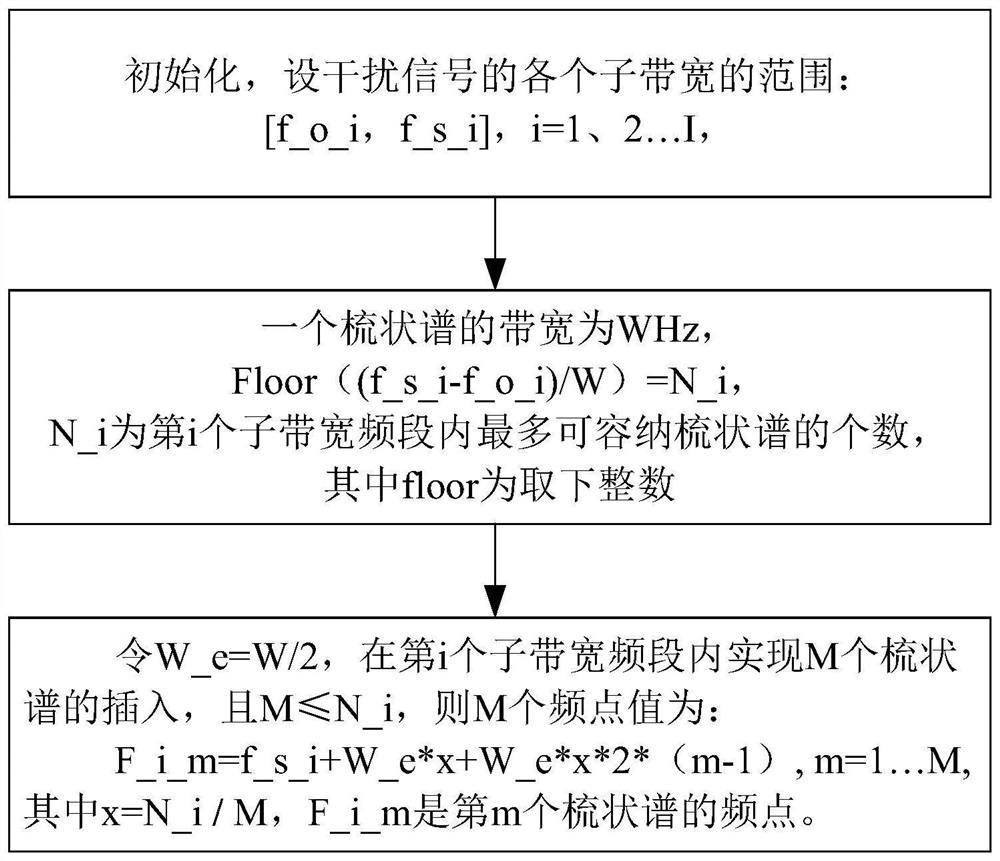
Figure 1
Abstract
Description
Technical field
[0001] The present invention relates to mobile communications, digital signal processing and other related technical fields, in particular an interference frequency point estimation method. Background
[0002] In order to generate a comb spectrum interference signal for a digital receiver operating in a plurality of limited bandwidth ranges, in order to achieve targeted interference at one or more frequency points in the signal of different operating bandwidth bands, a method for determining the frequency points of comb spectrum interference signals in a plurality of limited bandwidth ranges is proposed. The technology is based on different finite bands to produce different frequency intervals of the comb spectrum, by calculating a limited bandwidth maximum number of comb spectrum can be inserted, based on the ratio of the maximum number of comb spectrum that can be inserted and the number of comb spectrum that actually needs to be inserted, the insertion frequenc...
Examples
Embodiment Construction
[0013] The present invention is further described below in conjunction with the accompanying drawings and embodiments.
[0014] The present invention provides a plurality of limited bandwidth range comb spectrum interference signal frequency point determination method. The core idea is to obtain the insertion frequency point of each comb spectrum based on the ratio of the maximum number of combs that can be inserted and the number of combs that actually need to be inserted, to generate comb spectrum with different frequency intervals based on different finite bands, to generate comb spectrums with different frequency intervals based on the maximum number of combs that can be inserted with a limited bandwidth, and to obtain the insertion frequency point of each comb spectrum based on the ratio of the maximum number of combs that can be inserted and the number of combs that actually need to be inserted, so as to produce accurate interference with different operating frequencies in d...