
Method for rapidly detecting total nitrogen content of urban green land soil by using archaea molecular marker OTU300
A nitrogen content and soil technology, applied in the fields of biochemical equipment and methods, soil material testing, material inspection products, etc., can solve the problems of difficult to achieve rapid detection of large-scale samples, large demand for samples, and long cycle, and achieve rapid The effect of automatic detection, small sample demand, and low labor cost
Patent Information
- Authority / Receiving Office
- CN · China
- Patent Type
- Applications(China)
- Current Assignee / Owner
- Publication Date
- 2021-07-20
Smart Images
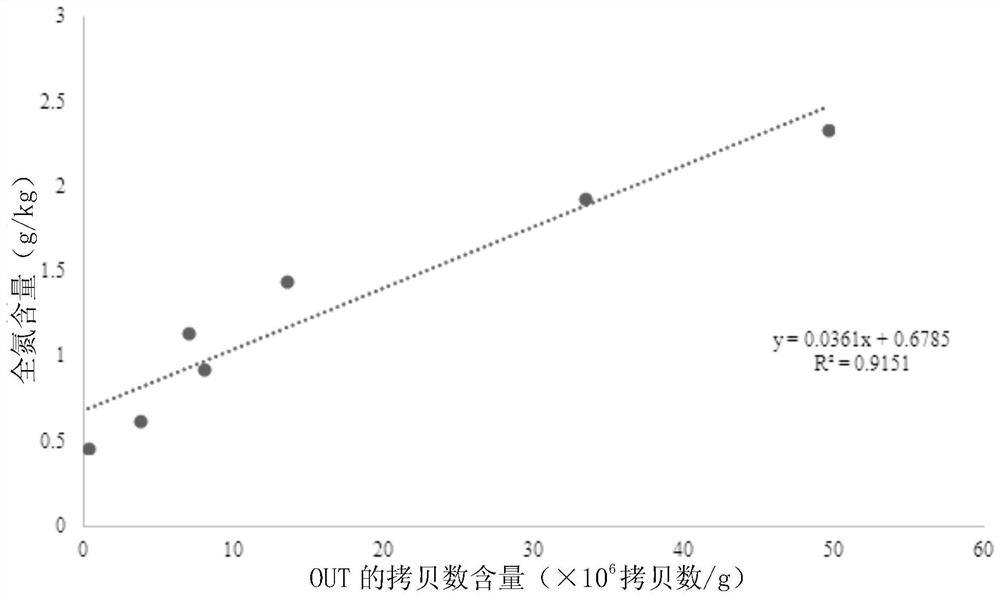
Figure 1 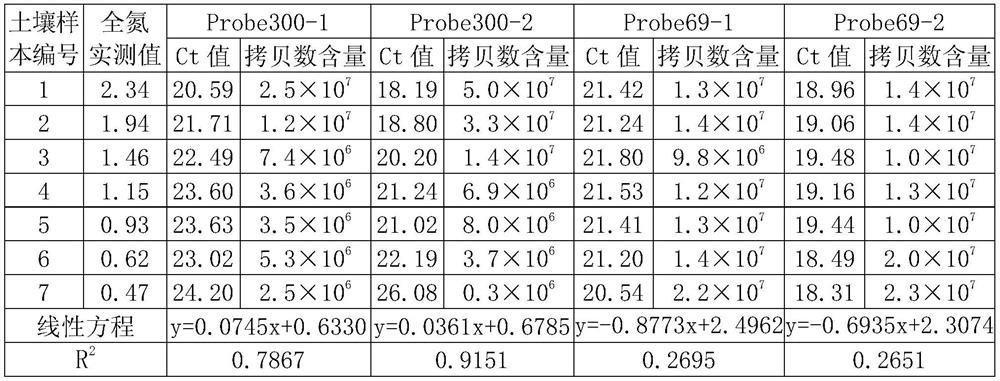
Figure 2 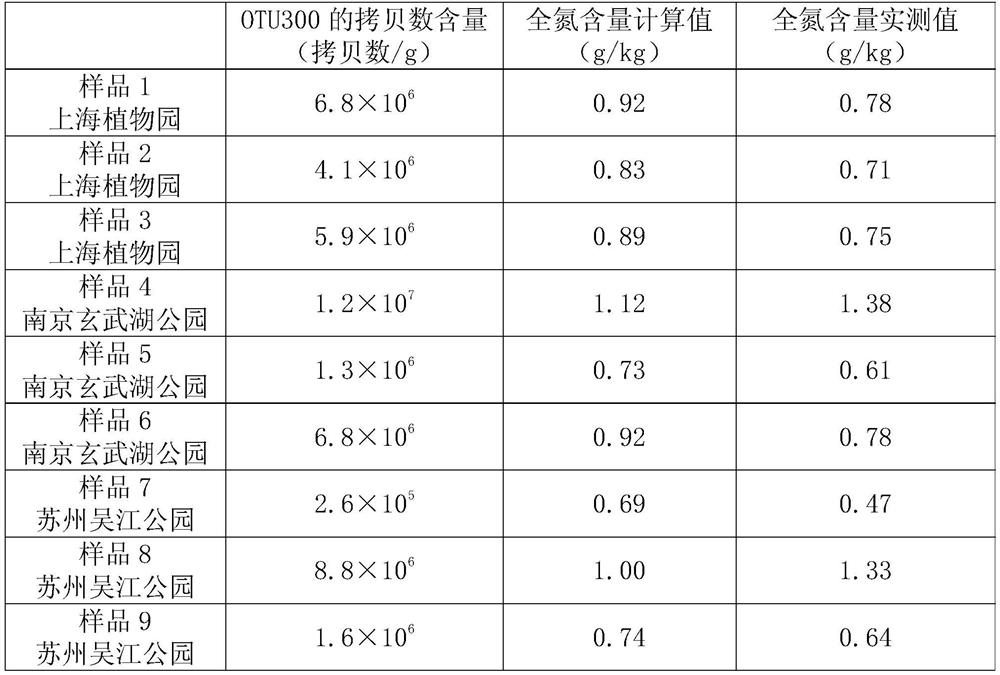
Figure 3
Abstract
Description
technical field
[0001] The invention belongs to the field of biotechnology, and relates to a method for quickly detecting the total nitrogen content of urban greenbelt soil by using an archaeal molecular marker OTU300. Background technique
[0002] Urban landscaping construction is an important part of the construction of ecological civilization and the construction of a beautiful China. It plays an important role in optimizing the urban environment, improving the quality of life of the people, and promoting the sustainable development of the city. As the material basis of urban ecological environment, the quality of urban green space soil directly affects the healthy growth of plants, ecological benefits, and landscape functions, and determines the quality of urban green space to a certain extent. Therefore, scientific and objective monitoring and evaluation of the soil quality of urban green space is an important reference and basis for urban green space management. [00...
Examples
Embodiment 1
[0059] Embodiment 1, find the OUT relevant to soil total nitrogen content
[0060] 1. Collection of soil samples
[0061] In November 2017, research plots were set up in representative parks and green spaces in 16 administrative districts of Shanghai.
[0062] Sampling method: Soil sample collection follows the sampling principle of multi-point mixing. Select 8 sampling points for each plot, and use a 2.5cm diameter soil drill to collect 0-20cm surface soil respectively, and then mix them into 1 soil sample.
[0063] A total of 76 soil samples were collected.
[0064] The soil samples were mixed evenly and passed through a 2mm sieve to remove plant roots, gravel and other debris. Each soil sample was then divided into two. One sample was air-dried naturally, and then sampled for the determination of soil chemical properties in step 2; the other sample was stored at -80°C, and then sampled for the extraction of total soil DNA in step 3.
[0065] 2. Analysis and determinatio...
Embodiment 2
[0087] Embodiment 2, establishing the linear relationship between OTU and soil chemical characteristics
[0088] 1. Archaeal Marker Gene Probe Design
[0089] According to the sequencing results, a probe for detecting OTU300 was designed.
[0090] Probe300-1 probe: 5'-AGGATACTACAGAGCTAGGA-3'.
[0091] Probe300-2 probe (SEQ ID NO: 1 of the Sequence Listing): 5'-TTGGCTTCGCGCTAACCCAGT-3'.
[0092] The Probe300-1 probe is a Taqman probe with a fluorescent group FAM at the 5' end and a fluorescent quencher TAMRA at the 3' end. The Probe300-2 probe is a Taqman probe with a fluorescent group FAM at the 5' end and a fluorescent quencher TAMRA at the 3' end.
[0093] According to the sequencing results, a probe for detecting OTU69 was designed.
[0094] Probe69-1 probe: 5'-ACCCGCTCAACGGTTGGGCT-3'.
[0095] Probe69-2 probe: 5'-TGATGGGATGGCCTCGAGCT-3'.
[0096] The Probe69-1 probe is a Taqman probe with a fluorescent group FAM at the 5' end and a fluorescent quencher TAMRA at the 3...
Embodiment 3
[0118] Example 3, Molecular detection of total nitrogen content in unknown urban green space soil samples
[0119] Three green spaces were randomly selected in Shanghai Botanical Garden, Nanjing Xuanwu Lake Park and Suzhou Wujiang Park respectively.
[0120] Sampling method: Soil sample collection follows the sampling principle of multi-point mixing. Select 8 sampling points for each plot, and use a 2.5cm diameter soil drill to collect 0-20cm surface soil respectively, and then mix them into 1 soil sample.
[0121] The soil samples were mixed evenly and passed through a 2mm sieve to remove plant roots, gravel and other debris. Each soil sample was then divided into two. One sample was air-dried naturally, then sampled to detect the total nitrogen content, and the measured value of the total nitrogen content (in g / kg) was obtained; the other sample was stored at -80°C, and then sampled for total soil DNA extraction.
[0122] 1. Extract the total DNA from the soil sample. Pow...