
Solid lubricant and preparation method thereof
A technology for solid lubricants and preparation steps, applied in lubricating compositions, petroleum industry, etc., can solve the problems of reducing the strength, toughness and wear resistance of composite materials, continuous damage of matrix, and loss of lubricity, etc., to improve strength, toughness, Protects against oxidation damage and improves lubricating performance
Patent Information
- Authority / Receiving Office
- CN · China
- Current Assignee / Owner
- Publication Date
- 2021-07-30
- Estimated Expiration
- Not applicable · inactive patent
Smart Images
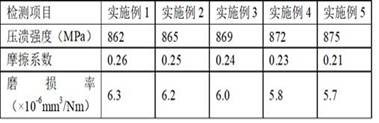
Figure 1 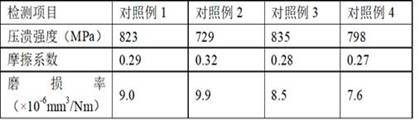
Figure 2
Abstract
Description
technical field
[0001] The invention relates to a solid lubricant and a preparation method thereof, belonging to the technical field of lubricant preparation. Background technique
[0002] At present, solid lubrication is to replace lubricating grease with solid micropowder, thin film or composite material, and isolate the friction surface of relative motion to achieve the purpose of reducing friction and wear resistance. With the advancement of modern science and technology, in order to solve the mechanical lubrication problems under special working conditions such as high load, high vacuum, high and low temperature, strong radiation and strong corrosion, solid lubricating materials have been developed from a single micropowder, adhesive film or unit material. As a composite material composed of multiple components, the research on its mechanism of action and application methods has been developed rapidly, and many new techniques and technologies for the preparation and app...
Examples
Embodiment 1
[0036] Weigh expandable graphite and put it into a vacuum freeze-drying box to freeze-dry, then put the dried expandable graphite into a microwave reactor, treat it with a power of 1.3kW for 30s, then cool it naturally to room temperature, and heat and expand it by circulating microwave treatment for 5 times, to obtain expanded graphite;
[0037] In parts by weight, 70 parts of nickel nitrate, 60 parts of molybdenum chloride, 40 parts of aluminum chloride, 8 parts of cobalt nitrate and 8 parts of yttrium chloride were weighed to obtain a mixed salt, and the mixed salt was heated to 200 ° C. Put the mixed salt into the electrolytic cell after melting, use the aluminum sheet as the positive electrode, and use the above-mentioned expanded graphite as the negative electrode, keep the distance between the two stages at 40mm, and the current density is 1.06A / dm 2 After electroplating for 4 hours under certain conditions, remove the electroplated negative electrode, which is composit...
Embodiment 2
[0043] Weigh the expandable graphite and put it into a vacuum freeze-drying box to freeze-dry, then put the dried expandable graphite into a microwave reactor, treat it with a power of 1.3 kW for 31 seconds, then cool it down to room temperature naturally, and heat and expand it by circulating microwave treatment for 5 times, to obtain expanded graphite;
[0044] In parts by weight, 72 parts of nickel nitrate, 62 parts of molybdenum chloride, 42 parts of aluminum chloride, 8 parts of cobalt nitrate and 8 parts of yttrium chloride were weighed to obtain a mixed salt, and the mixed salt was heated to 205 ° C. Put the mixed salt into the electrolytic cell after melting, use the aluminum sheet as the positive electrode, and use the above-mentioned expanded graphite as the negative electrode, keep the distance between the two stages at 40mm, and the current density is 1.06A / dm 2 After electroplating for 4 hours under certain conditions, remove the electroplated negative electrode, ...
Embodiment 3
[0050] Weigh the expandable graphite and put it into a vacuum freeze-drying box to freeze-dry, then put the dried expandable graphite into a microwave reactor, treat it with a power of 1.4kW for 33s, then cool it naturally to room temperature, and heat and expand it by cyclic microwave treatment for 6 times, to obtain expanded graphite;
[0051] In parts by weight, 75 parts of nickel nitrate, 65 parts of molybdenum chloride, 45 parts of aluminum chloride, 9 parts of cobalt nitrate and 9 parts of yttrium chloride were weighed to obtain a mixed salt, and the mixed salt was heated to 210° C. Put the mixed salt into the electrolytic cell after melting, use the aluminum sheet as the positive electrode, and use the above-mentioned expanded graphite as the negative electrode, keep the distance between the two stages at 40mm, and the current density is 1.06A / dm 2 After electroplating for 4 hours under certain conditions, remove the electroplated negative electrode, which is composite ...