
Thermal power generating unit low-frequency oscillation analysis method considering nonlinear link
A thermal power unit, low-frequency oscillation technology, applied in the direction of reducing/preventing power oscillation, electrical components, circuit devices, etc., can solve problems that are rarely seen in applications
Patent Information
- Authority / Receiving Office
- CN · China
- Current Assignee / Owner
- Publication Date
- 2022-06-24
Smart Images
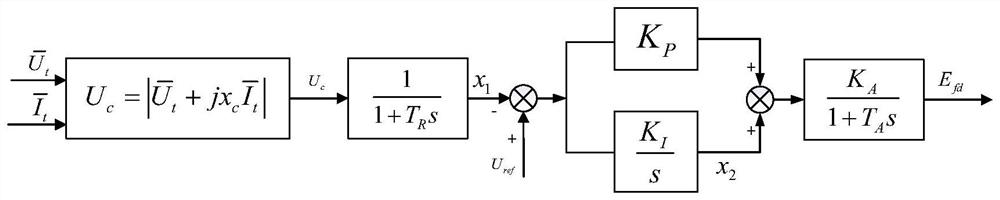
Figure 1 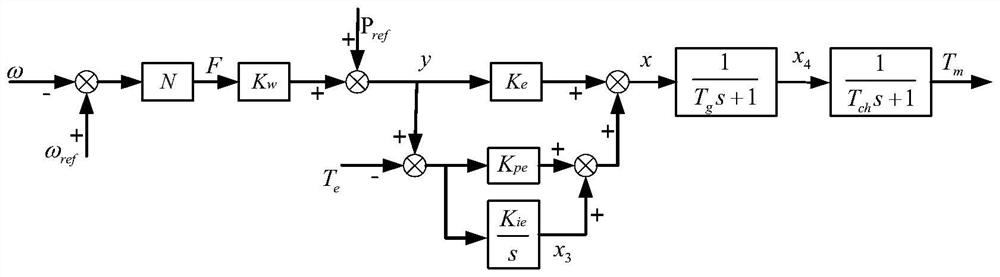
Figure 2 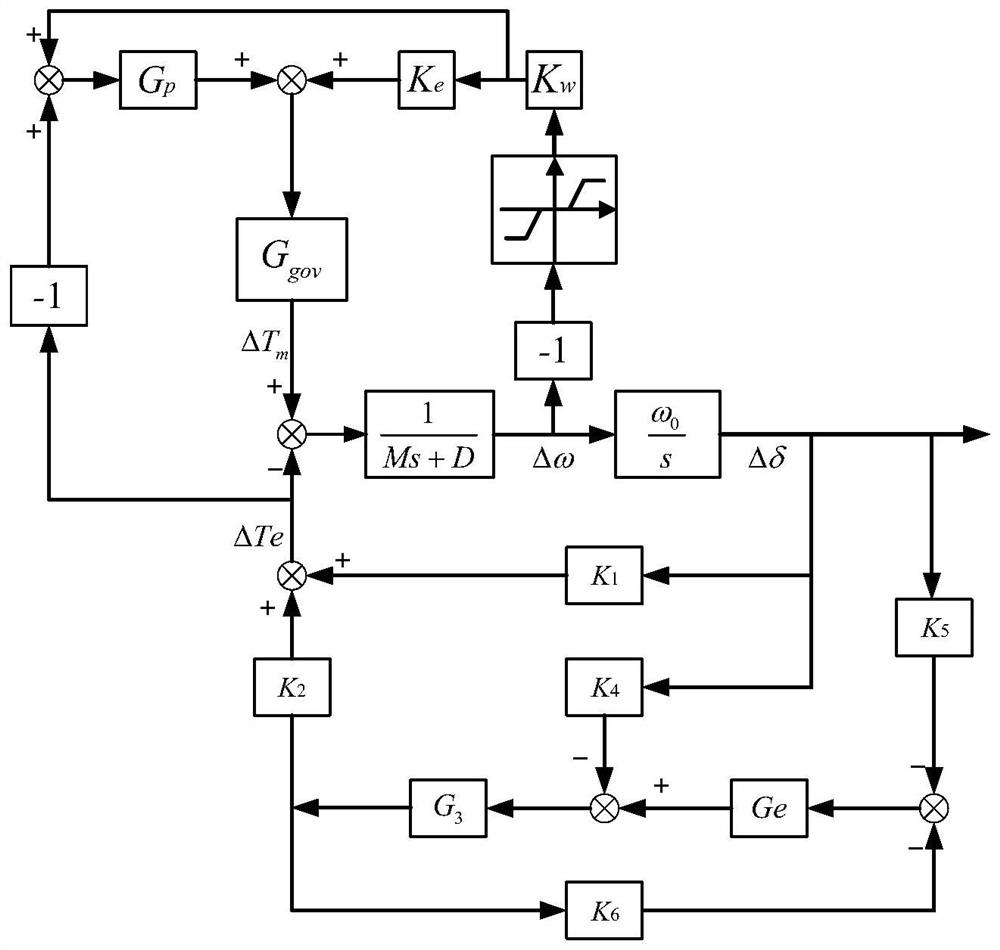
Figure 3
Abstract
Description
technical field
[0001] The invention relates to the field of stable operation analysis of power systems, in particular to an analysis method for low-frequency oscillation of thermal power units considering nonlinear links. Background technique
[0002] In the 1960s, after the low-frequency oscillation occurred in the North American power system, American scholars F.P.Demello and C.Concordia adopted the consideration of generator transient potential E′ q The changing Phillips-Hafferon model is used to analyze the causes of low-frequency oscillations in power systems. It was first believed that the low-frequency oscillation was mainly caused by the lack of sufficient damping of the system. In 1969, two scholars proposed a corresponding theory based on the concept of damping torque, which was widely accepted.
[0003] On the other hand, the power system is a highly complex nonlinear dynamic system, including many switching links such as dead zones. In its analysis methods, th...
Examples
Embodiment Construction
[0042] The technical solutions in the embodiments of the present invention will be clearly and completely described below in conjunction with the accompanying drawings in the embodiments of the present invention. Obviously, the described embodiments are only some of the embodiments of the present invention, not all of them. Based on the embodiments of the present invention, all other embodiments obtained by persons of ordinary skill in the art without making creative efforts belong to the protection scope of the present invention.
[0043] The embodiment of the present invention will be further described in detail below in conjunction with the accompanying drawings, and the specific analysis process is as follows:
[0044] Step 1. Consider the excitation system and speed control system of the thermal power unit, and establish a 9th-order time-domain model of the single-machine infinite system;
[0045] according to figure 1 The excitation system shown and figure 2 The block...