
Production process of photosensitive monomer material
A technology of photosensitive monomer and production process, applied in the direction of photosensitive materials for opto-mechanical equipment, etc., can solve the problems of inconvenience for large-scale mass production of enterprises and high price of polymer materials, achieve low production cost and improve molding processing performance. , the effect of good photosensitive performance
Patent Information
- Authority / Receiving Office
- CN · China
- Current Assignee / Owner
- Publication Date
- 2022-08-02
- Estimated Expiration
- Not applicable · inactive patent
Smart Images
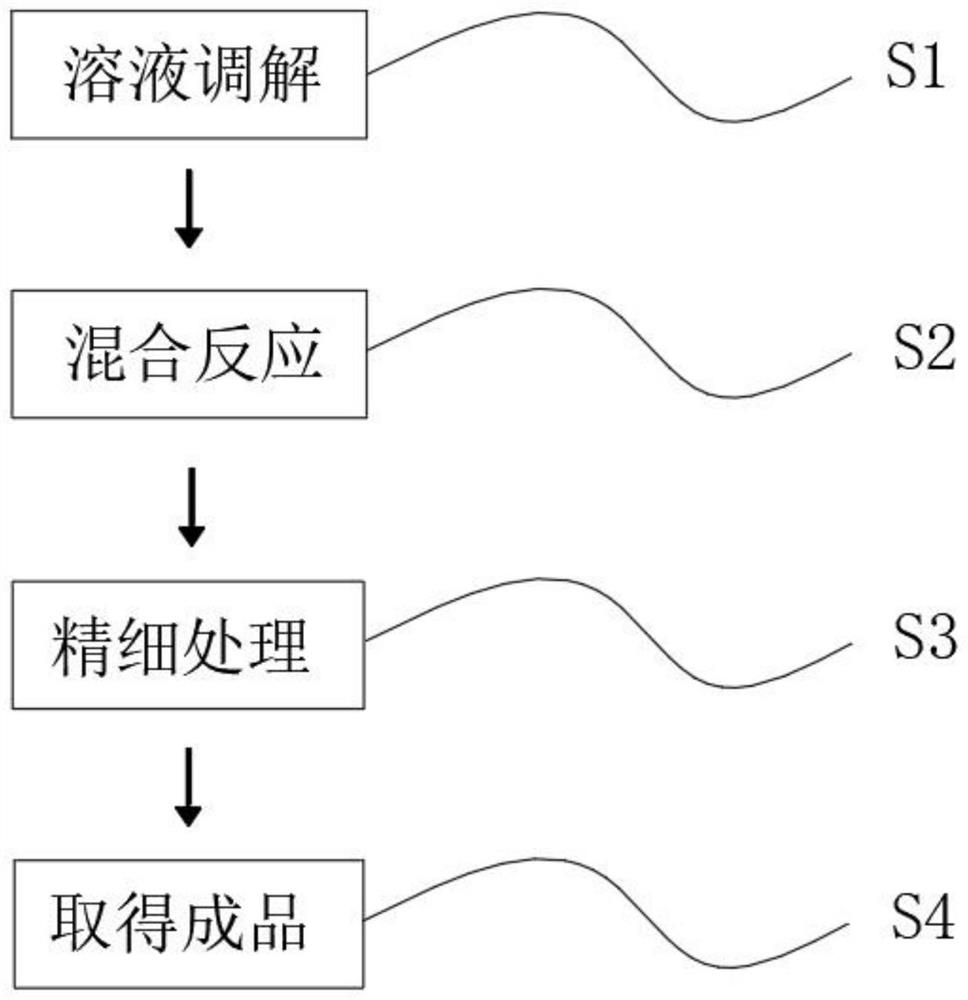
Figure 1
Abstract
Description
technical field
[0001] The invention relates to the technical field of production of photosensitive monomer materials, in particular to a production process of photosensitive monomer materials. Background technique
[0002] Photosensitive material refers to a semiconductor material with photosensitive properties, so it is also called photoconductive material or photosensitive semiconductor. Commonly used photosensitive materials on copiers are: organic photosensitive drum (OPC), amorphous silicon photosensitive drum, cadmium sulfide photosensitive drum and selenium photosensitive drum. In addition, photosensitive materials are often used in photography. There are many varieties of photosensitive materials, which are generally classified according to their uses, supports and color-sensing properties. Acrylamide-diacetone acrylamide copolymer is a new type of water-soluble that has developed rapidly internationally in recent years. Sexual functional polymer materials, but thi...
Examples
Embodiment 1
[0022] Example 1, please refer to figure 1 , the present invention provides a technical scheme: the production process of the photosensitive monomer material, comprising the following steps:
[0023] S1: Solution adjustment, first take deionized water and photosensitive resin, dilute to 155ml / l working solution when using, then measure pH with acidity meter, then adjust pH, then take acrylamide and diacetone acrylamide, after obtaining the acrylamide and diacetone acrylamide in conditioned deionized water:
[0024] S2: Mixing reaction, then weigh the initiator and add it into the reaction kettle, and gradually increase the temperature of the reaction kettle itself, and keep it for 4 hours. After the maintenance, the initiator is added to the reaction kettle again, and the polymerization operation is carried out for 10 hours to obtain the photosensitive polymer:
[0025] S3: Fine treatment, then add defoaming agent to the reaction kettle, and continuously defoaming the solutio...
Embodiment 2
[0035] Example 2, please refer to figure 1 , the present invention provides a technical scheme: the production process of the photosensitive monomer material, comprising the following steps:
[0036] S1: Solution adjustment, first take deionized water and photosensitive resin, dilute to 120ml / l working solution when using, then measure pH with acidity meter, then adjust pH, then take acrylamide and diacetone acrylamide, after obtaining acrylamide and diacetone acrylamide in conditioned deionized water:
[0037] S2: Mixing reaction, then weigh the initiator and add it to the reaction kettle, and gradually increase the temperature of the reaction kettle itself, and keep it for 3 hours. After the maintenance, the initiator is added to the reaction kettle again, and the polymerization operation is carried out for 8 hours to obtain the photosensitive polymer:
[0038] S3: Fine treatment, then add defoaming agent to the reaction kettle, and continuously defoaming the solution in th...
Embodiment 3
[0048] Example three, please refer to figure 1 , the present invention provides a technical scheme: the production process of the photosensitive monomer material, comprising the following steps:
[0049] S1: Solution adjustment, first take deionized water and photosensitive resin, dilute to 200ml / l working solution when using, then measure pH with acidity meter, then adjust pH, then take acrylamide and diacetone acrylamide, after obtaining the acrylamide and diacetone acrylamide in conditioned deionized water:
[0050] S2: Mixing reaction, then weigh the initiator and add it to the reaction kettle, and gradually increase the temperature of the reaction kettle itself, and keep it for 4 hours. After holding, the initiator is added to the reaction kettle again, and the polymerization operation is carried out for 8 hours to obtain the photosensitive polymer:
[0051] S3: Fine treatment, then add defoaming agent to the reaction kettle, and continuously defoaming the solution in th...