
Dietary compositions for reducing blood glucose levels and for weight management
a technology of dietary compositions and blood glucose levels, applied in the field of dietary compositions, can solve the problems of high incidence of metabolic disorders in humans and their related impact on health and mortality, high use of pharmaceuticals as a measure, and serious burden on patients, so as to reduce the glycemic index of foods, improve glucose homeostasis, and reduce blood glucose levels
Patent Information
- Authority / Receiving Office
- US · United States
- Patent Type
- Patents(United States)
- Current Assignee / Owner
- Publication Date
- 2021-07-27
Smart Images
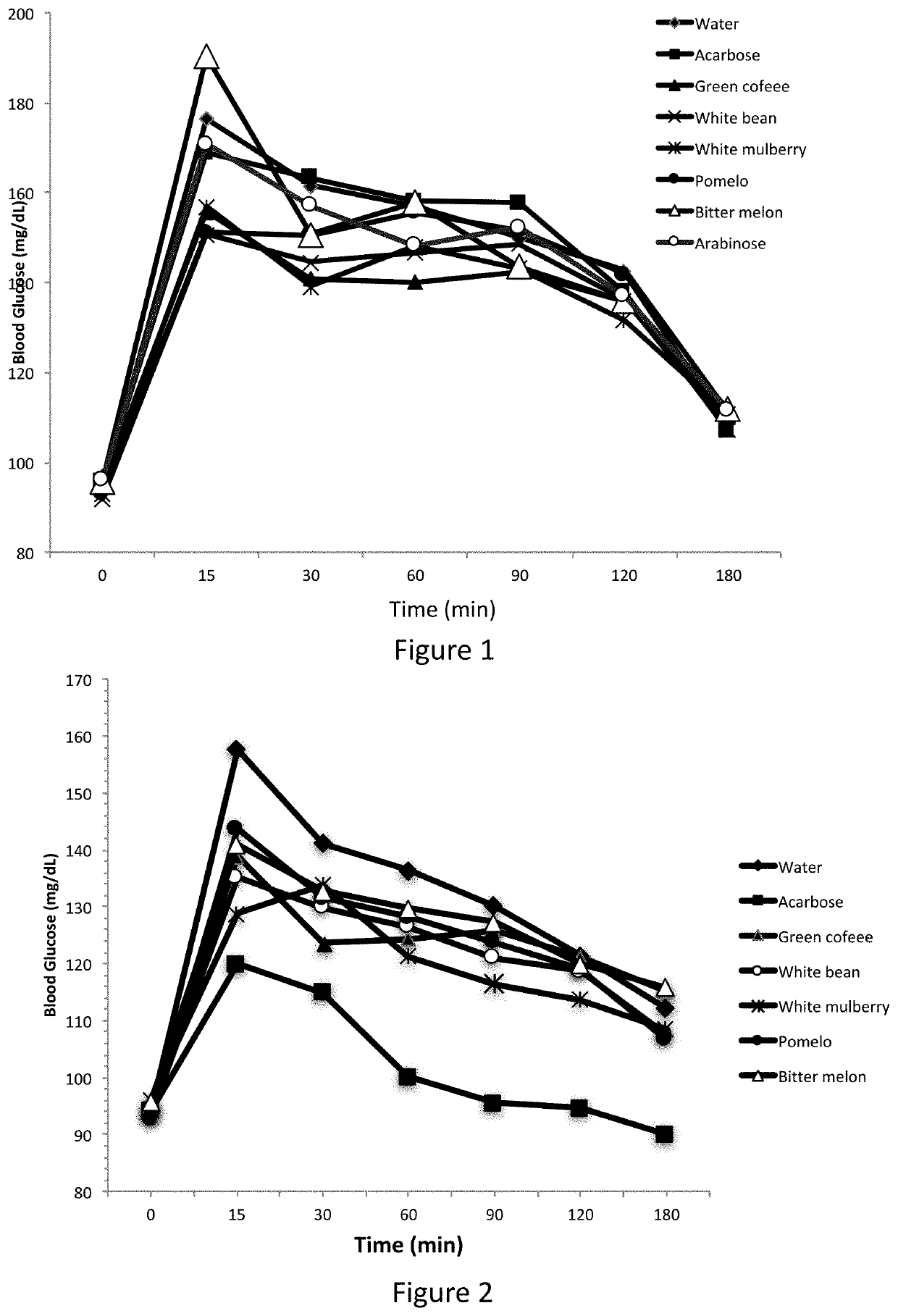
Figure 1 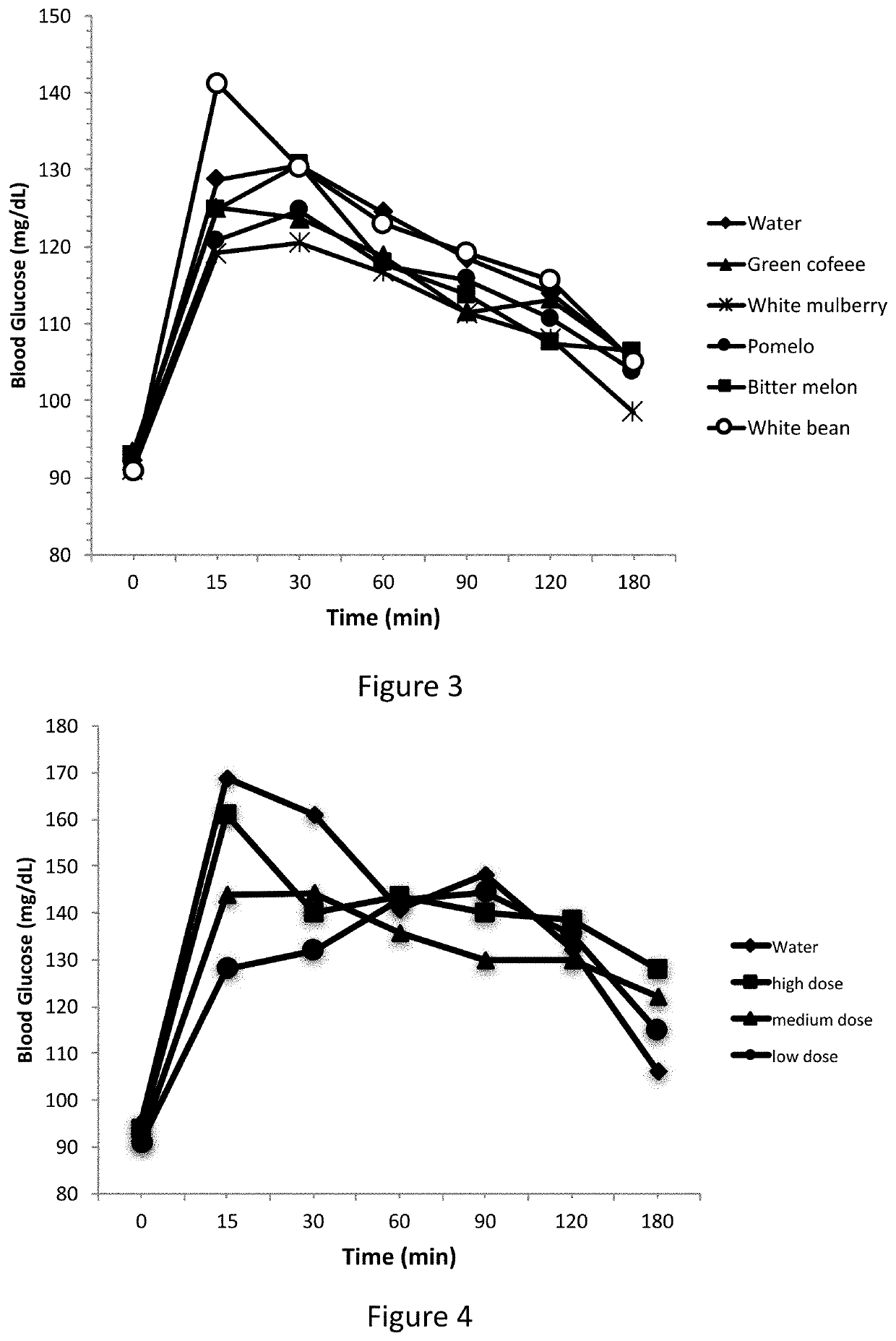
Figure 2 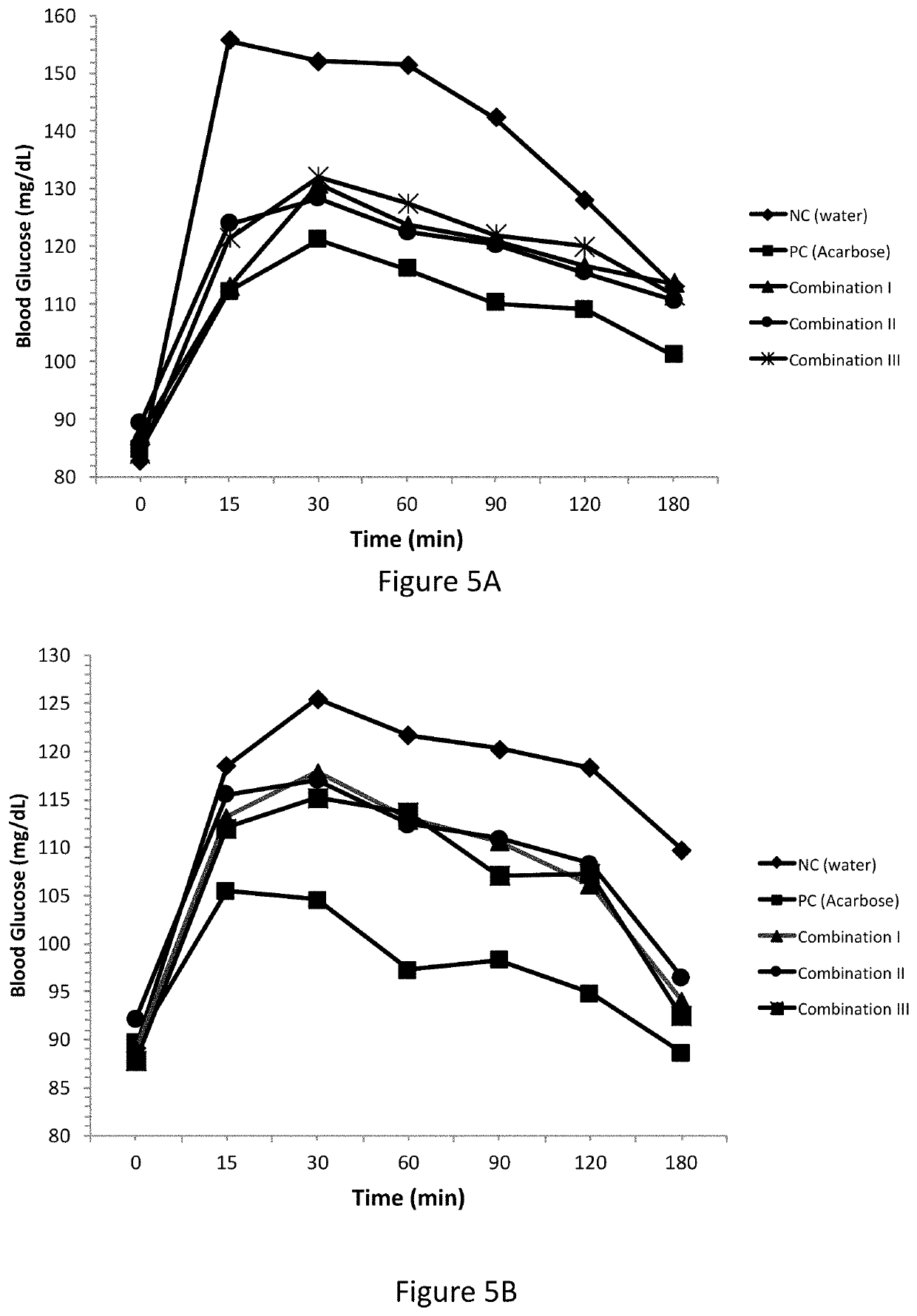
Figure 3
Abstract
Description
FIELD OF THE INVENTION
[0001] The present invention provides dietary compositions comprising mulberry extract, coffee extract, bean extract, optionally, dietary fibers, and a nutraceutically acceptable carrier. The present invention further provides methods for preventing the increase in postprandial hyperglycemia and hypoglycemia, hyperinsulinemia and diseases and disorders associated therewith, including, endothelial dysfunction, inflammatory conditions, oxidative stress, hyperlipidemia, and consecutive pathologies like insulin resistance, diabetes, visceral obesity, hypertension and cardiovascular diseases.BACKGROUND OF THE INVENTION
[0002] The high incidence of metabolic disorders in humans and their related impact on health and mortality represents a significant threat to public health. These include obesity and type II diabetes, among others. However, pharmaceuticals currently used as a measure against disorders associated with abnormal glucose blood level, such as, diabetes, obes...
Examples
example 1
Single Plant Extracts on Postprandial Blood Glucose Levels In Vivo
[0141]An experiment was conducted on 96 male Wistar rats with mean body weight of 381.2±16.6 g, bred at IARFR PAS in Olsztyn. Each study group consisted of 12 rats. The animals were kept in individual cages in a ventilated room at a constant temperature of about 22° C., controlled relative humidity of about 60% and appropriate lighting (day / night, 12 / 12 hours). During the experimental period, the animals were fed a standard laboratory rodent mix. Rats were deprived of food 12 hours prior to the first measurement of blood glucose levels, while constant access to water was maintained. On the day of the experiment, the rats were weighed and fasting blood glucose measurements were taken, via a scalpel incision at the tip of the tail. Next, the animals received aqueous solutions of plant extracts, Acarbose, which served as a positive control (PC) or water, which served as a negative control (NC) at pre-defined quantities v...
example 2
ract Combinations Reduce Blood Glucose Levels In Vivo
[0155]The effect of plant extract combinations was tested in an experiment conducted with 50 male Wistar rats having mean body weight of 294.9±21.0 g, bred at IARFR PAS in Olsztyn. Each study group consisted of 10 rats. Rats were kept in individual cages in a ventilated at a constant temperature of about 22° C., controlled relative humidity of about 60% and appropriate lighting (day / night, 12 / 12 hours). During the experimental period, rats were fed the standard laboratory rodent mix. Rats were deprived of food 12 hours prior to the first measurement of blood glucose levels, while constant access to water was maintained. On the day of the experiment, rats were weighed and fasting blood glucose measurements were taken, via a scalpel incision at the tip of the tail. Next, rats were administered water (negative control), acarbose (positive control) or aqueous solutions of pre-defined combinations of plant extracts, as follows:[0156]ac...
example 3
ract Combinations Reduce Blood Glucose Levels in Obese Rats
[0167]In order to assess whether administration of plant extracts as dietary supplements can positively affect blood glucose levels in animals fed on a high-fat diet an in vivo experiment was performed in two stages: a preliminary stage and a test stage, each lasting 10 weeks. During the preliminary stage, a group of 40 Wistar rats aged about 35 days, originating from a single pack of the IARFR animal house were fed a commercial high fat diet C 1090-45 (Altromin GmbH, Lage, Germany) consisting of 21% crude protein, 22% crude fat, 3.95% crude fiber and 5.1% crude ash. A second group of 10 rats from the same pack and of the same age were fed a commercial low fat diet C 1090-10 (Altromin GmbH, Lage, Germany) consisting of 21% crude protein, 3.9% crude fat, 4.0% crude fiber and 4.7% crude ash. The above diets were significantly different in metabolic energies (ME) obtained from individual components. The details of the diets use...