
Use of Rhodiola crenulata extract via the topical route
a technology of rhodiola crenulata and extract, which is applied in the field of topical use of rhodiola crenulata extract, can solve the problems of inability to draw any teaching, inability to solve the problems brought about by various problems, and inability to study, so as to improve the plasticity reduce the risk of infection, and prevent the loosening of the cutaneous tissue
Patent Information
- Authority / Receiving Office
- US · United States
- Patent Type
- Applications(United States)
- Current Assignee / Owner
- Publication Date
- 2005-03-03
- Estimated Expiration
- Not applicable · inactive patent
Smart Images
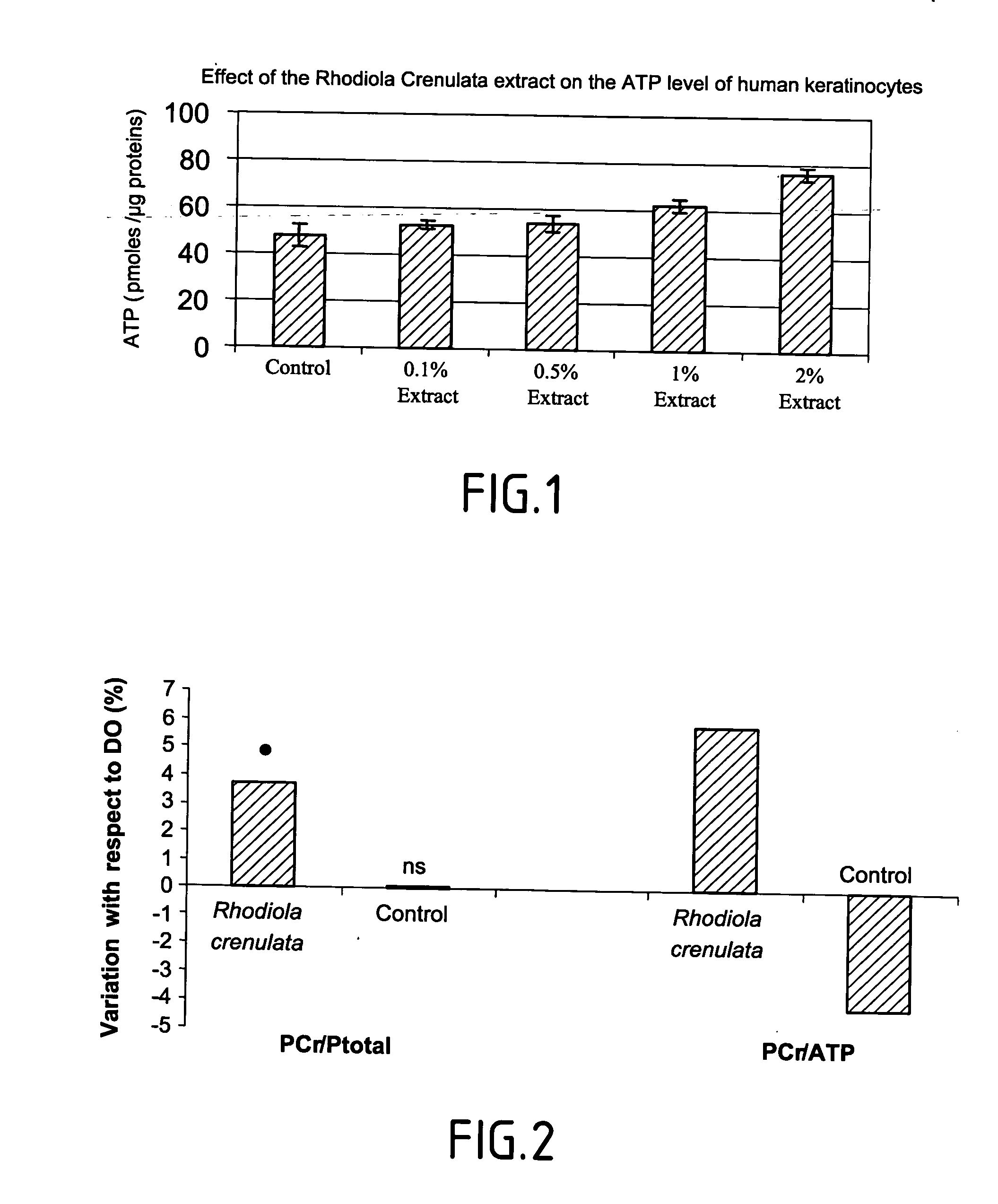
Figure 1 
Figure 2
Abstract
Description
The invention relates to the use of a Rhodiola crenulata extract, via the topical route, for increasing the energy metabolism of the cutaneous tissues of a subject. STATE OF THE ART It is known that this family of plants, which is also called Rhodiola, grows in altitude, in an environment which is unfavorable even hostile, and that it possesses adaptogenic properties. The extracts of Rhodiola have been used via the oral route, in the form of alcoholic drinks for multiple applications: effects on the cardiovascular system, effects on the memory, anti-histaminic effects, etc. . . . , without the effects being studied well from a biological mechanistic point of view. Furthermore, the effects have been described mainly about Rhodiola rosea, Rhodiola kirilowii and Rhodiola sachalinensis, since Rhodiola crenulata is a plant which is relatively difficult to find, it only grows on the high Tibetan plateaux, and, due to this, has been the subject of only very few studies up to now. Furthe...
Examples
example 1
Preparation of a Rhodiola crenulata Extract
A Rhodiola crenulata extract was made from roots which were cut, and then ground into a powder. The powder obtained was mixed with ethanol in order to obtain a 10% (w / w) solution in ethanol. This solution was brought to reflux. The extraction was carried out for 1 hour, and the solution was then brought to ambient temperature and was filtered, and the ethanol was removed. The result was dissolved at 5% (w / w) in a water / glycol 75 / 25 (w / w) mixture, and was then ultrafiltered on a ceramic filter having various cut-off thresholds, and was then finally filtered at 0.45 μm.
0.1% of methyl paraben, used as preservative, was then added last in the presence or not of a xanthan gel.
example 2
Preparation of a Rhodiola crenulata Extract
A Rhodiola crenulata extract was made from roots which were cut, and then ground into a powder. The powder obtained was mixed with cyclohexane in order to obtain a 10% (w / w) solution in cyclohexane. This solution was brought to reflux. The extraction was carried out for 24 hours, and the solution was then brought to ambient temperature and was filtered, and the cyclohexane was removed. The result was dissolved at 5% (w / w) in a water / glycol 75 / 25 (w / w) mixture, and was then ultrafiltered on ceramic filters having various cut-off thresholds, and was then finally filtered at 0.45 μm.
0.1% of methyl paraben, used as preservative, was then added last in the presence or not of a carbomer gel.
example 3
Preparation of a Rhodiola crenulata Extract
A Rhodiola crenulata extract was made from roots which were cut, and then ground into a powder. The powder obtained was mixed in a solvent made up of 75% water and 25% butylene glycol, in order to obtain a 10% (w / w) solution in the solvent. Soaking was allowed for 1 night at 45° C., and the solution was then ultrafiltered on ceramic filters having various cut-off thresholds, and was then finally filtered at 0.45 μm.
0.1% of methyl paraben, used as preservative, was then added last in the presence or not of a cellulose gel.