
Nucleotide analogs
a technology of nucleotide analogs and analogs, applied in the field of nucleotide analogs, can solve the problems of difficult simultaneous resolution and chemical specificity needed to resolve individual detectably labeled bases, and limited read-length, so as to increase the resolving power of scanned probe microscopy, reduce background noise, and reduce steric hindrance to polymerizing agents.
Patent Information
- Authority / Receiving Office
- US · United States
- Current Assignee / Owner
- Publication Date
- 2007-05-24
- Estimated Expiration
- Not applicable · inactive patent
Smart Images
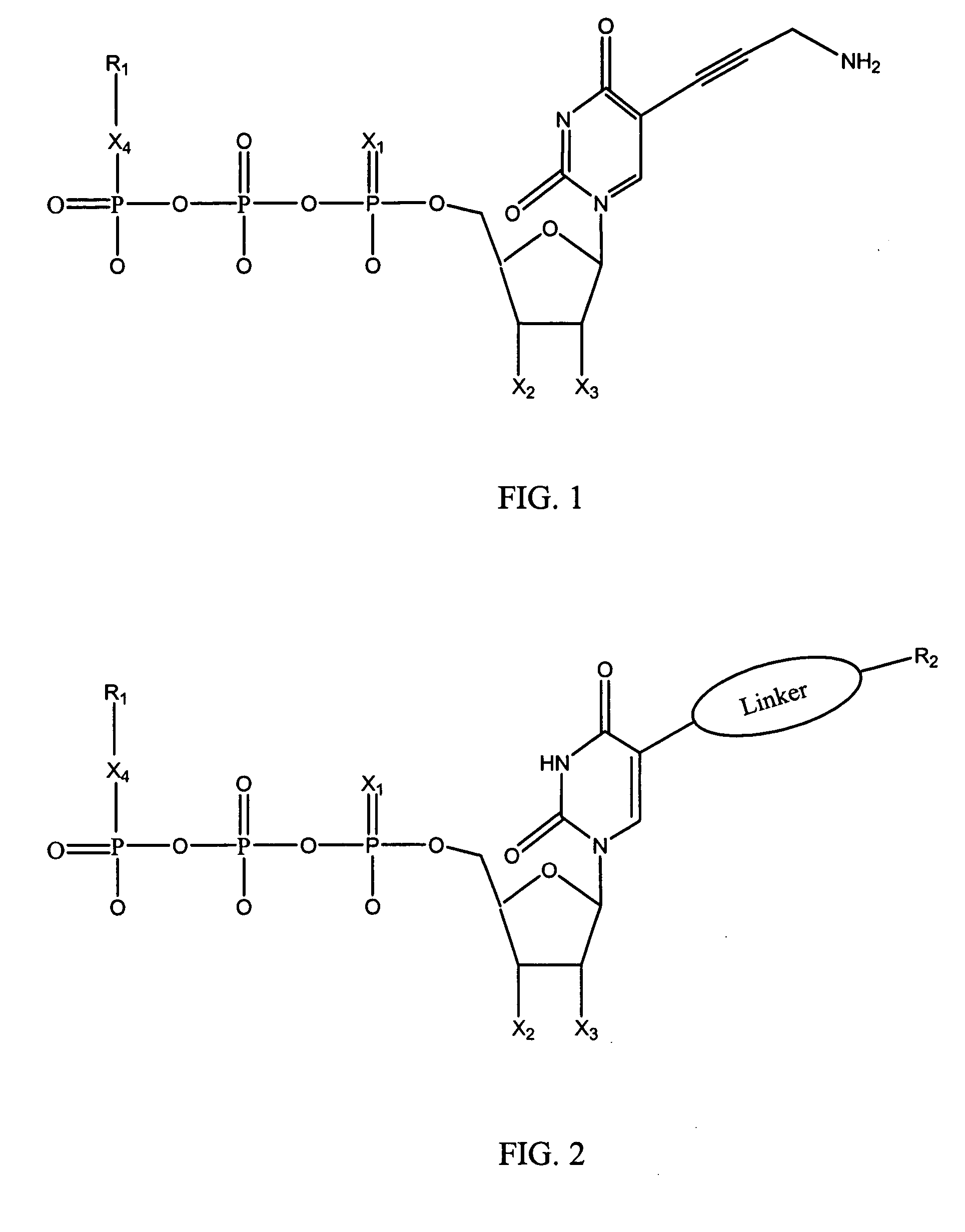
Figure 1 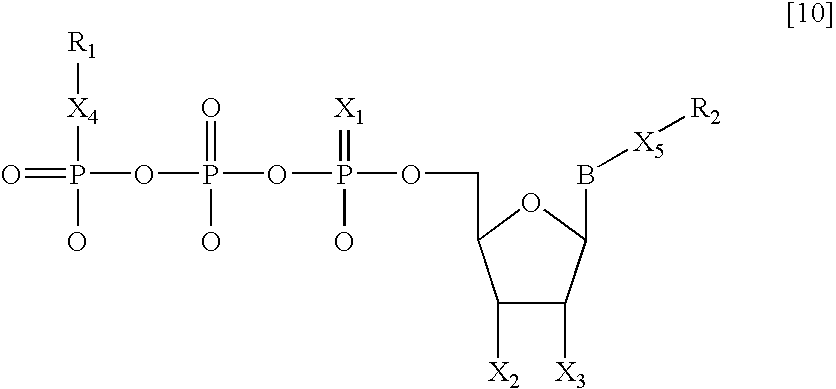
Figure 2 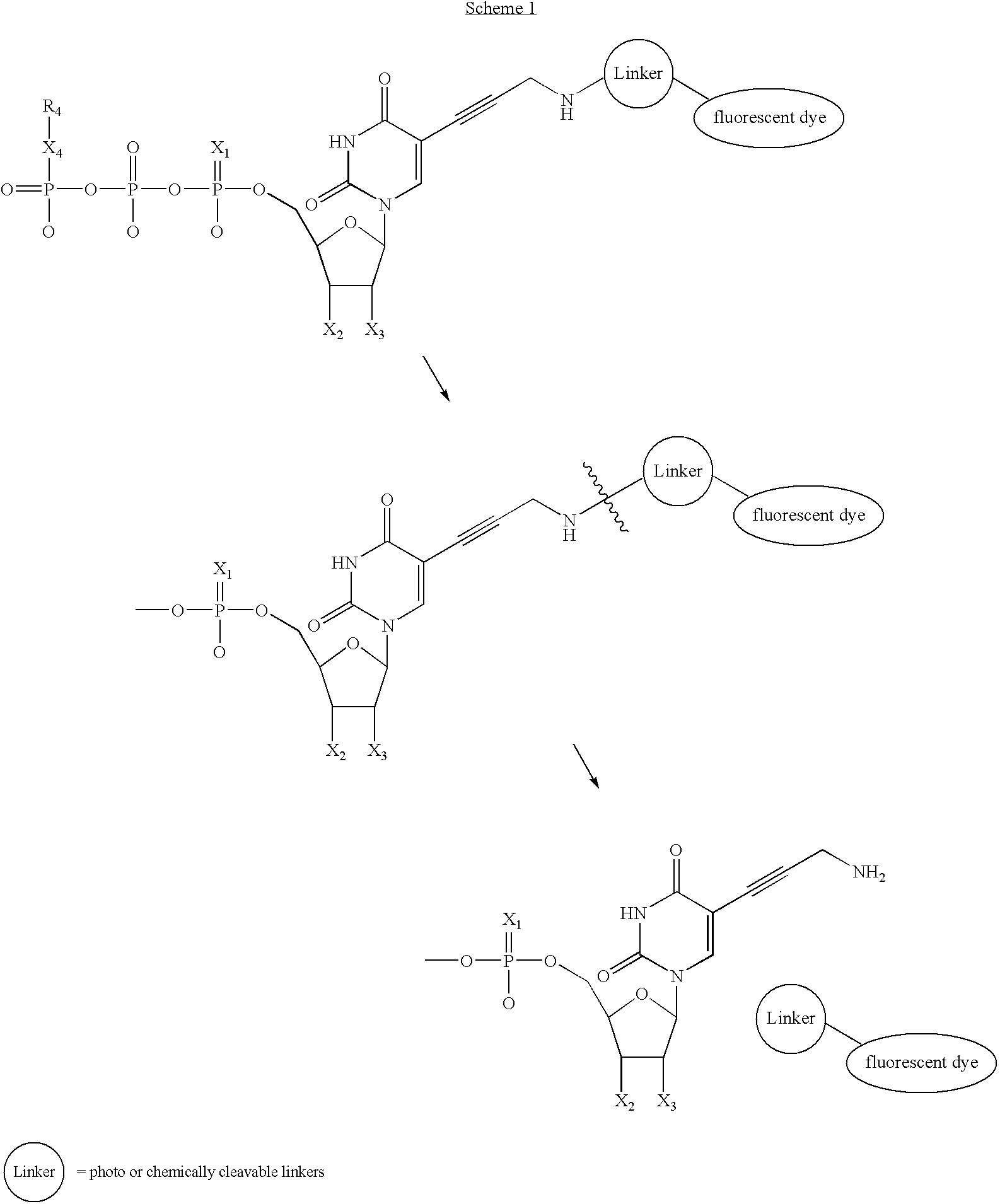
Figure 3
Abstract
Description
FIELD OF THE INVENTION
[0001] The invention relates to nucleotide analogs and methods for sequencing a nucleic acid using the nucleotide analogs. BACKGROUND
[0002] There have been many proposals to develop new sequencing technologies based on single-molecule measurements. For example, sequencing strategies have been proposed that are based upon observing the interaction of particular proteins with DNA or by using ultra high resolution scanned probe microscopy. See, e.g., Rigler, et al., J. Biotechnol., 86(3):161 (2001); Goodwin, P. M., et al., Nucleosides & Nucleotides, 16(5-6):543-550 (1997); Howorka, S., et al., Nature Biotechnol., 19(7):636-639 (2001); Meller, A., et al., Proc. Nat'l. Acad. Sci., 97(3):1079-1084 (2000); Driscoll, R. J., et al., Nature, 346(6281):294-296 (1990).
[0003] Recently, sequencing by synthesis methodology has been proposed that resulted in sequence determination, but not with consecutive base incorporation. See, Braslavsky, et al., Proc. Nat'l Acad. Sci.,...
Examples
example
[0054] The 7249 nucleotide genome of the bacteriophage M13mp18 is sequenced using nucleotide analogs of the invention.
[0055] Purified, single-stranded viral M13mp18 genomic DNA was obtained from New England Biolabs. Approximately 25 ug of M13 DNA was digested to an average fragment size of 40 bp with 0.1 U Dnase I (New England Biolabs) for 10 minutes at 37° C. Digested DNA fragment sizes were estimated by running an aliquot of the digestion mixture on a precast denaturing (TBE-Urea) 10% polyacrylamide gel (Novagen) and staining with SYBR Gold (Invitrogen / Molecular Probes). The DNase I-digested genomic DNA was filtered through a YM10 ultrafiltration spin column (Millipore) to remove small digestion products less than about 30 nt. Approximately 20 pmol of the filtered DNase I digest was then polyadenylated with terminal transferase according to known methods (Roychoudhury, R and Wu, R. 1980, Terminal transferase-catalyzed addition of nucleotides to the 3′ termini of DNA. Methods Enzy...