
Novel pyrone-indole derivatives and process for their preparation
Patent Information
- Authority / Receiving Office
- US · United States
- Current Assignee / Owner
- Publication Date
- 2008-01-31
Smart Images
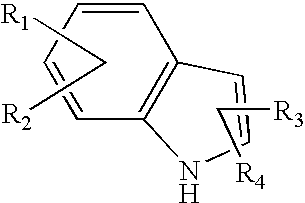
Figure 1 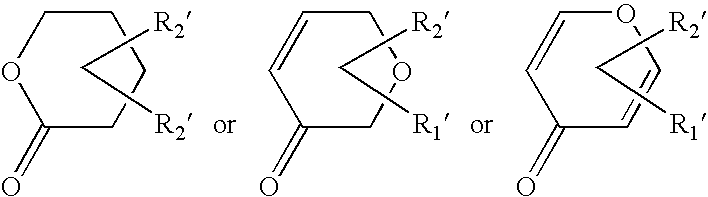
Figure 2 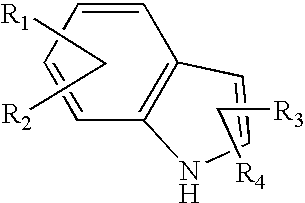
Figure 3
Abstract
Description
[0001] This application claims priority from U.S. patent application 60 / 773,322, filed Feb. 15, 2006. This application is incorporated herein by reference.BACKGROUND OF THE INVENTION
[0002] The alpha and gamma-pyrones are classes of compounds shown to be linked to several behavioral and pharmacological characteristics including sedative, anxiolytic, neuroprotective and antioxidative effects. Specifically, a gamma-pyrone derivative called maltol has been isolated from passion flower and shown to cause central nervous system (CNS) sedation and a reduction in caffeine-induced agitation and spontaneous motility in animals; these effects are mediated via activation of gamma-aminobutyric acid (GABA) receptors (Soulimani et al., J. Ethnopharmacology 57:11, 1997; Dhawan et al., J. Ethnopharmacology 78: 165-70, 2001). Other members of this family, the gamma-pyrones comenic, meconic and chelidonic acids have been shown to exert sedative effects via interaction with opiod receptors (U.S. Paten...
Examples
example 1
N-[2-(5-methoxy-indol-3-yl)-ethyl]-commenamide
[0067]
Reaction Scheme for the synthesis of the synthesis of N-[2-(5-methoxy-indole-3-yl)-ethyl]-commenamide
[0068]
General procedure of the synthesis of N-[2-(5-methoxy-indole-3-yl)-ethyl]-commenamide
[0069] Under an argon atmosphere, a 100 ml three-necked flask round-bottom flask was charged with comenic acid (560 mg, 1 equiv.) and 5-methoxytryptamine (750 mg, 1.1 equiv.), dissolved in DMF (20 ml), and brought to 0° C. by means of an ice-bath. HOBt (1-hydroxybenxotriazole monohydrate, 535 mg, 1.1 equiv.), EDC (1-(3-dimethylaminopropyl)-3-ethylcarbodiimide hydrochloride, 760 mg, 1.1 equiv.) and triethylamine (1.25 ml, 2.5 equiv.) were then added with magnetic stirring. The mixture was stirred for an additional 15 minutes at 0° C. and subsequently allowed to react for 48 h at room temperature. Water (25 ml) was then added and the mixture was extracted thoroughly with dichloromethane (6×30 ml). The combined organic phases were dried over N...
example 2
O-[2-(5-methoxy-indole-3-yl)-ethyl]-comenic ester
[0073]
Reaction Scheme for the synthesis of O-[2-(5-methoxy-indol-3-yl)-ethyl]-comenic ester
[0074]
[0075] Under an argon atmosphere, a 100 ml three-necked round-bottom flask was charged with comenic acid (300 mg, 1 equiv.) and 5-methoxytryptophol (365 mg, 1 equiv.) dissolved in CH2Cl2 / DMF (10 / 5 ml, respectively). DDC (dicyclohexylcarbodiimide, 435 mg. 1.1 equiv.) and DMAP (4-dimethylaminopyridine, 45 mg, 0.2 equiv.) were then added with magnetic stirring. After the mixture was stirred for 16 hours at room temperature, the white precipitate that formed was discarded by filtration through a Buchner funnel. From the clear filtrate, the solvent was removed by rotary evaporation. The crude was then chromatographed over a silica gel column by eluting with 250 ml of CH2Cl2 followed by dichloromethane / methanol 97 / 3. Fractions containing the product were combined and concentrated and the resulting solid was recrystallized from cyclohexane / ethy...
example 3
N-[2-5-methoxy-indol-3-yl)-ethyl]-chelidonamide
[0079]
Reaction Scheme for the synthesis of N-[2-(5-methoxy-indole-3-yl)-3-ethyl]-chelidonamide
[0080]
General Procedure for the synthesis of N-[2-(5-methoxy-indol-3-yl)-ethyl]-chelidonamide
[0081] In a 100 ml four-necked round-bottom flask kept under an argon atmosphere 5-methoxytryptamine (350 mg, 1.1 equiv.) was dissolved in 10 ml of DMF. Under magnetic stirring chelidonic acid (310 mg, 1.1 equiv) was added. The resulting solution was brought to 0° C. by means of an ice-bath and HOBt (1-hydroxybenxotriazole monohydrate, 250 mg, 1.1 equiv.), EDC (1-(3-dimethylaminopropyl)-3-ethylcarbodiimide hydrochloride, 350 mg, 1.1 equiv.) and triethylamine (0.6 ml, 2.5 equiv.) were then added under magnetic stirring. The mixture remained stirring for an additional 15 minutes at 0° C. and was subsequently allowed to react for 48 h at room temperature. The reaction course was followed by HPLC-MS. Precipitated materials were removed by filtration. Wat...