

Silicone adhesive for semiconductor element
a silicon adhesive and semiconductor technology, applied in the direction of non-macromolecular adhesive additives, transportation and packaging, layered products, etc., can solve the problems of deterioration in light extraction efficiency, deterioration in light reflection efficiency, and reduction in brightness, so as to achieve effective reflection of light emitted, improve light extraction efficiency, and high degree of concealment
Patent Information
- Authority / Receiving Office
- US · United States
- Patent Type
- Applications(United States)
- Current Assignee / Owner
- Publication Date
- 2009-10-15
- Estimated Expiration
- Not applicable · inactive patent
Smart Images
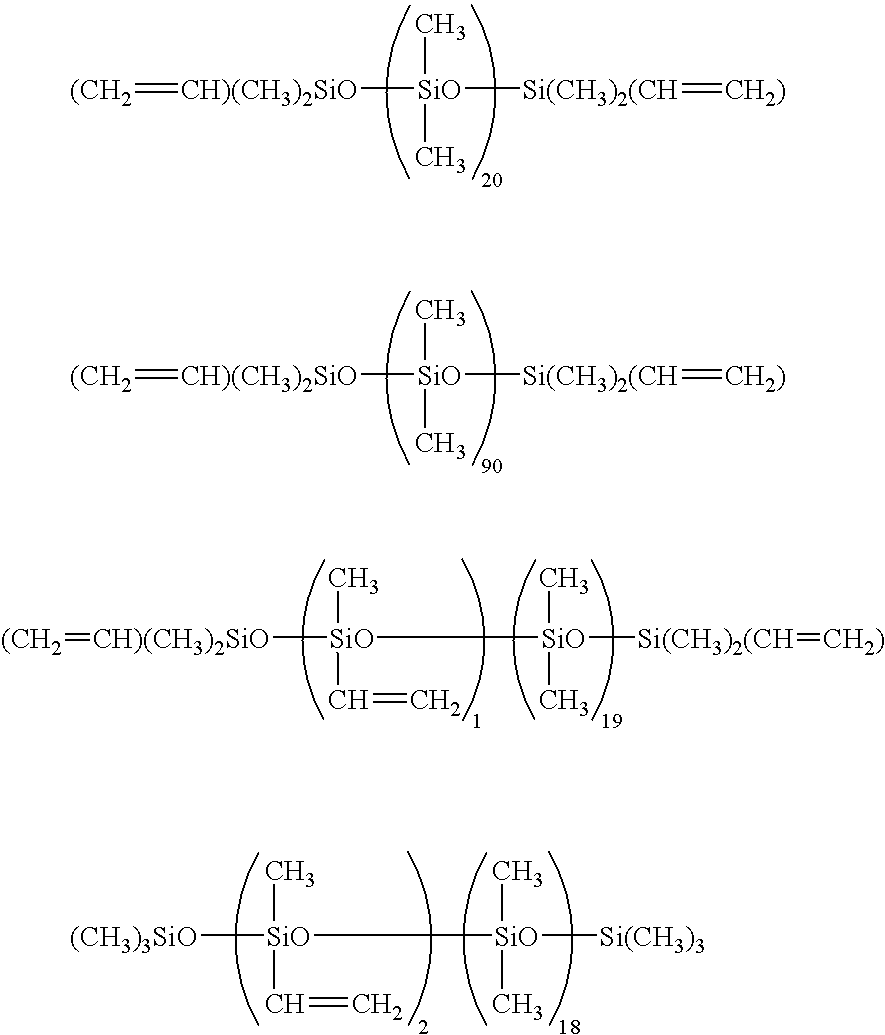
Figure 1 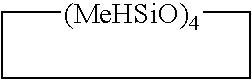
Figure 2 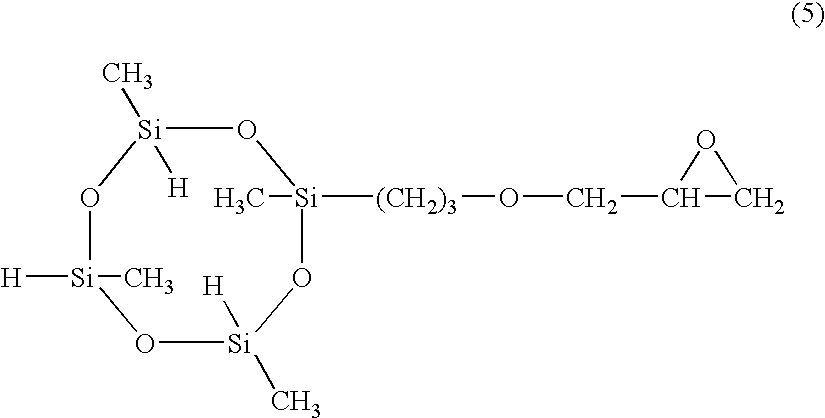
Figure 3
Abstract
Description
BACKGROUND OF THE INVENTION
[0001] 1. Field of the Invention
[0002] The present invention relates to a white die bonding material that is suitable for fixing a light emitting diode (LED) chip to a gold-plated substrate. More specifically, the invention relates to a heat-curable silicone adhesive for a semiconductor element that produces favorable chip positioning properties when a chip is pressed onto a substrate, exhibits high levels of concealment and adhesive strength, displays excellent durability, and effectively reflects light emitted from the chip.
[0003] 2. Description of the Prior Art
[0004] Epoxy resins have conventionally been used as the die bonding material for fixing LED light emitting elements (chips). However, die bonding materials used for fixing blue or white LED light emitting elements (chips) tend to yellow over time upon extended use, and in a similar manner to that observed for epoxy encapsulating materials, the die bonding material tends to absorb light, causing a red...
Examples
example 1
[0070](1) A linear dimethylpolysiloxane (A1) with both terminals blocked with vinyl groups and having a viscosity at 25° C. of 70 mPa·s,
[0071]a toluene solution of a silicone resin (B1) composed of Me3SiO1 / 2, ViMe2SiO1 / 2 (wherein Vi represents a vinyl group, this definition also applies below) and SiO4 / 2 units, with a molar ratio of the combination of the Me3SiO1 / 2 and ViMe2SiO1 / 2 units relative to the SiO4 / 2 units of 0.8, and having an amount of vinyl groups relative to the solid fraction of 0.085 mols / 100 g, and
[0072]a methylhydrogensiloxane (C1) of the above average composition formula (2): R4aHbSiO(4−a−b) / 2 wherein R4 represents a methyl group, a=1.44 and b=0.78, with both terminals blocked with trimethylsiloxy groups, and having a viscosity at 25° C. of 7.5 mPa·s
[0073]were mixed together in a solid fraction equivalent mass ratio of 25:75:10. The toluene was removed from the resulting mixture by treatment at 120° C. under a reduced pressure of not more than 10 mmHg, thereby yiel...
example 2
[0075]The silicone base 1 was prepared in the same manner as example 1, and to 100 parts by mass of this silicone base 1 were added 50 parts by mass of the same titanium oxide powder (b1) used in example 1, 90 parts by mass of an alumina powder (c2) having an average particle size of 4.0 μm (product name: AL-43PC, manufactured by Showa Denko K.K.), and the same platinum catalyst (D1) used in example 1, in sufficient amount to provide the equivalent of 10 ppm of platinum atoms relative to the silicone component. The mixture was then stirred thoroughly, and 3 parts by mass of a hydrocarbon solvent with a boiling point of at least 200° C. was added, yielding a white paste with a viscosity of 20 Pa·s.
example 3
[0076]A mixture containing 45.8 g of vinylmethyldichlorosilane, 111.0 g of phenyltrichlorosilane (molar ratio 38:62) (average composition of mixture: (CH3)0.38(C6H5)0.62(CH2═CH)0.38SiO1.31) and 20 g of toluene was added gradually, in a dropwise manner, to a mixture of 120 g of toluene and 320 g of water being stirred inside a flask, with the addition controlled so that the temperature inside the flask did not exceed 50° C., thereby effecting a cohydrolysis. A polycondensation was then conducted by continuing the reaction at not more than 70° C. for two hours, thus forming a toluene solution of a three dimensional network structure organopolysiloxane (silicone resin) (P1) that exhibited a non-volatile component of 70% when heated for 30 minutes at 150° C. The solid fraction (P1) within this solution existed in a non-fluid gum-like state at 25° C. This organopolysiloxane solution was stripped for one hour under conditions of 80° C. and 15 mmHg, and to 100 parts by mass of the resultin...