
Vectors for generating pluripotent stem cells and methods of producing pluripotent stem cells using the same
a technology of stem cells and vectors, applied in the field of new cells, can solve the problems of tissue rejection, heterogeneous cells cannot be used, tissue stem cell regeneration potential is often limited, etc., and achieve the effect of facilitating reprogramming of differentiated cells, eliminating the risk of foreign genes being inserted, and improving safety
Patent Information
- Authority / Receiving Office
- US · United States
- Patent Type
- Applications(United States)
- Current Assignee / Owner
- Publication Date
- 2010-12-09
Smart Images
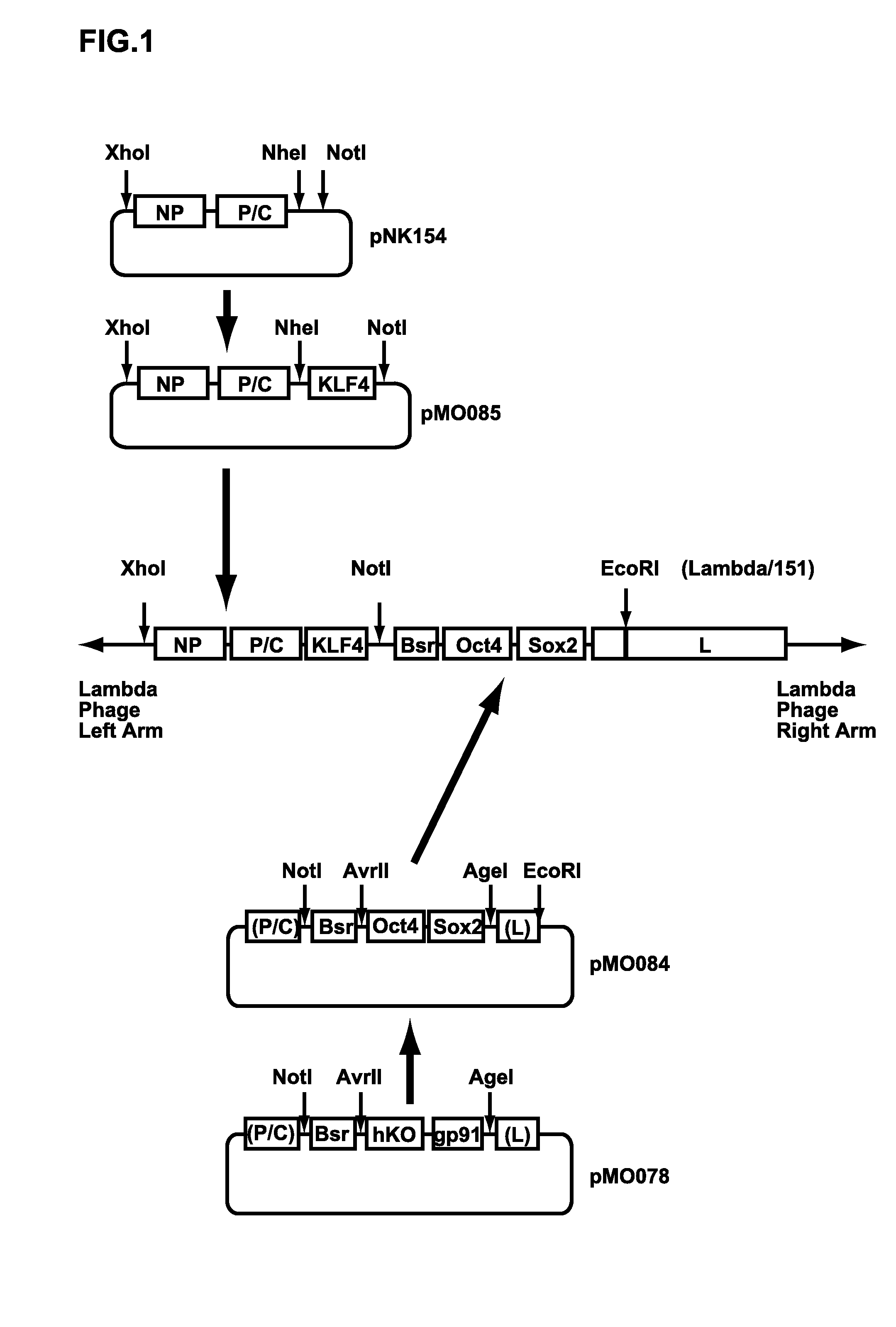
Figure 1 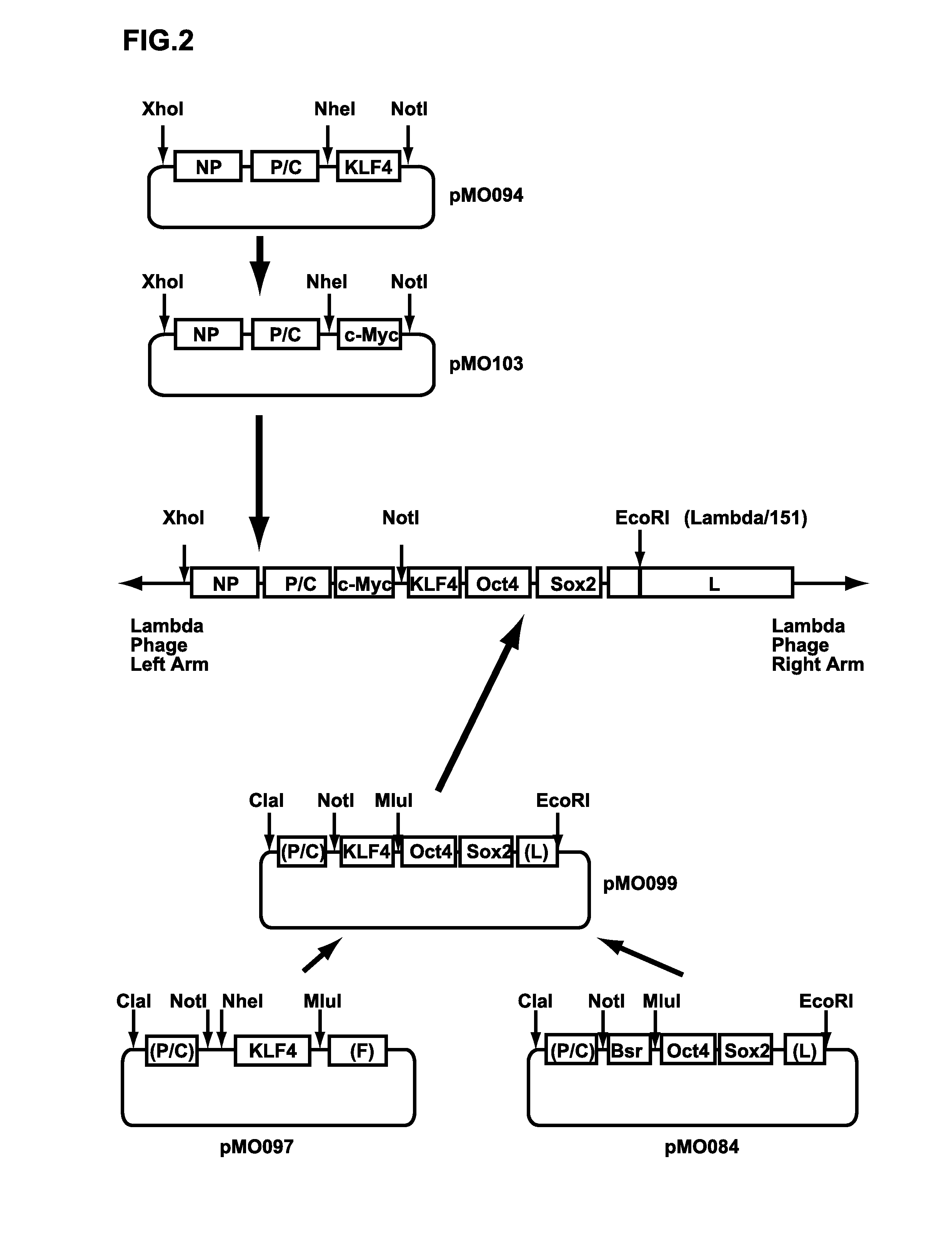
Figure 2 
Figure 3
Abstract
Description
RELATED APPLICATION
[0001] The application claims the benefit of U.S. Provisional patent application No. 61 / 183,724 filed on Jun. 3, 2009 and the International PCT application PCT / JP2010 / 058368 filed on May 18, 2010. The teachings of both of these priority documents are hereby incorporated herein by reference in their entirety.BACKGROUND OF THE INVENTION
[0002] 1. Field of the Invention
[0003] The present invention relates to novel recombinant Sendai virus vector constructs for the reprogramming of differentiated somatic cells into induced pluripotent stem (iPS) cells
[0004] 2. Description of the Related Art
[0005] Along with the progression toward an aging society, diseases caused by tissue degeneration and damage are increasing rapidly. For example, diseases that increase in frequency with age include metabolic syndromes, such as cerebral infarction, cardiac infarction and renal failure, as well as diseases caused by age-related tissue degeneration, such as Alzheimer's disease, Parkinson's ...
Examples
example 1
Preparation of Cells for Constructing Sustained Expression-Type Sendai Viral Vectors
[0133]A cDNA (SEQ ID NO: 1 in the following Sequence Table) encoding T7 RNA polymerase where codons are optimized to improve expression in an animal cell, was cloned into a plasmid pCX4SRalpha-neo vector for preparing a retroviral vector. A cDNA encoding Sendai virus strain Cl.151 M protein was first cloned into a plasmid pCX4SRalpha-puro vector for preparing a retroviral vector. The plasmid DNAs were then introduced into respective PLAT-E packaging cells using Lipofectamine 2000, and retroviruses (T7 RNA polymerase recombinant retrovirus and 151M recombinant retrovirus) obtained from a culture supernatant. The T7 RNA polymerase recombinant retrovirus was transfected into BHK-21 cells. The infected BHK-21 cells were then transferred to a Dulbecco's Modified Minimal Essential Medium (DMEM) containing 800 μg / ml of G418 and 10% of fetal bovine serum (FCS), and G418-resistant cells (BHK / T7 (SE)) which st...
example 2
Preparation of hOct4 / hSox2 / hKlf4 Sustained Expression-Inducing Sendai Viral Vector
[0134](1) Construction of Template cDNA for Preparing Recombinant Sendai virus
[0135]A double-stranded DNA (SEQ ID NO: 2 in the Sequence Table) including Avr II recognition sequence, human Oct4 ORF, Sendai virus (SeV) genome cDNA (bases 6617 to 6666), human Sox2 ORF and Age I recognition sequence in this order was synthesized, and then cloned into the plasmid vector pUC57 (the cloning was achieved using GenScript Inc.) (pUC57-OctSox). A DNA sequence cut from the pUC57-OctSox at Avr II and Age I sites was inserted between Arv II and Age I sites of a plasmid vector pMO078 (SEQ ID NO: 3 in the Sequence Table) where Cla I recognition sequence, SeV strain Cl.151 genome cDNA (bases 2871 to 3650), Not I recognition sequence, a blasticidin S-resistance gene, Mlu I recognition sequence, SeV strain Cl.151 genome cDNA (bases 4728 to 4828), Avr II recognition sequence, humanized Kusabira-Orange gene, an SeV strain ...
example 3
Preparation of hOct4 / hSox2 / hKlf4 / hc-Myc Sustained Expression-Inducing Sendai Viral Vector
[0141](1) Preparation of Vector cDNA
[0142]A human Klf4 gene was amplified from the pUC57-KLF4 by a PCR method using two primers consisting of 5′-ACTAGCTAGCAGTCTGACATGGCTGTCAGCGACGCGCT-3′ (SEQ ID NO: 7 in the Sequence Table (N-terminal side)) and 5′-GGTCCACGCGTTTAAAAA TGCCTCTTCATGTG-3′ (SEQ ID NO: 8 in the Sequence Table (C-terminal side)) as hKlf4 gene-amplifying primers. The termini of the obtained double-stranded DNA were cut at Nhe I and Mlu I sites, and inserted between Nhe I and Mlu I sites of pMO026 (SEQ ID NO: 9 in the Sequence Table) (a plasmid vector where Cla I recognition sequence, SeV strain Cl.151 genome cDNA (bases 2871 to 3650), Not I recognition sequence, Nhe I recognition sequence, blasticidin S-resistance gene, Mlu I recognition sequence and SeV strain Cl.151 genome cDNA (bases 4728 to 5335) were inserted into pBluescript II SK(+)). In this manner, pMO097 was obtained. Furtherm...