

Liquid Crystal Composition and Liquid Crystal Display Device
Patent Information
- Authority / Receiving Office
- US · United States
- Current Assignee / Owner
- Publication Date
- 2011-01-06
Smart Images
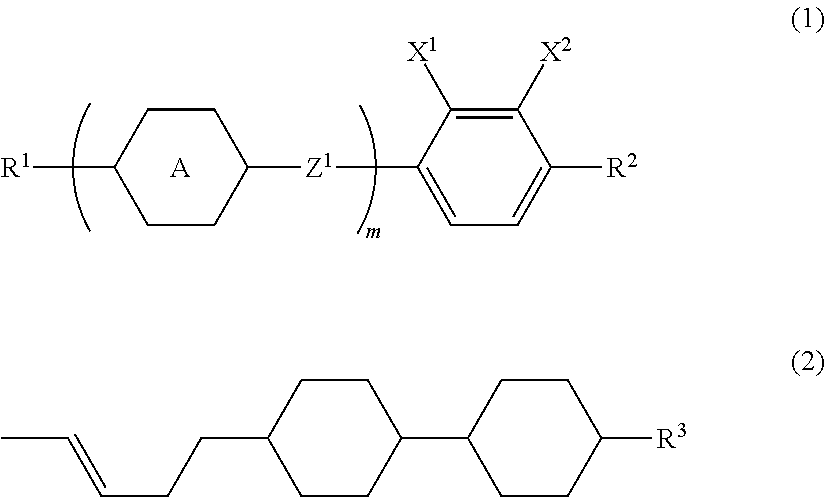
Figure 1 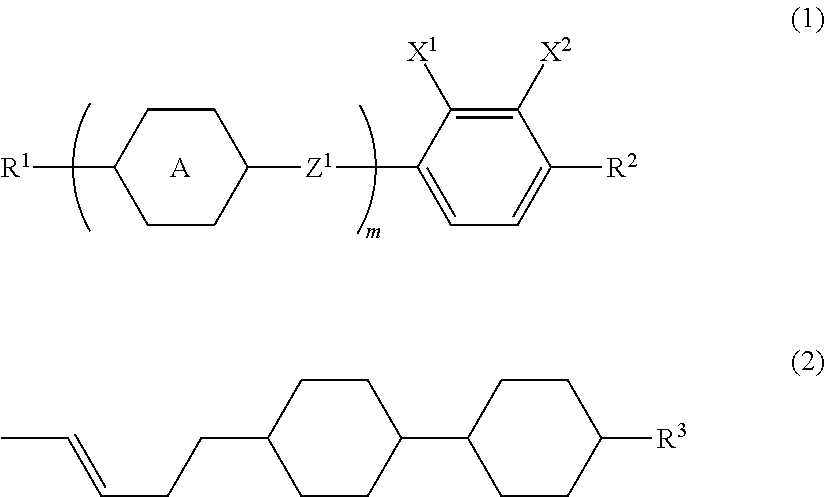
Figure 2 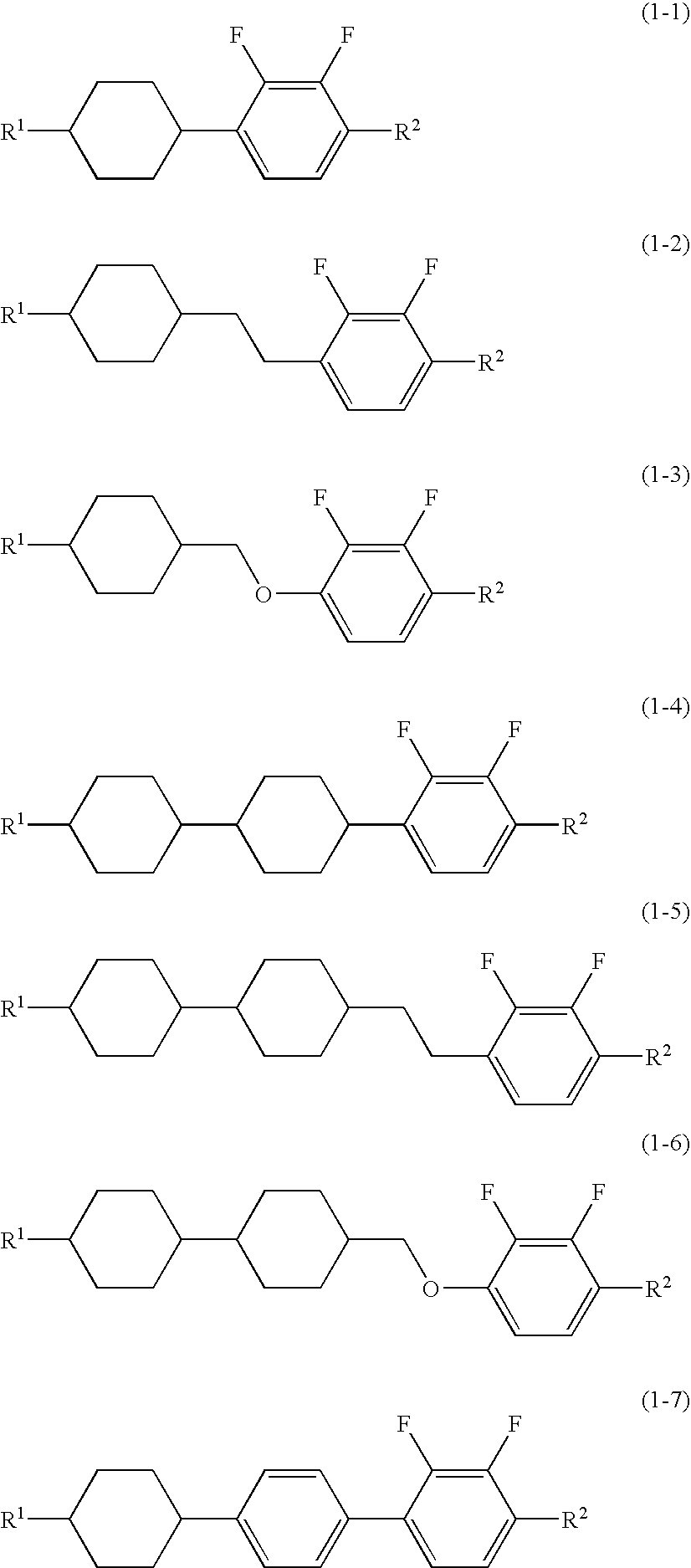
Figure 3
Abstract
Description
BACKGROUND OF THE INVENTION
[0001] 1. Field of the Invention
[0002] The invention relates mainly to a liquid crystal composition suitable for use in an active matrix (AM) device, and an AM device containing the composition. More specifically, the invention relates to a liquid crystal composition having a negative dielectric anisotropy, and a device having a mode such as IPS (in-plane switching), VA (vertical alignment) or PSA (polymer sustained alignment) containing the composition.
[0003] 2. Related Art
[0004] In a liquid crystal display device, a classification based on an operating mode for liquid crystals includes phase change (PC), twisted nematic (TN), super twisted nematic (STN), electrically controlled birefringence (ECB), optically compensated bend (OCB), in-plane switching (IPS), vertical alignment (VA), and polymer sustained alignment (PSA). A classification based on a driving mode in the device includes a passive matrix (PM) and an active matrix (AM). The PM is further classifie...
Examples
example 1
[0098]
3-H2B(2F,3F)-O2(1-2-1)12%5-H2B(2F,3F)-O2(1-2-1)11%V-HB(2F,3F)-O2(1-1-1) 4%3-HHB(2F,3F)-O2(1-4-1) 5%3-HBB(2F,3F)-O2(1-7-1)15%5-HBB(2F,3F)-O2(1-7-1) 5%1V2-HH-1(2-1)19%1V2-HH-2(2-1) 5%1V2-HH-3(2-1)10%V2-BB-1(3-1-2-1) 4%V-HHB-1(3-2-2-1)10%NI = 72.2° C.;Tc ≦−20° C.;Δn = 0.100;η = 19.1 mPa · s;Δε = −2.8;τ = 10.2 ms;Vth = 2.35 V;VHR-1 = 99.2%;VHR-2 = 98.0%;VHR-3 = 98.2%.
example 2
[0099]
3-HB(2F,3F)-O2(1-1-1)12% V-HB(2F,3F)-O4(1-1-1)5%3-H1OB(2F,3F)-O2(1-3-1)8%3-HH1OB(2F,3F)-O2(1-6-1)4%1V2-HH-1(2-1)20% 1V2-HH-3(2-1)8%3-HB-O2(3-1-1-1)7%1V2-BB-1(3-1-2-1)5%1V-HBB-2(3-2-3-1)4%2-BB(F)B-3(3-2-4-1)4%3-HHEBH-5(3-2-5-1)3%5-HB(F)BH-3(3-2-8-1)3%3-HDhB(2F,3F)-O2(4-1-5-1)8%3-HH2Cro(7F,8F)-5(4-2-3-2)3%3-HBCro(7F,8F)-5(4-2-3-4)3%3-BBCro(7F,8F)-5(4-2-3-5)3%NI = 71.0° C.;Tc ≦−20° C.;Δn = 0.106;Δε = −2.3;τ = 11.1 ms;VHR-1 = 99.1%;VHR-2 = 98.1%;VHR-3 = 98.2%.
example 3
[0100]
3-HBB(2F,3F)-O2(1-7-1)13% 1V2-HH-1(2-1)5%1V2-HH-3(2-1)6%7-HB-1(3-1-1-1)3%3-HHB-1(3-2-2-1)4%3-HHB-O1(3-2-2-1)4%1-BB(F)B-2V(3-2-4-1)6%3-HB(F)HH-5(3-2-6-1)4%5-HBB(F)B-2(3-2-9-1)3%5-DhB(2F,3F)-O2(4-1-1-1)5%3-Dh2B(2F,3F)-O2(4-1-2-1)5%5-DhHB(2F,3F)-O2(4-1-4-1)4%3-H2Cro(7F,8F)-5(4-2-1-1)3%3-H1OCro(7F,8F)-5(4-2-1-2)4%3-HHCro(7F,8F)-5(4-2-3-1)3%2-HH-3(—)28% NI = 80.8° C.;Tc ≦−20° C.;Δn = 0.095;η = 18.8 mPa · s;Δε = −2.3;τ = 10.6 ms;VHR-1 = 99.1%;VHR-2 = 98.1%;VHR-3 = 98.2%.