
Method for producing tolylene diisocyanate
a technology of tolylene diisocyanate and diisocyanate, which is applied in the preparation of isocyanic acid derivatives, isocyanic acid derivative purification/separation, organic chemistry, etc., can solve the problems of high toxicity, troublesome handling, and equipment corrosion, and achieves the effect of reducing the risk of contamination
Patent Information
- Authority / Receiving Office
- US · United States
- Patent Type
- Applications(United States)
- Current Assignee / Owner
- Publication Date
- 2014-03-13
Smart Images
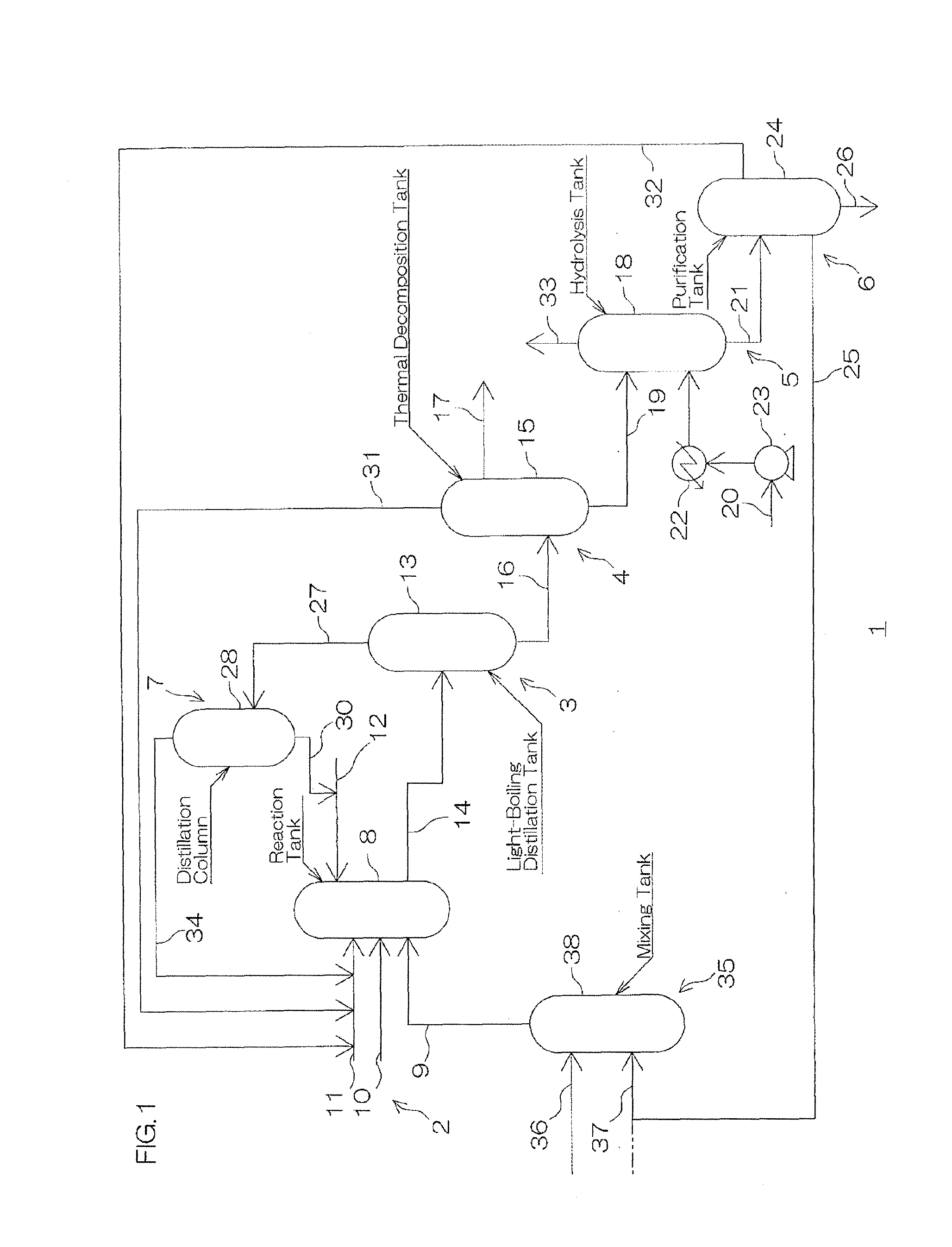
Figure 1
Abstract
Description
TECHNICAL FIELD
[0001] The present invention relates to a method for producing tolylene diisocyanate, and more particularly to a method for producing tolylene diisocyanate containing 2,4-tolylene diisocyanate and 2,6-tolylene diisocyanate at a desired isomer ratio.BACKGROUND ART
[0002] Tolylene diisocyanate is widely known as versatile isocyanate for use as a raw material for polyurethane, polyurea and the like.
[0003] Conventionally, tolylene diisocyanate has been industrially produced by reaction (phosgene method) between diaminotoluene and phosgene. However, phosgene has various problems such as being highly toxic and troublesome in handling, and requiring careful attention to corrosion of the equipment because it by-produces a large amount of hydrochloric acid. Accordingly, there is a need to develop industrial production methods for tolylene diisocyanate that can replace the phosgene method.
[0004] Generally known tolylene diisocyanate production methods that do not use phosgene includ...
Examples
preparation example 1
(Carbamate Producing Step)
[0217]A 1-liter SUS autoclave equipped with a pressure control valve, a reflux condenser, a gas-liquid separator, and a stirrer was charged with a first diaminotoluene (2,4-diaminotoluene / 2,6-diaminotoluene=80 / 20 (molar ratio)) (122 g: 1 mol), butyl carbamate (333 g: 2.85 mol) and 1-butanol (211 g: 2.85 mol), and zinc p-toluenesulfonate (1.0 g: 2.5 mmol) as a catalyst. These were stirred at 500 rpm with a nitrogen gas allowed to flow at 1 liter per minute, while the internal pressure was controlled to maintain the reaction temperature at 200° C. by the pressure control valve, and were allowed to react for eight hours to give a reaction solution.
[0218]A portion of the reaction solution was sampled and quantified, and as a result it was confirmed that tolylene dicarbamate was obtained at a yield of 95 mol % as the total amount of 2,4-bis(butoxycarbonylamino)toluene (2,4-tolylene dicarbamate) and 2,6-bis(butoxycarbonylamino)toluene (2,6-tolylene dicarbamate).
(...
example 1
[0227]Mixed diaminotoluene was obtained by mixing 100 g of first diaminotoluene (2,4-diaminotoluene / 2,6-diaminotoluene=80 / 20 (molar ratio)) and 21 g of decomposed diaminotoluene (2,4-diaminotoluene / 2,6-diaminotoluene=95 / 5 (molar ratio)) produced in Preparation Example 1 as a second diaminotoluene (mixing step).
[0228]The isomer ratio of the obtained mixed diaminotoluene was 2,4-diaminotoluene / 2,6-diaminotoluene=82.6 / 17.4 (molar ratio).
[0229]Tolylene dicarbamate was produced in the same manner as in Preparation Example 1, except that the mixed diaminotoluene was used in place of the first diaminotoluene. It was confirmed that tolylene dicarbamate was obtained at a yield of 95 mol % as the total amount of 2,4-bis(butoxycarbonylamino)toluene (2,4-tolylene dicarbamate) and 2,6-bis(butoxycarbonylamino)toluene (2,6-tolylene dicarbamate).
[0230]Also, vacuum distillation of light-boiling fractions was performed in the same manner as in Preparation Example 1, except that the obtained tolylene ...
example 2
[0234]Tolylene dicarbamate was produced in the same manner as in Example 1, except that 27 g of the decomposed diaminotoluene (second diaminotoluene) obtained in Preparation Example 1 was blended with 100 g of the first diaminotoluene. It was confirmed that tolylene dicarbamate was obtained at a yield of 95 mol % as the total amount of 2,4-bis(butoxycarbonylamino)toluene (2,4-tolylene dicarbamate) and 2,6-bis(butoxycarbonylamino)toluene (2,6-tolylene dicarbamate).
[0235]The isomer ratio of the mixed diaminotoluene was 2,4-diaminotoluene / 2,6-diaminotoluene=83.2 / 16.8 (molar ratio).
[0236]Also, vacuum distillation of light-boiling fractions was performed in the same manner as in Example 1, except that the obtained tolylene dicarbamate was used, and then the obtained concentrate was thermally decomposed to give tolylene diisocyanate and a filter residue.
[0237]The yield of the obtained tolylene diisocyanate was quantified by HPLC and found to be 99.1 mol % with respect to the first diamino...