

Co-catalysts for polyurethane cold box binders
Patent Information
- Authority / Receiving Office
- US · United States
- Current Assignee / Owner
- Publication Date
- 2017-06-15
- Estimated Expiration
- Not applicable · inactive patent
Smart Images
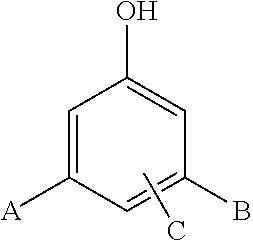
Figure 1 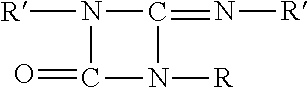
Figure 2
Abstract
Description
[0001] The present invention relates to a binder system containing blocked tertiary amines or amidines as co-catalysts for a polyurethane cold box application. It also relates to the molding material mixtures produced using such a binder system further comprising volatile tertiary amines, a method for producing the molding material mixtures, and the cores and molds made from the molding material mixtures according to the cold box process.PRIOR ART AND PROBLEM OF THE INVENTION
[0002] Casting mold materials are essentially composed of molds or molds and cores, which form the negative shape of the casting to be produced. As a rule, these molds and cores are made of molding mixtures comprising in content at least one refractory material, for example quartz sand, as a refractory molding basic material and a suitable binder or a binder precursor, which imparts adequate mechanical strength to the casting mold after its removal from the molding tool. The molding mixture is filled into a suitab...
Examples
experiment 1
[0108]Amine requirement: To 200 parts by weight (PW) quartz sand H32 (Quarzwerke Frechen) were added successively 0.6 PW each of the phenol resin solutions listed in Table 1 (all values given in PW) and the polyisocyanate components listed in Table 2 (all values given in PW) and mixed intensively in a laboratory mixer (Vogel and Schemmann AG). After the mixture had been mixed for 2 minutes, the molding material mixtures were transferred to the holding tank of a core shooting machine (Röperwerke Gieβereimaschinen GmbH) and from there introduced using compressed air (4 bar) into a cylindrical molding tool of 300 mm length and 50 mm diameter. Then 0.1 ml dimethylpropylamine (2 bar pressure, followed by 10 sec. flushing with air) were passed through the mold Immediately after the flushing, the mold was opened and the fraction of non-hardened molding material was removed. Then weighing was used to determine how much molding material mixture had been cured by the predetermined quantity of...
experiment 2
[0111]First, molding material mixtures were produced as described in Experiment 1, part of them transferred to the holding tank of a core shooting machine, and from there introduced into a molding tool to produce so-called Georg Fischer test pieces. These are ashlar-shaped test pieces with dimensions of 220 mm×22.36 mm×22.36 mm. The molds were hardened by sparging with 0.5 ml dimethylpropylamine (2 bar pressure, followed by 10 sec. flushing with air). To determine the bending strengths, after predetermined times (30 sec. or 24 h after they were produced) the test pieces were placed in a Georg Fischer strength testing device, equipped with a three-point bending device (Simpson Technologies GmbH) and the strength leading to breakage of the test piece was measured.
[0112]The results are likewise listed in Tab. 3. It is apparent that the presence of a co-catalyst has no effect on the strength.
TABLE 3Notaccording toinventionaccording to inventionA1 / B1A1 / B2A2 / B1A2 / B2A3 / B1A3 / B2hardened72462...