
Method of Producing Carbon Nanotubes in Fluidized Bed Reactor
a technology of carbon nanotubes and fluidized beds, which is applied in the direction of physical/chemical process catalysts, metal/metal-oxide/metal-hydroxide catalysts, chemical instruments and processes, etc., can solve the problems of complex effects of carbon nanotube formation, high cost of carbon nanotubes, and inability to produce carbon nanotubes in time, so as to improve yield and purity
Patent Information
- Authority / Receiving Office
- US · United States
- Current Assignee / Owner
- Publication Date
- 2018-12-13
Smart Images
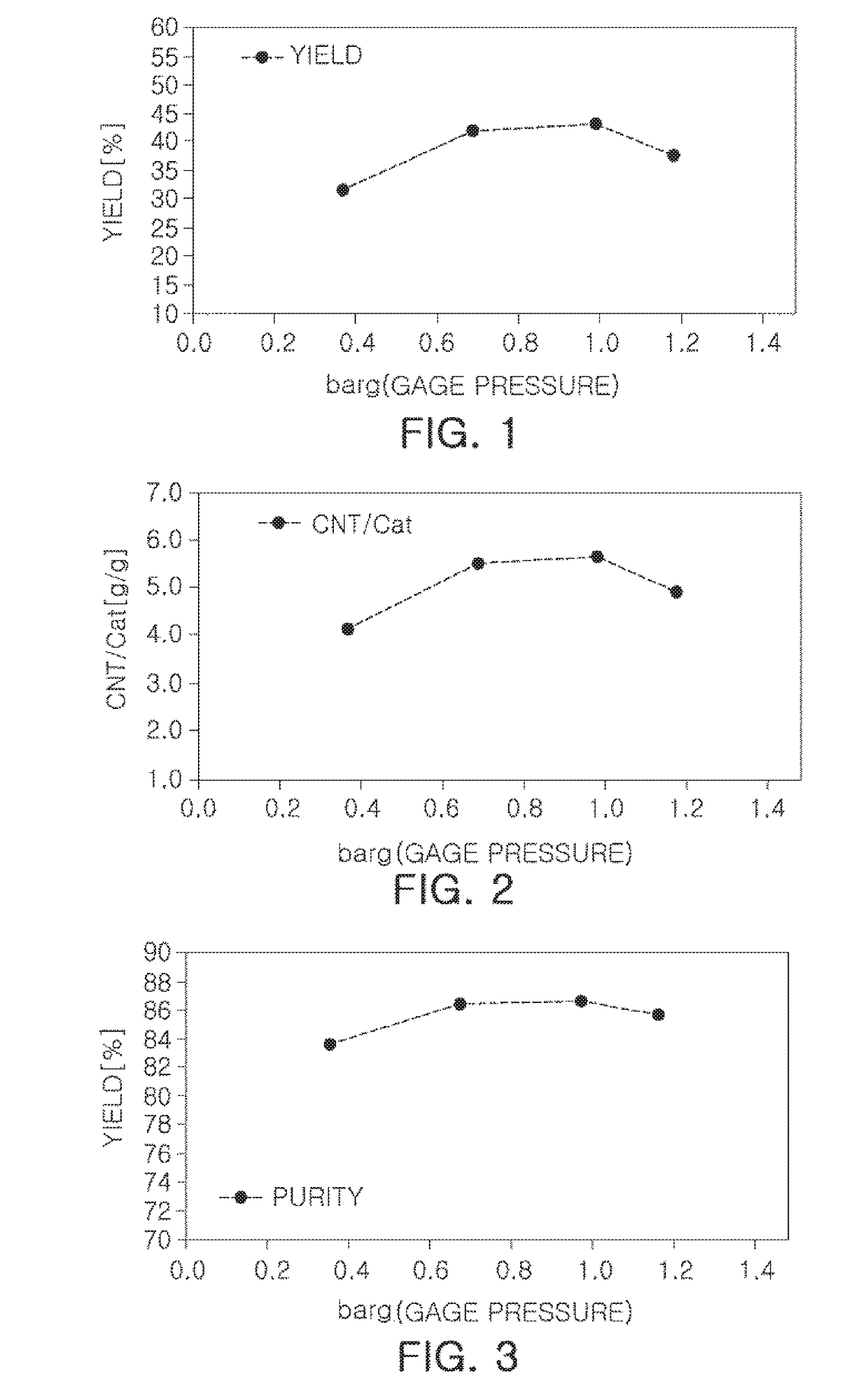
Figure 1
Abstract
Description
CROSS-REFERENCE TO RELATED APPLICATION
[0001] This application claims priority to Korean Patent Application No. 10-2017-0071867 filed Jun. 8, 2017, the disclosure of which is hereby incorporated in its entirety by reference.BACKGROUND OF THE INVENTIONField of the Invention
[0002] The present disclosure relates to a method of producing carbon nanotubes in a fluidized bed reactor.Description of Related Art
[0003] Carbon nanotubes have very low resistance values due to one-dimensional structure and an electrical structure thereof, inherent to graphite. For example, the resistance value of single-wall carbon nanotubes is only 1 / 100 of that of copper. In addition, the current carrying capacity of carbon nanotubes has a unique electrical characteristic, being 1,000 times that of copper. Furthermore, carbon nanotubes have an sp2 bond between carbon and carbon, and thus, have relatively high stiffness and strength. Carbon nanotubes are characterized in that the degree of thermal conductivity ther...
Examples
embodiment
[0035]As a catalyst, 90 g of iron-cobalt alloy having a diameter of 130 μm and a density of 1300 kg / m3 were put into a fluidized bed reactor, and the inside of the fluidized bed reactor was heated to 690° C. As a result, an initial temperature of the catalyst was 690° C. Ethylene gas was fed to the fluidized bed reactor, at a temperature of 530° C., and the reaction was performed for 30 minutes, while controlling a fluidization rate thereof in the fluidized bed reactor to be at 26 cm / s. For smooth fluidization, 250 g of carbon nanotubes prepared by the same method were filled, and the catalyst was filled to maintain the same specific velocity according to a flow rate.
[0036]In this case, the internal pressures of the fluidized bed reactor was controlled to 0.4, 0.7, 1.0, and 1.2 barg (gauge pressure), respectively, to measure the yield of carbon nanotubes, a production amount of carbon nanotube per catalyst, and the purity of carbon nanotube, based on the internal pressures of the fl...