
Rubber composition
a technology of rubber and composition, applied in the field of epdm copolymers with improved elasticity properties, can solve the problems of limited to the total loading of rubber compounds, inability to meet the requirements of a single molecule,
Patent Information
- Authority / Receiving Office
- US · United States
- Current Assignee / Owner
- Publication Date
- 2019-05-23
Smart Images
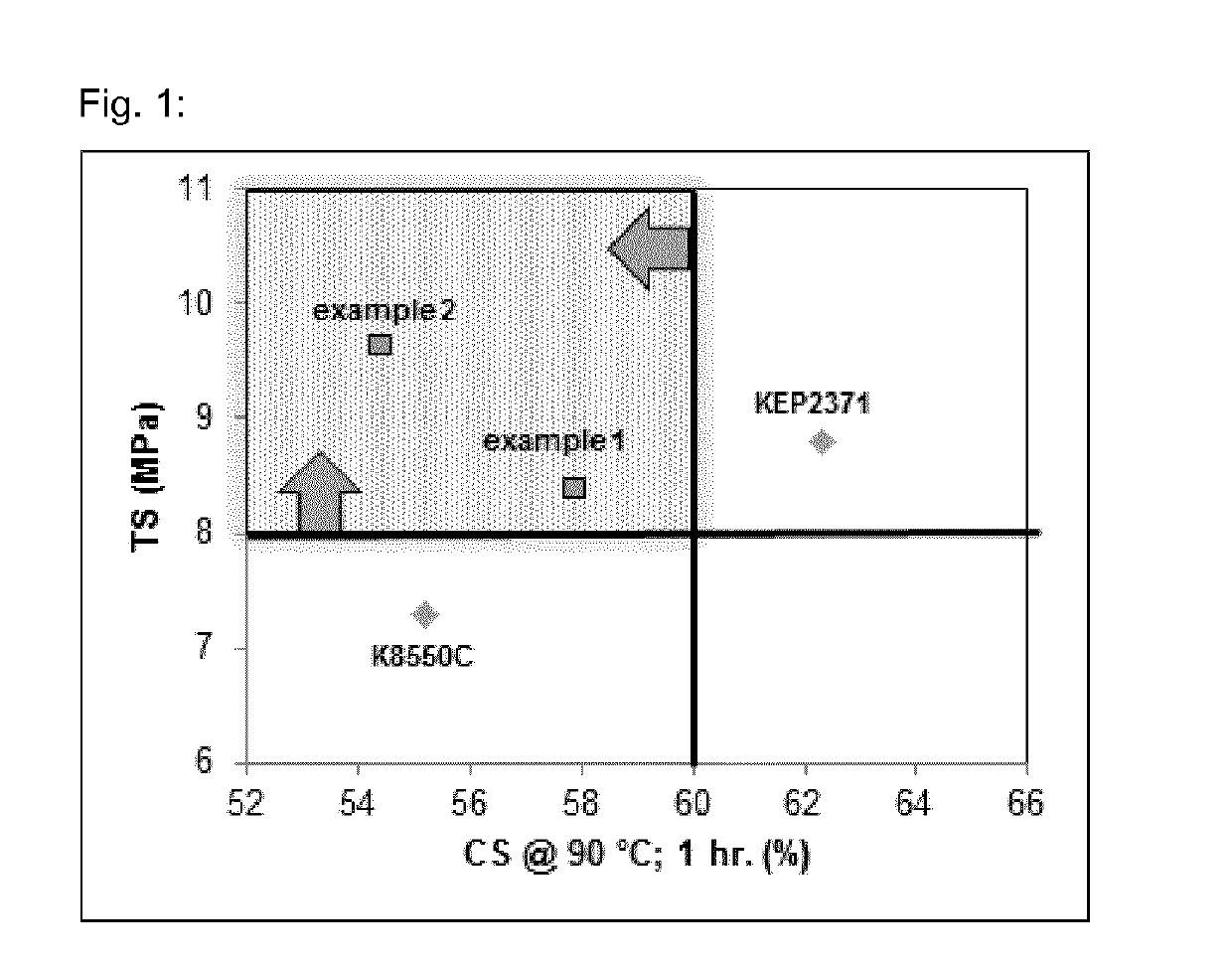
Figure 1
Abstract
Description
[0001] The present invention relates to a certain rubber composition having a limited amount of extender oil, a process for its manufacturing, and its use for making highly loaded vulcanizates.
[0002] For automotive seals, building and construction window gaskets and other applications highly filled vulcanizates are preferred. In particular for automotive applications EPDM rubber compositions are desired that combine good elasticity with good mechanical properties. Highly filled rubber vulcanisates with good elasticity and mechanical properties pose a problem for todays industry.
[0003] Vulcanized rubber compounds are typically characterized in terms of mechanical performance and elasticity. In the context of this invention, tensile properties, such as tensile strength and elongation at break, and tear strength are critical mechanical properties; compression sets at elevated temperature and at or below room temperature are critical characteristics for elasticity.
[0004] Ethylene-α-olefin-d...
Examples
Embodiment Construction
Preparation of EPDM Copolymers Examples 1 and 2.
[0071]The polymerization was carried out in a solution polymerization reactor with a volume of 3 L. The hexanes, ethylene, propylene, dienes and hydrogen feed streams were purified by contacting with various absorption media to remove catalyst-killing impurities, such as water, oxygen and polar compounds, as is known to those skilled in the art. The process is continuous in all feed streams. Pre-mixed hexanes, propylene, ethylene, dienes, hydrogen, tri-octyl aluminium and butylated hydroxytoluene were pre-cooled before being fed to the reactor. A solution, containing the catalyst compound 19 as disclosed in WO2005 / 090418 and triphenylcarbenium tetrakisperfluorophenylborate, was fed separately to the reactor. The hydrogen content was adjusted to achieve the desired polymer Mooney as given in Table 2. The polymer solution was continuously removed through a discharge line, where a solution of Irganox® 1076 in iso-propanol was added, optio...