
Modified Conjugated Diene-Based Polymer And Method Of Preparing The Same
a conjugated diene-based polymer and modified technology, applied in the field of modified conjugated diene-based polymers and methods of preparing the same, can solve the problems of reducing physical properties, br or sbr with the filler, and reducing wet skid resistance of rubbers, so as to achieve excellent affinity, easy to react, and high anionic reactivity
Patent Information
- Authority / Receiving Office
- US · United States
- Patent Type
- Applications(United States)
- Current Assignee / Owner
- Publication Date
- 2020-04-23
Smart Images
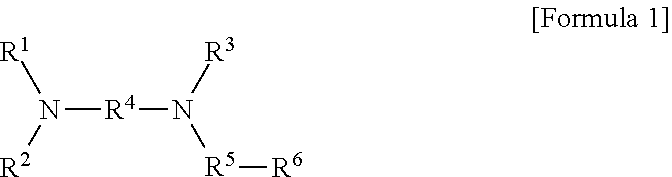
Figure 1 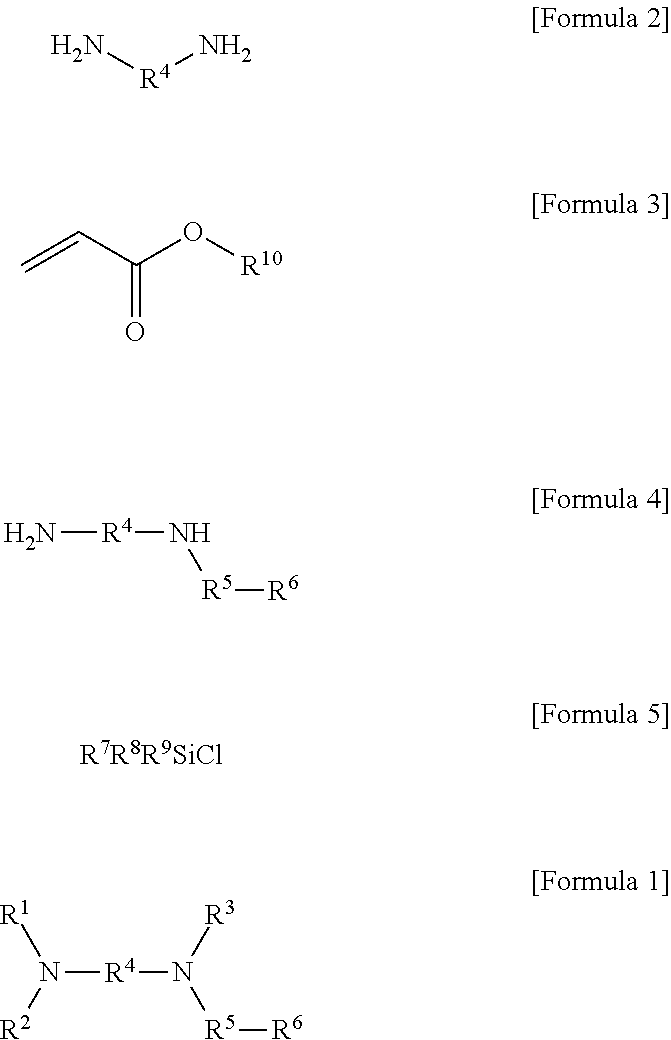
Figure 2 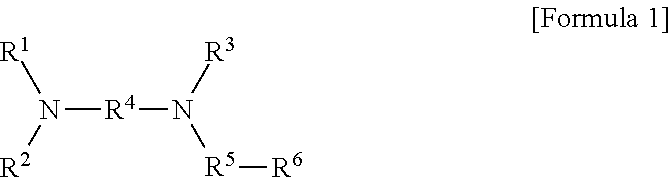
Figure 3
Abstract
Description
CROSS-REFERENCE TO RELATED APPLICATIONS
[0001] This application claims the benefit of Korean Patent Application Nos. 10-2016-0146927, filed on Nov. 4, 2016, and 10-2017-0143946, filed on Oct. 31, 2017, in the Korean Intellectual Property Office, the disclosure of which is incorporated herein in its entirety by reference.TECHNICAL FIELD
[0002] The present invention relates to a modifier represented by Formula 1, a method of preparing the same, a modified conjugated diene-based polymer having a high modification ratio which includes a modifier-derived functional group, and a method of preparing the polymer.BACKGROUND ART
[0003] In line with the recent demand for fuel-efficient cars, a conjugated diene-based polymer having adjustment stability represented by wet skid resistance as well as low rolling resistance and excellent abrasion resistance and tensile properties is required as a rubber material for a tire.
[0004] In order to reduce the rolling resistance of a tire, there is a method of re...
Examples
preparation example 1
[0175]1) Preparation of Compound Represented by Formula (i)
[0176]After 46.5 g (400 mmol) of hexamethylenediamine and 400 ml of tetrahydrofuran (THF) were added to a 1 L round-bottom flask, 48.1 g (480 mmol, 1.2 eq) of ethyl acrylate was slowly added thereto. Thereafter, a reaction was performed while stirring for 12 hours at room temperature, and, after the complete consumption of the hexamethylenediamine was confirmed, the reaction was terminated and the solvent was then removed under reduced pressure. Thereafter, 500 ml of n-hexane was added and the solution was filtered using a celite pad and concentrated to obtain a compound represented by the following Formula (i) (yield 80%). 1H nuclear magnetic resonance spectroscopic data of the obtained compound represented by Formula (i) are as follows.
[0177]1H-NMR (500 MHz, CDCl3) δ 4.13 (2H, q, J=7.2 Hz), 2.86 (2H, td, J=6.5 Hz, 1.5 Hz), 2.67 (2H, td, J=7.0 Hz, 3.5 Hz), 2.59 (2H, td, J=7.1 Hz, 3.2 Hz), 2.49 (2H, t, J=6.5 Hz), 1.50-1.40 (...
preparation example 2
[0183]1) Preparation of Compound Represented by Formula (i)
[0184]After 46.5 g (400 mmol) of hexamethylenediamine, 111.6 g of aluminum oxide, and 400 ml of tetrahydrofuran (THF) were added to a 1 L round-bottom flask, 48.1 g (480 mmol, 1.2 eq) of ethyl acrylate was slowly added thereto. Thereafter, a reaction was performed while stirring for 12 hours at room temperature, and, after the complete consumption of the hexamethylenediamine was confirmed, the reaction was terminated and the solvent was then removed under reduced pressure. Thereafter, 500 ml of n-hexane was added and the solution was filtered using a celite pad and concentrated to obtain a compound represented by the following Formula (i) (yield 95%). 1H nuclear magnetic resonance spectroscopic data of the obtained compound represented by Formula (i) are as follows.
[0185]1H-NMR (500 MHz, CDCl3) δ 4.13 (2H, q, J=7.2 Hz), 2.86 (2H, td, J=6.5 Hz, 1.5 Hz), 2.67 (2H, td, J=7.0 Hz, 3.5 Hz), 2.59 (2H, td, J=7.1 Hz, 3.2 Hz), 2.49 (2...
preparation example 3
[0190]1) Preparation of Compound Represented by Formula (ii)
[0191]After 29.7 g (400 mmol) of 1,3-diaminopropane and 400 ml of tetrahydrofuran (THF) were added to a 1 L round-bottom flask, 48.1 g (480 mmol, 1.2 eq) of ethyl acrylate was slowly added thereto. Thereafter, a reaction was performed while stirring for 12 hours at room temperature, and, after the complete consumption of the 1,3-diaminopropane was confirmed, the reaction was terminated and the solvent was then removed under reduced pressure. Thereafter, 500 ml of n-hexane was added and the solution was filtered using a celite pad and concentrated to obtain a compound represented by the following Formula (ii) (yield 85%). 1H nuclear magnetic resonance spectroscopic data of the obtained compound represented by Formula (ii) are as follows.
[0192]1H-NMR (500 MHz, CDCl3) δ 4.13 (2H, q, J=7.2 Hz), 2.86 (2H, td, J=6.5 Hz, 1.5 Hz), 2.67 (2H, td, J=7.0 Hz, 3.5 Hz), 2.59 (2H, td, J=7.1 Hz, 3.2 Hz), 1.47 (2H, m), 1.25 (3H, t, J=7.3 Hz)...