
Optical receiver module with TO-Can structure
a technology of optical receiver module and tonal structure, which is applied in the direction of optical elements, instruments, and semiconductor/solid-state device details, etc., can solve the problems of increased impedance mismatch between trans-impedance amplifier and signal lead, and achieve the effect of reducing the distance between the laser diode and the impedance mismatch
Patent Information
- Authority / Receiving Office
- US · United States
- Patent Type
- Patents(United States)
- Current Assignee / Owner
- Publication Date
- 2006-07-11
- Estimated Expiration
- Not applicable · inactive patent
Smart Images
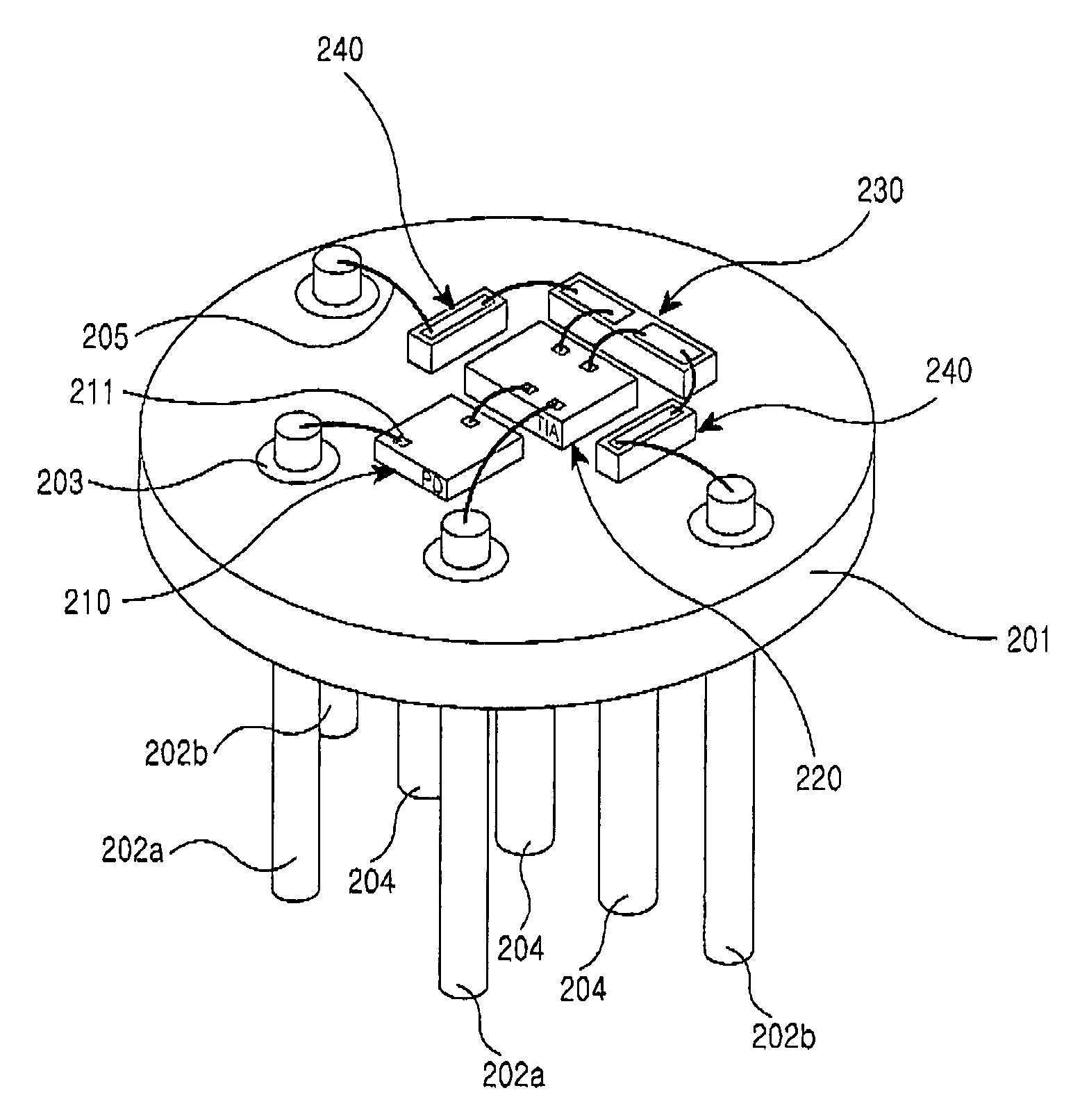
Figure 1 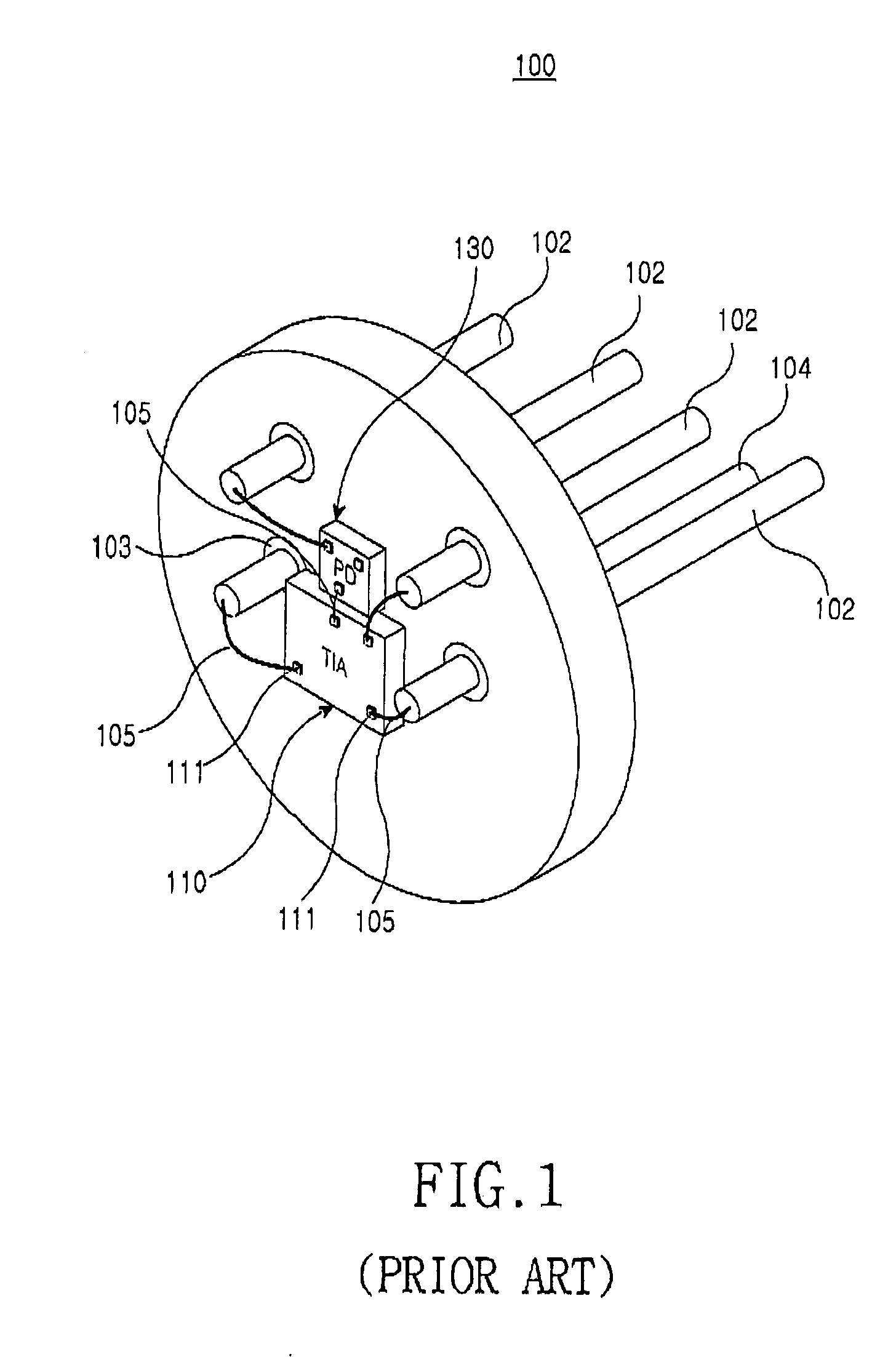
Figure 2 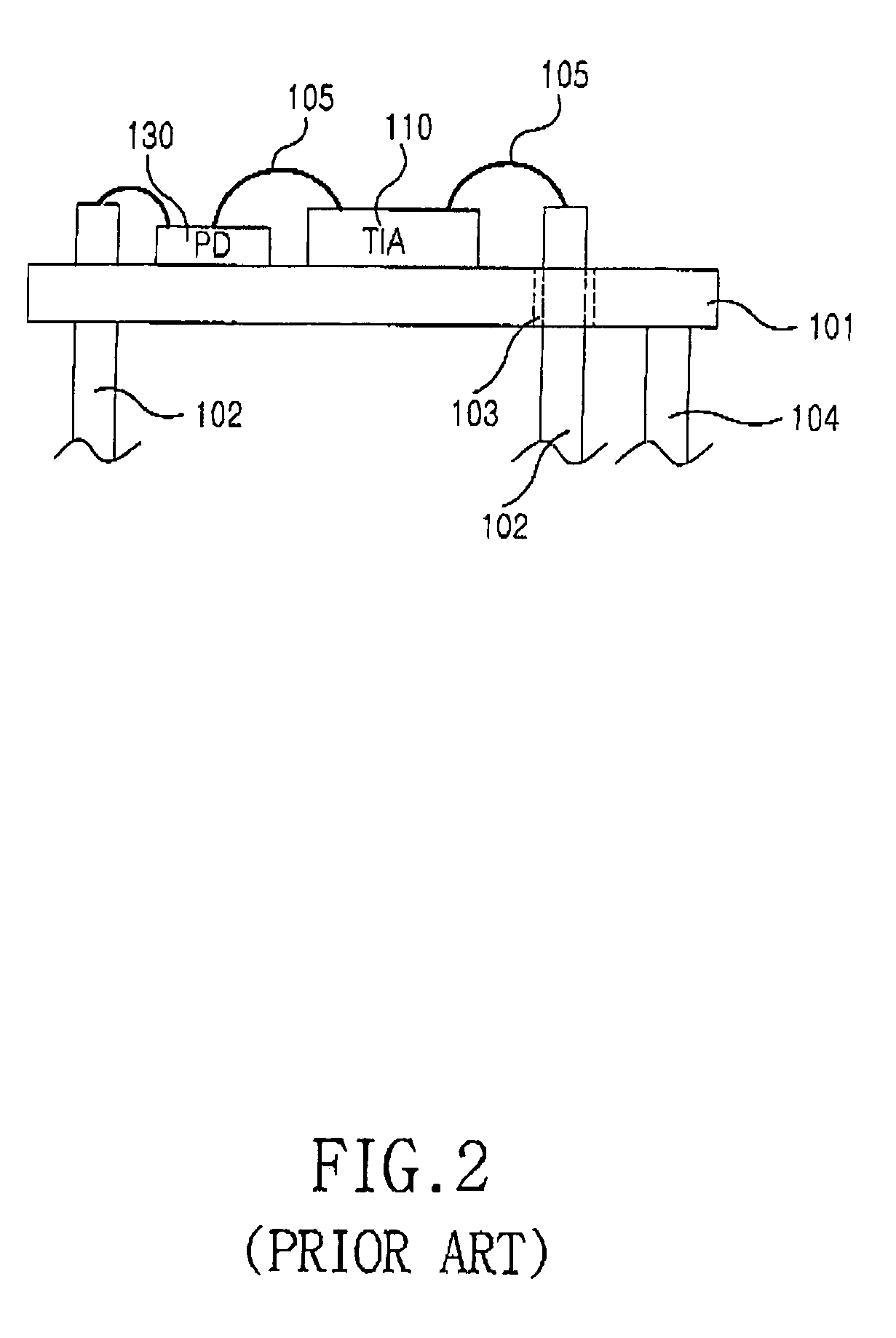
Figure 3
Abstract
Description
CLAIM OF PRIORITY
[0001] This application claims priority under 35 U.S.C. § 119 to an application entitled “Optical Receiver Module with TO-Can Structure,” filed in the Korean Intellectual Property Office on Jun. 20, 2003 and assigned Serial No. 2003-40298, the contents of which are incorporated herein by reference.BACKGROUND OF THE INVENTION
[0002] 1. Field of the Invention
[0003] The present invention relates generally to an optical receiver module, and in particular, to an optical receiver module with a top open can (hereinafter referred to as “TO-Can”) structure for high-speed optical communication. The optical receiver module may include a photo diode for converting an optical input signal into an electric current.
[0004] 2. Description of the Related Art
[0005] In order to meet the increasing demand for optical communication capacity, high-speed optical communication systems capable of supporting a rate of 10 GHz or higher have been developed. Such systems may include optical receiver m...
Examples
Embodiment Construction
[0024]A preferred embodiment of the present invention will now be described in detail with reference to the annexed drawings. In the following description, a detailed description of known functions and configurations incorporated herein has been omitted for conciseness.
[0025]FIG. 3 is a perspective view illustrating an optical receiver module with a TO-Can structure according to an embodiment of the present invention. Referring to FIG. 3, an optical receiver module 200 with a TO-Can structure includes a stem 201 with holes 203 passing through both sides thereof, a photo diode (PD) or POD (PD on block) 210 mounted on the upper side of the stem 201, a trans-impedance amplifier (TIA) 220 also mounted on the upper side of the stem 201, DC leads 202a passing through the holes 203 of the stem 201, signal leads 202b also passing through the holes 203 of the stem 201, ground leads 204, a first waveguide 230 and second waveguides 240.
[0026]The photo diode 210 converts an optical input signal...