
Composition for forming porous film, porous film and method for forming the same, interlevel insulator film, and semiconductor device
Patent Information
- Authority / Receiving Office
- US · United States
- Current Assignee / Owner
- Publication Date
- 2006-10-24
- Estimated Expiration
- Not applicable · inactive patent
Smart Images
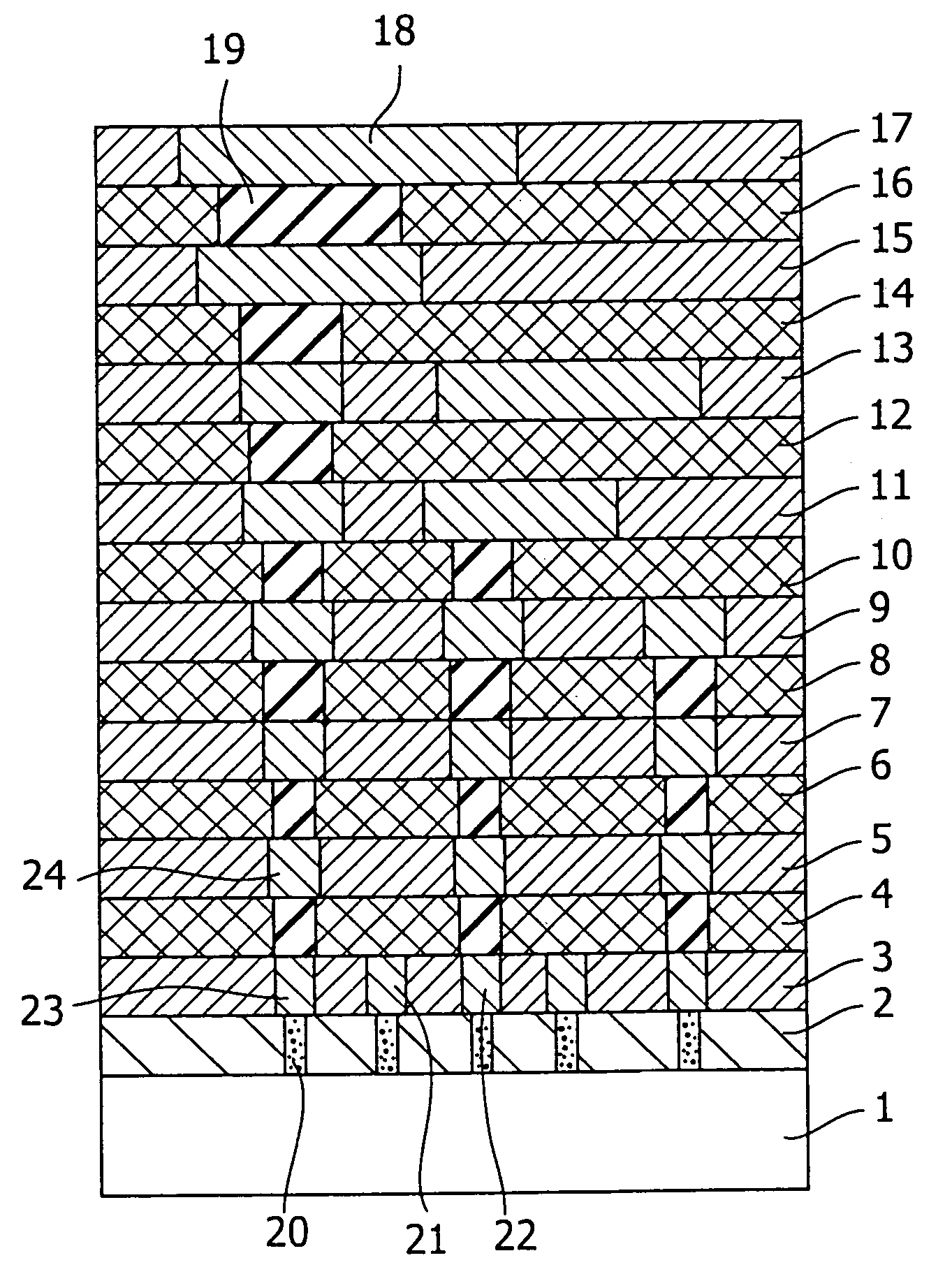
Figure 1 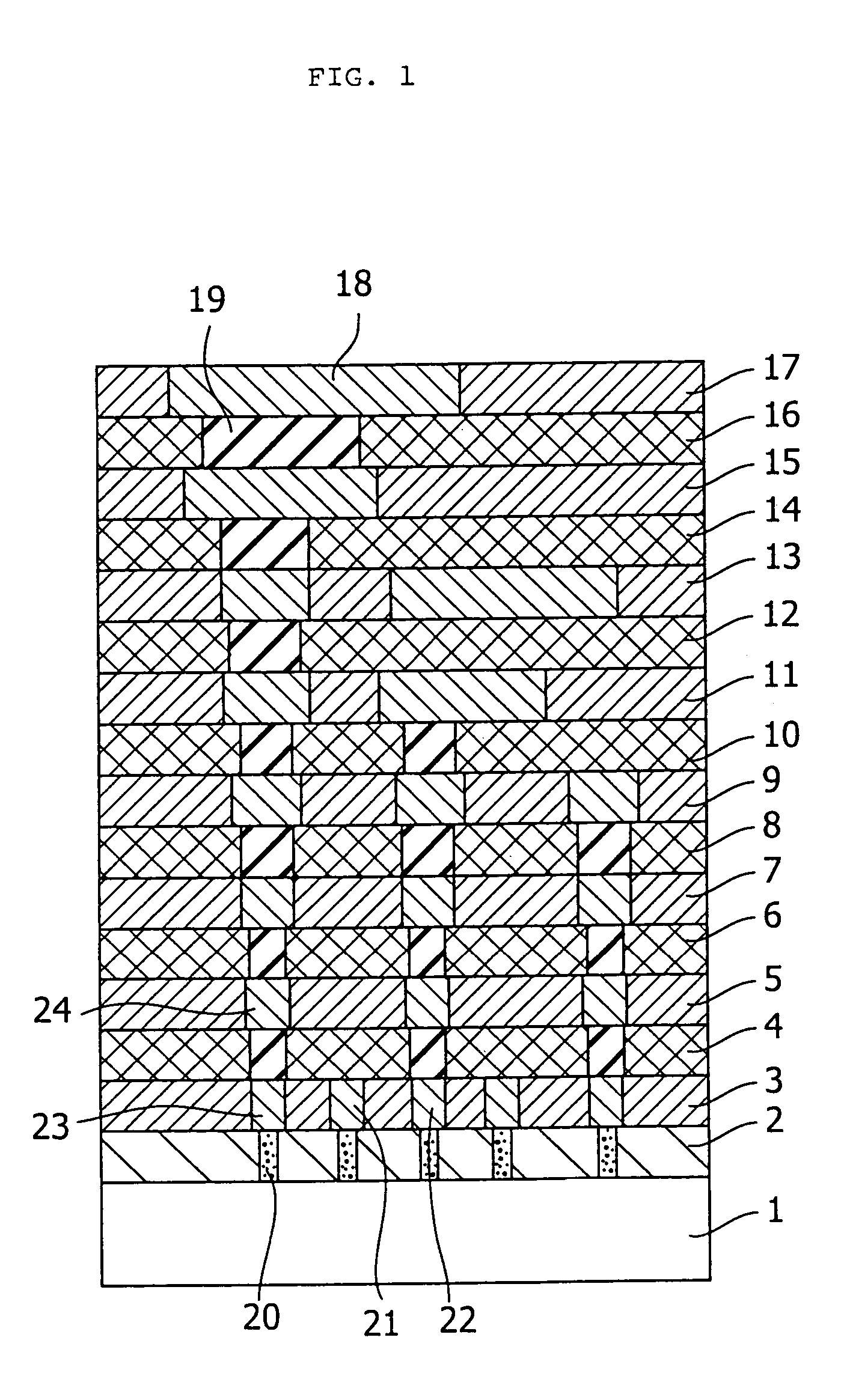
Figure 2 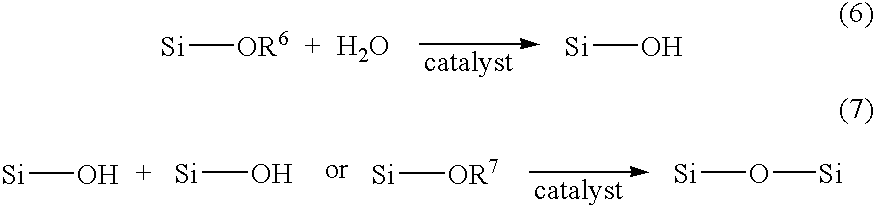
Figure 3
Abstract
Description
CROSS-REFERENCE TO RELATED APPLICATION
[0001] The present application claims priority to Japanese Patent Application No. 2002-329126, filed Nov. 13, 2002, the disclosure of which is incorporated herein by reference in its entirely.BACKGROUND OF THE INVENTION
[0002] 1. Field of the Invention
[0003] The present invention relates to a composition for film formation, which can be formed into a porous film that excels in-dielectric properties, adhesion, film consistency and mechanical strength, and has reduced absorption; a porous film and a method for forming the same; and a semiconductor device, which contains the porous film inside.
[0004] 2. Description of the Related Art
[0005] In the fabrication of semiconductor integrated circuits, as the circuits are packed tighter, an increase in interconnection capacitance, which is a parasitic capacitance between metal interconnections, leads to an increase in interconnection delay time, thereby hindering the enhancement of the performance of semiconduc...
Examples
synthetic example 1
[0086]In a 2 liter flask placed were placed 6.9 g. of 60% nitric acid, 13.7 g of isopropyl alcohol, 1233 g of methyl isobutyl ketone (MIBK) and 206 g (1.0 mol) of thexyltrimethoxysilane. The 40.5 g (2.25 mol) of water was added thereto and hydrolysis was carried out. After methanol as a by-product was evaporated, 30 g of an aqueous 10% NaOH solution was added and the condensation reaction was carried out. The aqueous phase was separated and the polysiloxane solution containing 53 g solid portion was obtained. The number-average molecular weight of this hydrolysate was 1350.
synthetic example 2
[0087]The 559 g of acidic water having nitric acid was placed in a 2 liter flask. The 155 g (0.75 mol) of thexyltrimethoxysilane and 34 g of methyltrimethoxysilane were added dropwise thereto and hydrolysis was carried out at 25° C. Next, methyl isobutyl ketone was added thereto and methanol was evaporated. The aqueous phase was separated from the remaining solution and the polysiloxane solution containing 87 g solid portion was obtained. According to 29Si-NMR analysis of this silanol group-containing hydrolysate, Unit MeSiO3 / 2 (hereafter, Me refers to methyl group) contained 6 mol % of Unit T-1, 62 mol % of Unit T-2 and 32 mol % of Unit T-3 and the number-average molecular weight of this silanol group-containing hydrolysate was 1500. Furthermore, according to 1H-NMR analysis, the ratio of Me-SiOMe / SiMe was less than 0.01.
[0088]It is noted that the ratio of Me-SiOMe / SiMe means in Me-SiOMe the ratio of three protons of the methoxy group bonded to Si to three protons of the methyl gro...
synthetic example 3
[0089]In a 1 liter flask were placed 354 g of propylene glycol monomethyl ether acetate, 155 g (0.75 mol) of thexyltrimethoxysilane and 34 g (0.25 mol) of methyltrimethoxysilane. The 66.9 g of 6% nitric acid was added thereto and hydrolysis was carried out. After methanol as a by-product was evaporated, the aqueous phase was separated. Consequently, the polysiloxane solution containing 83.6 g solid portion was obtained. According to 29Si-NMR analysis of the hydrolysate, 12 mol % of Unit T-1, 67 mol % of Unit T-2 and 22 mol % of Unit T-3 were contained in MeSiO3 / 2. The number-average molecular-weight of this silanol group hydrolysate was 1880. Moreover, according to 1H-NMR analysis, the ration of Me-SiOMe / SiMe was 0.64.