
Limited play optical devices with interstitial reactive layer and methods of making same
a reactive layer and optical device technology, applied in the field of limited play optical devices with interstitial reactive layers and methods of making same, can solve the problems of limited content lifetime, inconvenient physical media return, and inability to meet the minimum changes to existing manufacturing processes referred to above, and achieve the minimum changes to existing manufacturing processes. the effect of avoiding rental returns
Patent Information
- Authority / Receiving Office
- US · United States
- Patent Type
- Patents(United States)
- Current Assignee / Owner
- Publication Date
- 2007-02-13
- Estimated Expiration
- Not applicable · inactive patent
Smart Images
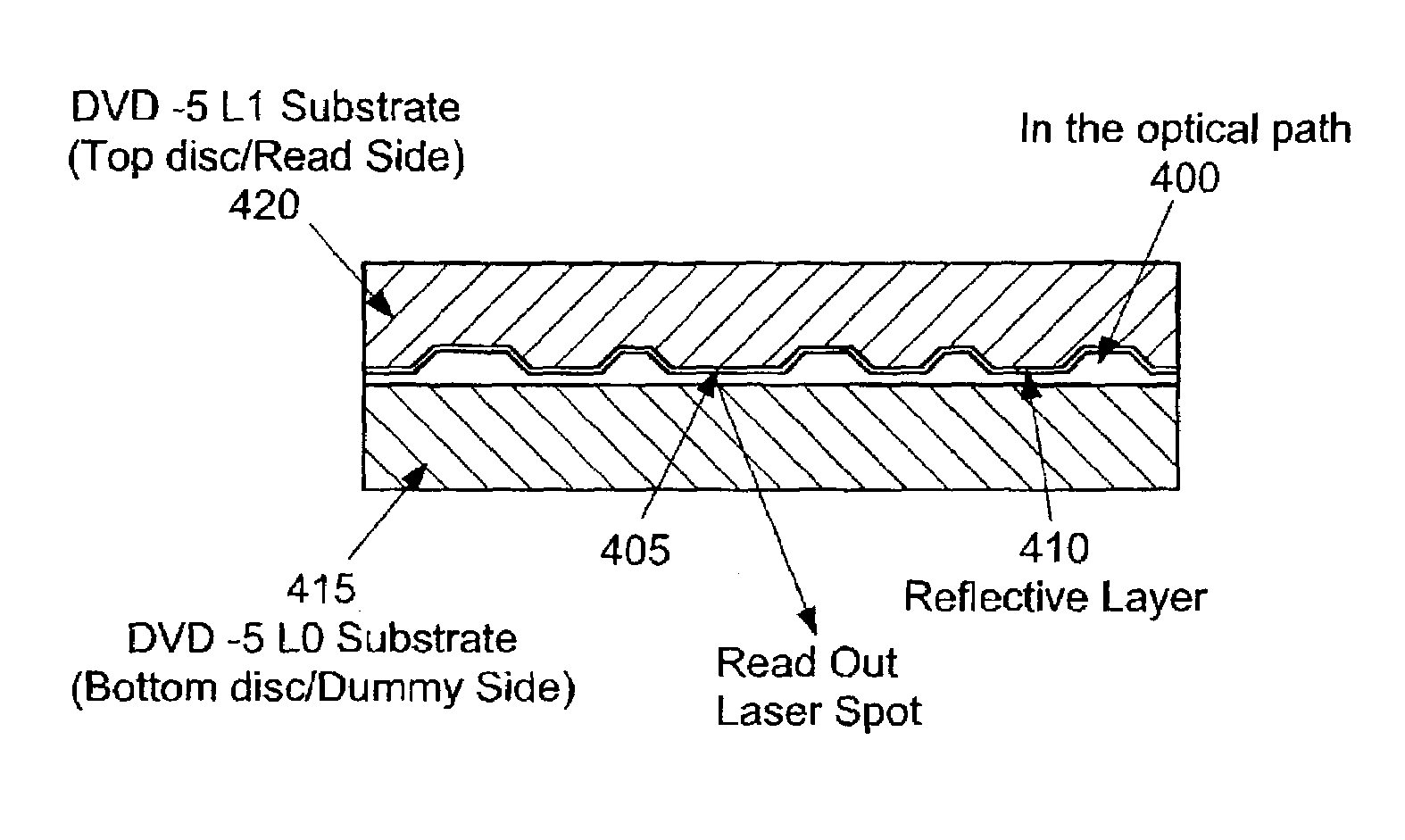
Figure 1 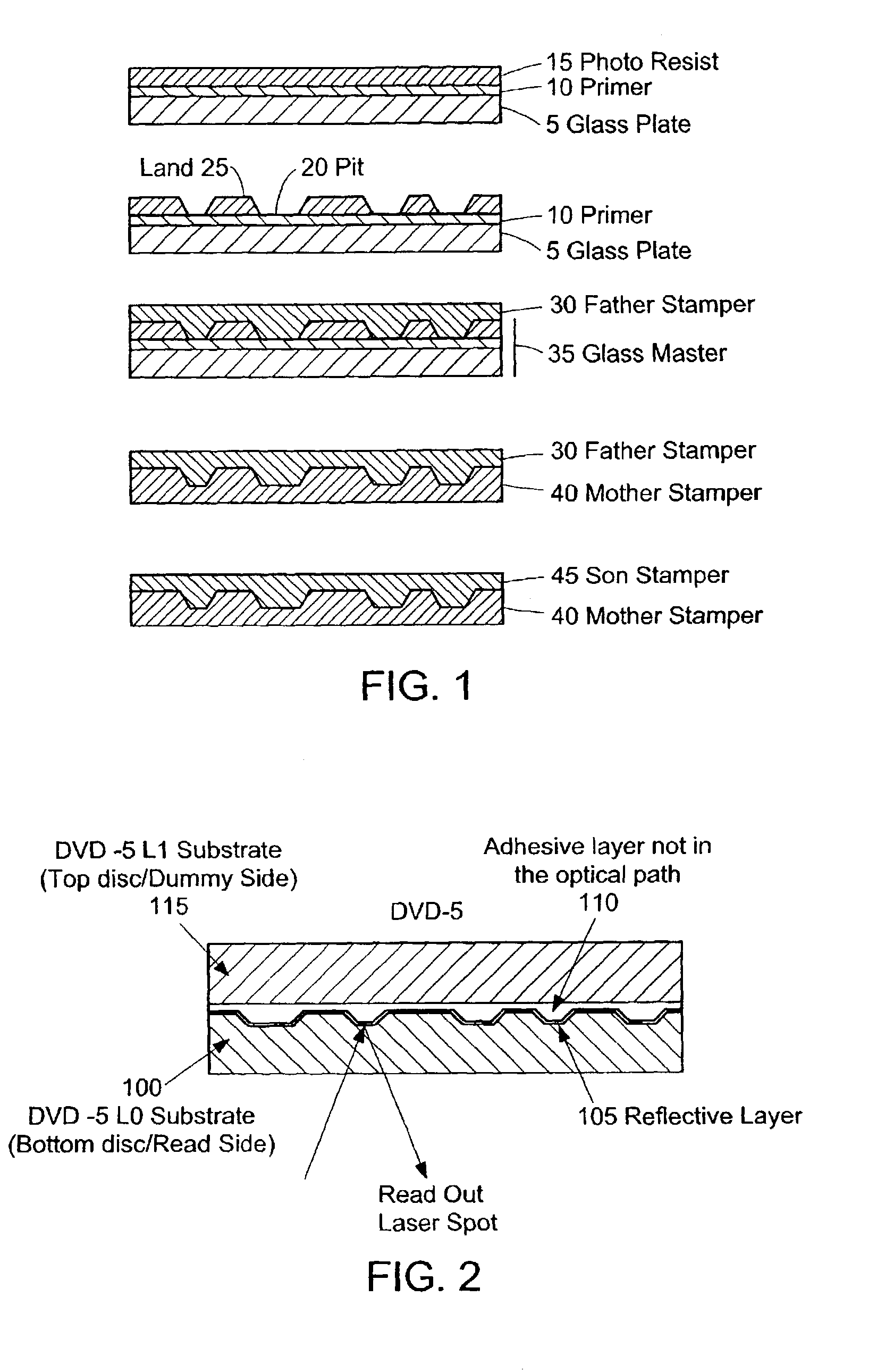
Figure 2 
Figure 3
Abstract
Description
[0001] Priority is herewith claimed under 35 U.S.C. § 120 from Non-Provisional patent application Ser. No. 09 / 507,224 filed Feb. 18, 2000, which claims priority to Provisional Patent Application Nos. 60 / 125,927 filed Mar. 23, 1999 and 60 / 128,197 filed Apr. 7, 1999; Non-Provisional patent application Ser. No. 09 / 507,490 filed Feb. 18, 2000, which claims priority to Provisional Patent Application Nos. 60 / 125,927 filed Mar. 23, 1999 and 60 / 128,197 filed Apr. 7, 1999; and Non-Provisional patent application Ser. No. 09 / 608,328 filed Jun. 29, 2000, which claims priority to Provisional Patent Application No. 60 / 143,474 filed Jul. 12, 1999; and under 35 U.S.C. § 119(e) from copending Provisional Patent Application 60 / 295,903 filed Jun. 5, 2001. The disclosure of all prior Patent Applications is incorporated by reference herein in its entirety.FIELD OF THE INVENTION
[0002] This invention relates to optically readable data storage media and, more particularly, to methods, compositions, and artic...
Examples
example 1
Special DVD-5 Design #1
[0073]A father stamper 30 was mastered with slightly increased symmetry (positive asymmetry=larger pits 20 compared to lands 25). The asymmetry can be increased or decreased many ways. The simplest method and the one used for this design, was to increase the development time (endpoint detection set point) to overdevelop the pits 20. By lengthening the development process, the pit volume surrounding, that which was exposed, will increase in volume causing a shift to positive asymmetry.
[0074]A mother stamper 40 was grown from the father stamper 30 as with a normal family process. Disc substrates were molded from the mother stamper 40, taking advantage of the larger indentation caused by the positive asymmetry. The larger pits 20 that resulted from molding with the mother 40 helped to compensate for the additional shrinkage of the pit 20, which is now an extremity to the body of the substrate, rather than a cavity as in the standard molding process. Typically, th...
example 2
Special DVD-5 Design #2
[0080]A special stamper for molding L1 substrates 420 for Special DVD-5 Design #2 was produced through a modified mastering process, where the direction of rotation of the laser beam recorder turntable was reversed during the cutting process, resulting in a spiral tracking path in the opposite direction from that in a normal DVD-5. This stamper was produced by forcing the turntable to rotate in the reverse direction from cutting a normal DVD-5, while the content information was fed to the laser beam recorder as a DVD-5 image. The scanning velocity that is normally preset for DVD formats was manually set to the velocity of 3.49 m / s typical in DVD-5 mastering. L1 substrates 420 were then molded on standard molding machines set up for DVD-5 fabrication.
[0081]Some of the molded L1 substrates 420 were bonded using optical grade UV curable DVD adhesives to blank L0 substrates 415, to manufacture design #2 of the Special DVD-5. As in Example 1, the L0 substrates 415 ...
example 3
BocLMB Preparation
[0108]
ChemicalAmountMolesMol. Wt.Na2S2O460.0 g0.345 (2.1 eq)174.11H2O 300 mL10% aq. NaOH 240 mLMethylene Blue60.0 g0.160373.90CH2Cl2 700 mL + 25 mLBoc2O 81 mL (d = 0.95 g / mL)0.352 (2.2 eq)218.25DMAP 3.0 g0.025 (0.15 eq)122.17Hexanes 400 mLMethanol 200 mL estimate
[0109]In a 2-liter separatory funnel was dissolved 60.0 g of sodium hydrosulfite (sodium dithionite, Na2S2O4) in 300 mL cold distilled water. To this solution was added 60.0 g methylene blue (dark green powder) from several different bottles, and the separatory funnel was stoppered and shaken vigorously over a 30-minute period, during which time the dark green solids gradually form a tan suspension of insoluble leucomethylene blue. To this suspension was added three 60-mL portions of 10% aqueous sodium hydroxide solution with vigorous shaking after each addition. Some heat is evolved, and a lighter suspension results. After allowing the mixture to stand for a short while to cool, 700 mL methylene chloride ...