
System and method of applying adaptive control to the control of particle accelerators with varying dynamics behavioral characteristics using a nonlinear model predictive control technology
a particle accelerator and predictive control technology, applied in the field of system and method of adaptive control of processes with varying dynamics, can solve problems such as critical influence of models on the way models behave, and achieve the effect of more efficient collisions
Patent Information
- Authority / Receiving Office
- US · United States
- Current Assignee / Owner
- Publication Date
- 2007-02-27
Smart Images
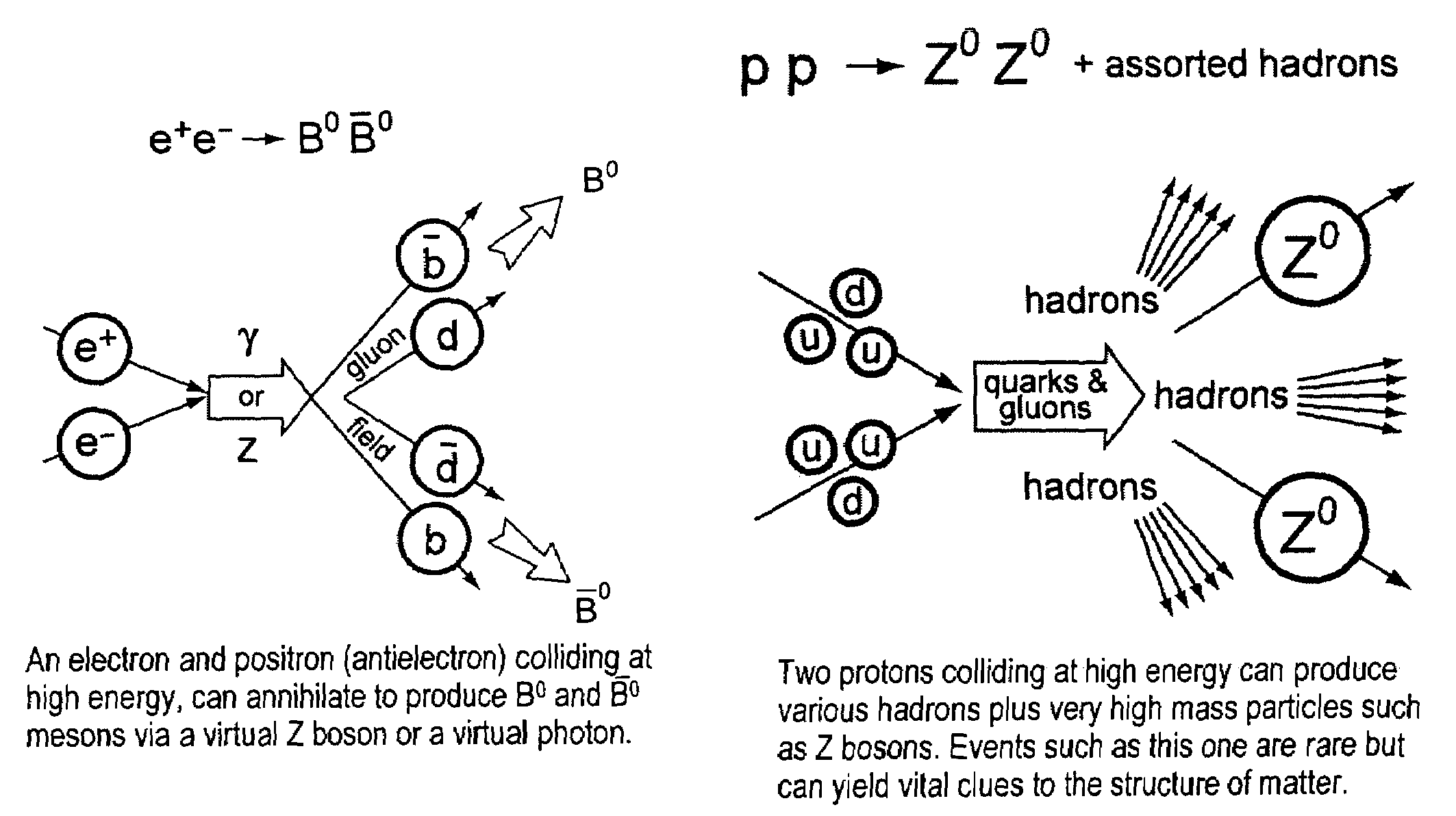
Figure 1 
Figure 2 
Figure 3
Abstract
Description
TECHNICAL FIELD OF THE INVENTION
[0001] This application claims benefit of priority to U.S. provisional application Ser. No. 60 / 431,821, titled “System and Method of Adaptive Control of Processes With Varying Dynamics,” filed Dec. 9, 2002, whose inventors were Bijan Sayyarrodsari, Eric Hartman, Celso Axelrud, and Kadir Liano.BACKGROUND OF THE INVENTION
[0002] The study of fundamental particles and their interactions seeks to answer two questions: (1) what are the fundamental building blocks (smallest) from which all matter is made; and (2) what are the interactions between these particles that govern how the particles combine and decay? To answer these questions, physicist use accelerators to provide high energy to subatomic particles, which then collide with targets. Out of these interactions come many other subatomic particles that pass into detectors. FIGS. 1A and 1B illustrate typical collisions or interactions used in this study. From the information gathered in the detectors, phys...
Examples
Embodiment Construction
[0037]Preferred embodiments of the present invention are illustrated in the FIGUREs, like numerals being used to refer to like and corresponding parts of the various drawings.
[0038]The present invention provides methodologies for the computationally efficient modeling of processes with varying dynamics. More specifically, the present invention provides a method for robust implementation of indirect adaptive control techniques in problems with varying dynamics through transparent adaptation of the parameters of the process model that is used for prediction and online optimization. Such problems include but are not limited to the control of: particle trajectories within particle accelerators, temperature in a chemical reactors, and grade transition in a polymer manufacturing process.
[0039]This innovation enables improvement of existing control software, such as Pavilion Technology's Process Perfecter®, to exert effective control in problems with even severely varying dynamics. This is...