

Equalization for DMT and OFDM communication systems
a communication system and equalization technology, applied in the field of equalization for receivers, can solve the problems of channel capacity being highly degraded, available channel capacity in such a system is not a smooth function of synchronization, etc., and achieve smooth signal-to-noise ratio (snr) distribution function, improve overall performance, and improve the effect of hardware implementation
Patent Information
- Authority / Receiving Office
- US · United States
- Patent Type
- Patents(United States)
- Current Assignee / Owner
- Publication Date
- 2008-10-07
Smart Images
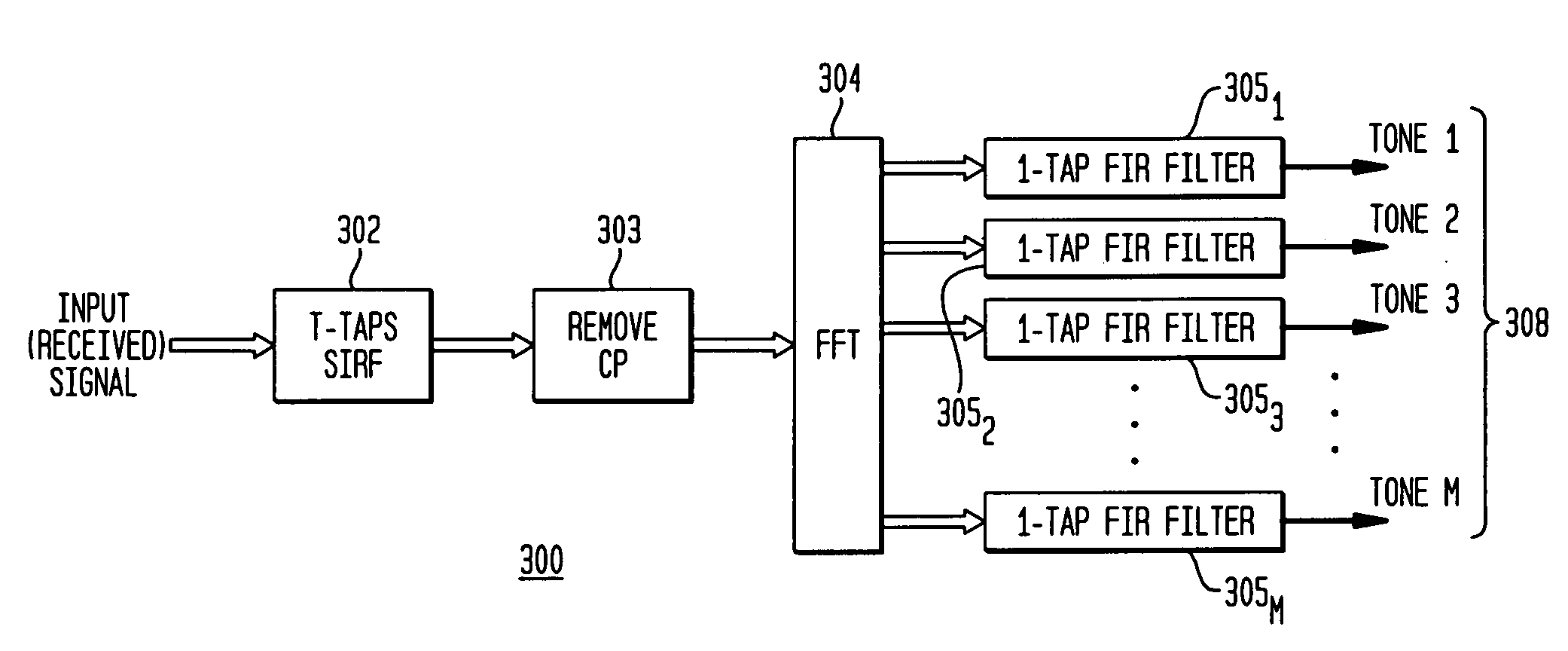
Figure 1 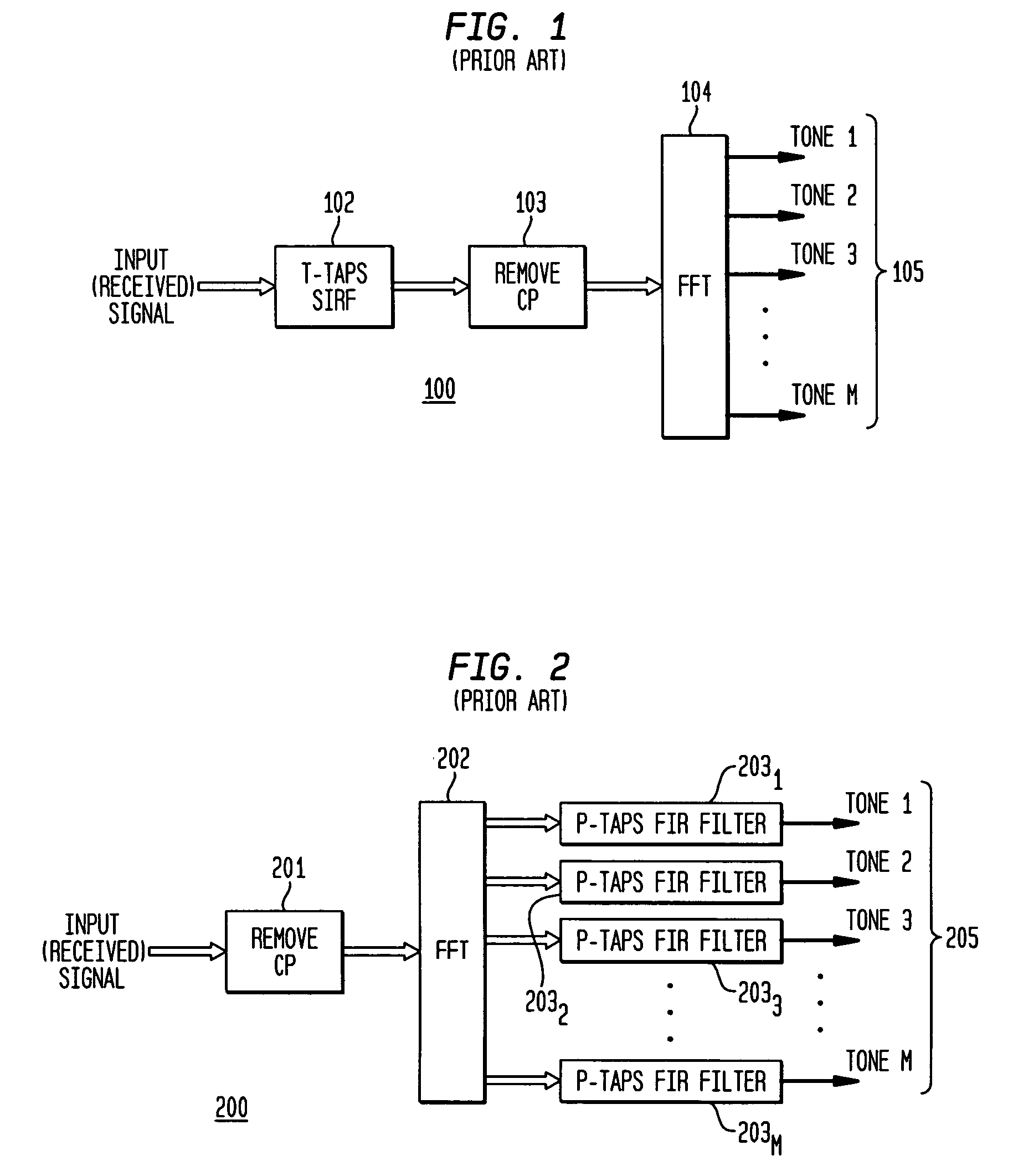
Figure 2 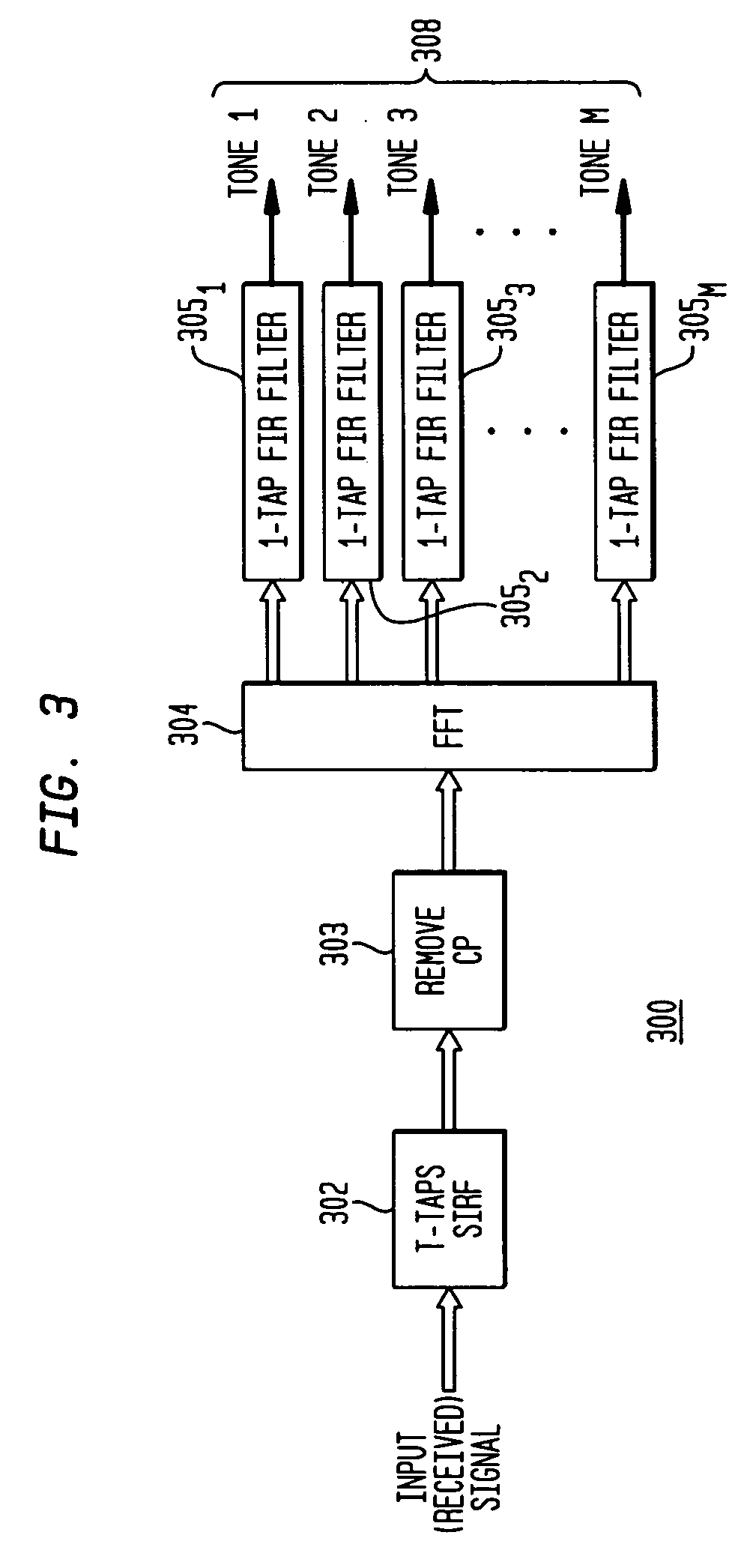
Figure 3
Abstract
Description
FIELD OF THE INVENTION
[0001] This invention relates generally to equalization for receivers used in discrete multi-tone (DMT) and orthogonal frequency-division multiplexing (OFDM) communication systems and, in particular, to a combination of time-domain and frequency-domain equalization, and is more particularly directed toward a system that provides proper equalization filter coefficients for both time-domain and frequency domain equalization through application of global optimization criteria.BACKGROUND OF THE INVENTION
[0002] Digital modulation schemes are increasingly employed to provide high data throughput over inherently band-limited channels. A prominent example of this is the DSL (digital subscriber line) service provided over telephone lines. Another prominent example is wireless internet communication, such as under the Institute for Electrical and Electronics Engineers (IEEE) 802.11 standards.
[0003] Since telephone lines are known to provide a narrow-band channel, digital mo...
Examples
Embodiment Construction
[0019]While the present invention is susceptible of embodiment in many different forms, there are shown in the drawings and will be described herein in detail specific embodiments thereof, with the understanding that the present disclosure is to be considered as an exemplification of the principles of the invention and is not intended to limit the invention to the specific embodiments illustrated.
[0020]There is described herein an equalization for DMT-based communication systems that offers distinct advantages when compared to the prior art. A system 100 known in the prior art is illustrated in block diagram form in FIG. 1. In the system of FIG. 1, an input signal 101 is received from the physical channel (telephone lines or wireless channels, for example). As a general principal, the input signal 101 would be received through an analog front end, processed through an analog to digital converter (ADC), and subjected to appropriate digital signal processing, although these elements a...