
Addressing a management object
Patent Information
- Authority / Receiving Office
- US · United States
- Current Assignee / Owner
- Publication Date
- 2010-06-08
- Estimated Expiration
- Not applicable · inactive patent
Smart Images
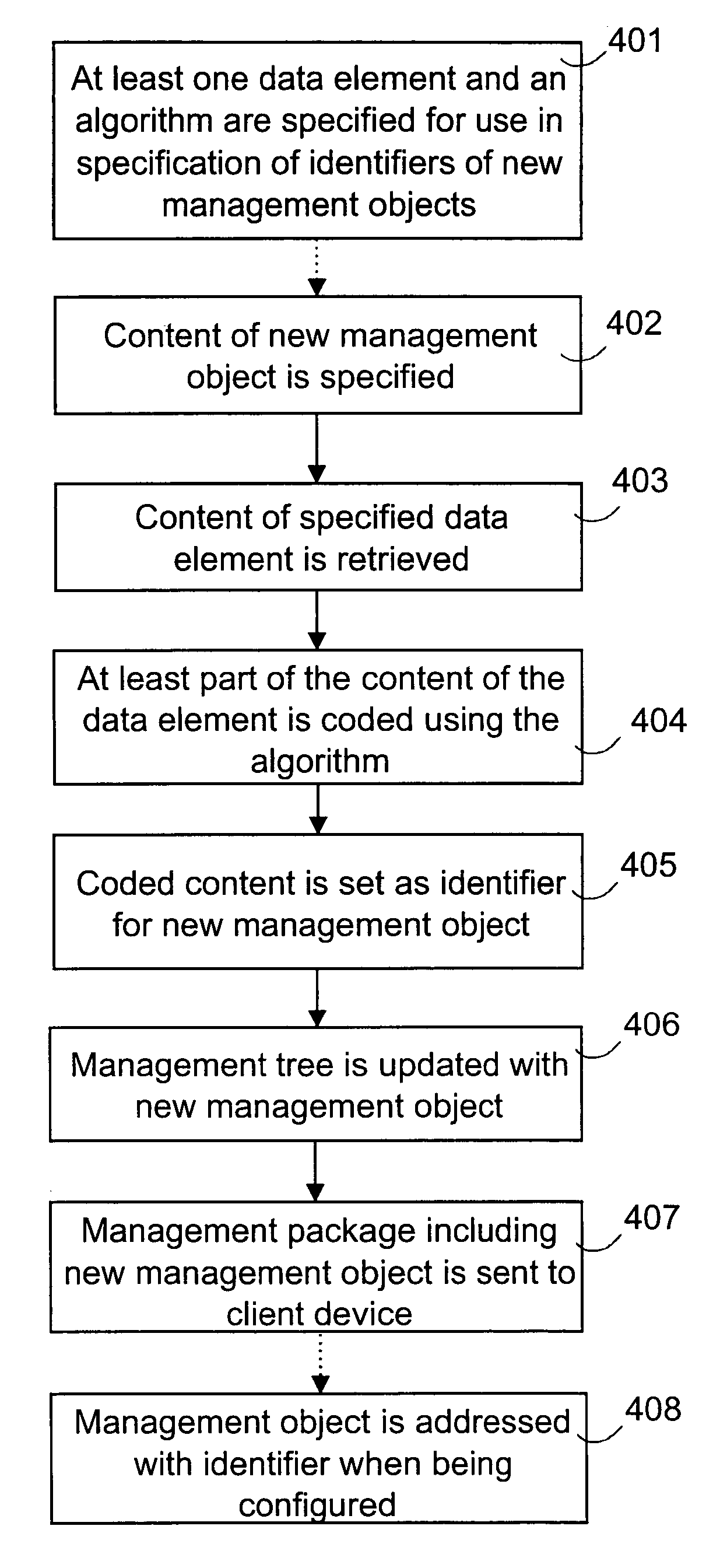
Figure 1 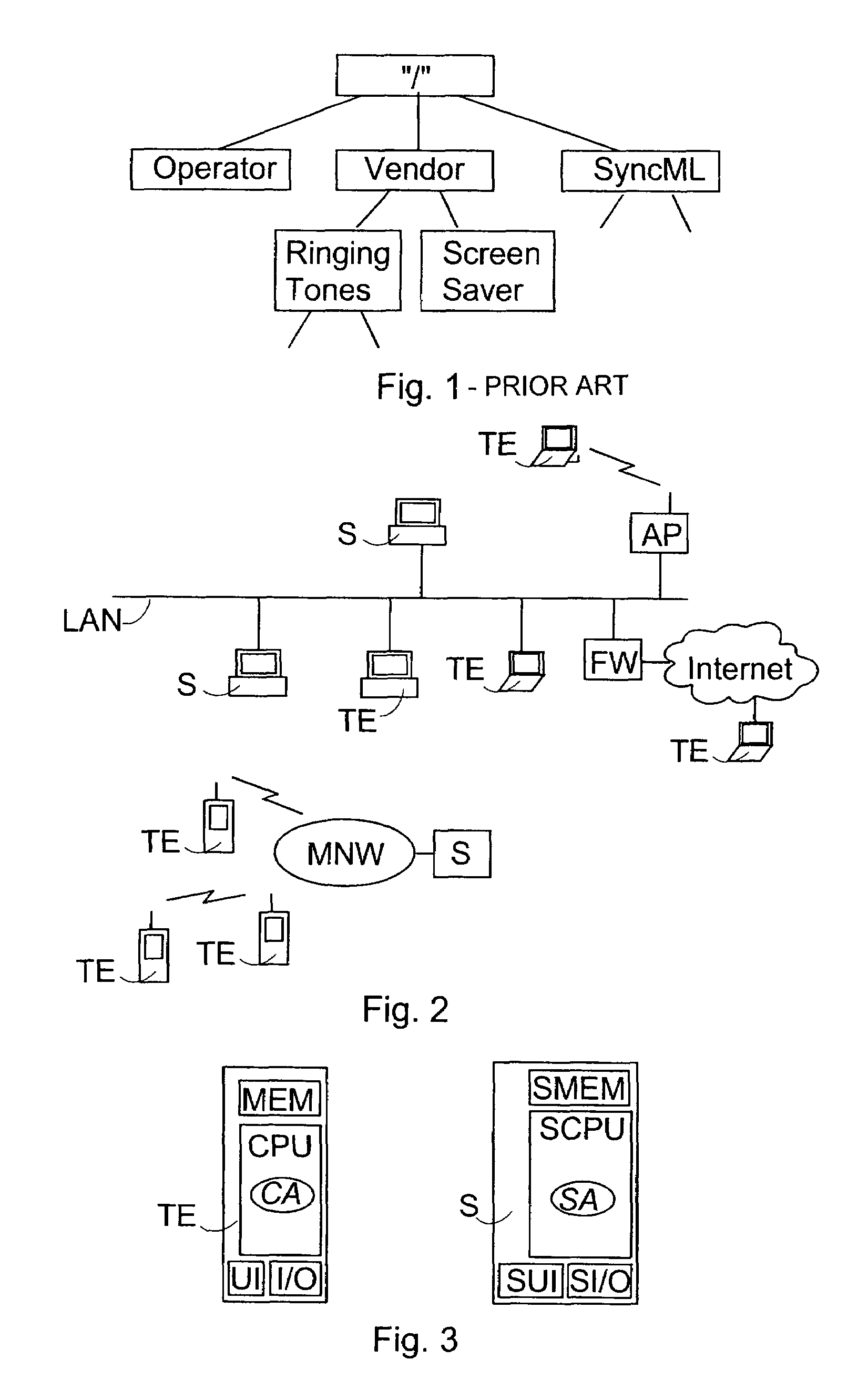
Figure 2 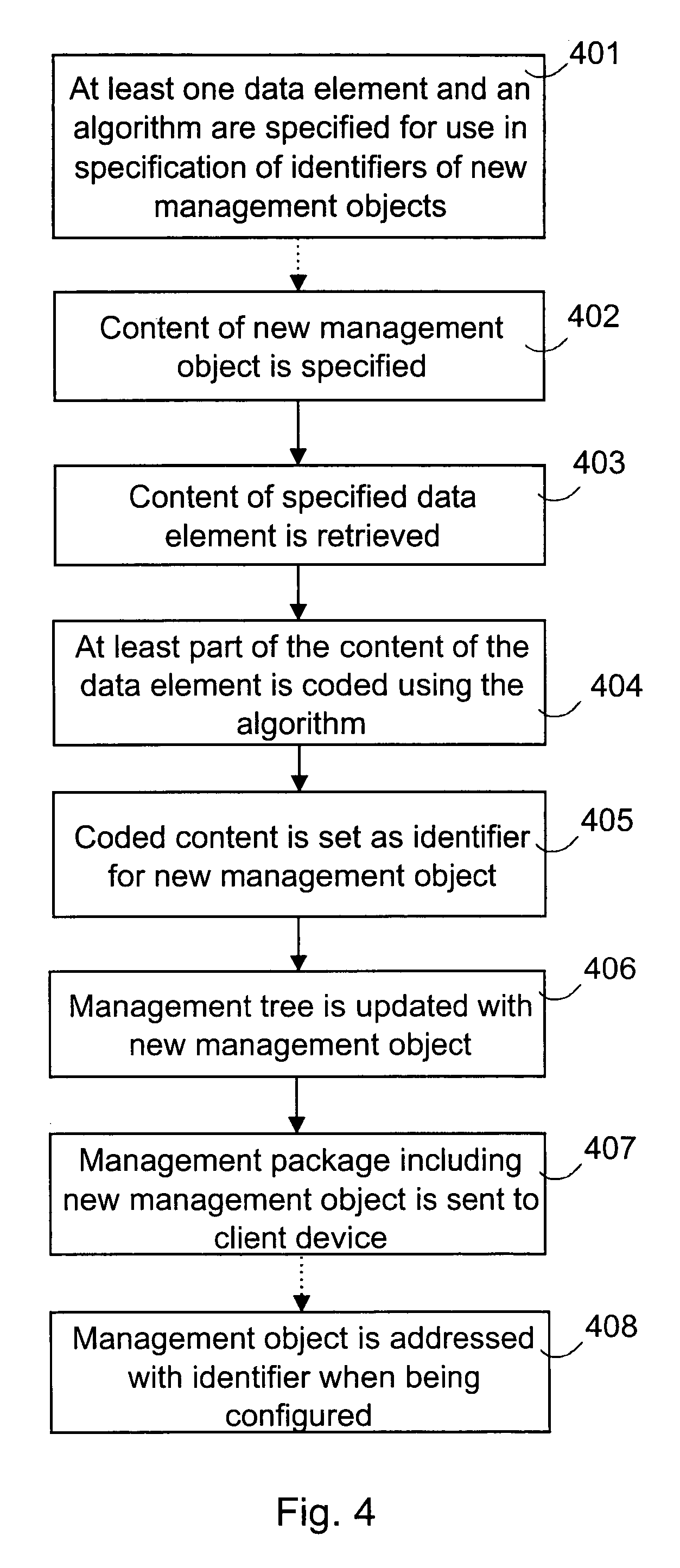
Figure 3
Abstract
Description
BACKGROUND OF THE INVENTION
[0001] The invention relates to addressing a management object of a device in a device management system of the device.
[0002] The significance of device management is emphasized as the different data processing devices, such as mobile stations, become more complex. Various settings are required in the devices, such as settings associated with Internet access points, which are laborious and difficult to set manually by the user. Device management solutions have been developed for instance to solve this problem, by means of which for instance an administrator of a company's data system or a teleoperator is able to configure a device suitably. Usually device management refers to measures by which parties external to the device are able to change the configuration of the device, for instance change the settings or even some protocol used by the device. Not only setting associated with the device, but also user-specific data, such as user profiles, logos, ringing...
Examples
Embodiment Construction
[0017]In the following, a preferred embodiment of the invention will be described in a system supporting management of a SyncML device, but is should be noted, however, that the invention is applicable to any device management system enabling the organization of management objects of the device also in other ways than as a tree structure.
[0018]FIG. 2 illustrates a networked system. A network server or PC typically acts as a server S. A TE is typically a mobile phone, a PC (Personal Computer), laptop computer or a PDA device. The assumption in the following embodiments is that from the point of view of device management, the terminal TE serves as the client device and the server S as the management server. The server S may manage several client devices TE.
[0019]FIG. 2 shows two examples, client devices TE and management servers S being connected to a local area network LAN in the first one. The client device TE connected to the network LAN comprises a functionality, e.g. a network ca...