
Preservation and controlled delivery / release of spermatozoa
a technology of spermatozoa and sperm, which is applied in the field of preservation and controlled delivery/release of spermatozoa, can solve the problems of less flexibility in regard to semen processing and storage possibilities, the inability to meet the preferred point of insemination with respect to ovulation, and the limitation of obtaining pregnancies in the female animal by performing artificial insemination, etc., and achieves the effect of superior preservation characteristics
Patent Information
- Authority / Receiving Office
- US · United States
- Patent Type
- Patents(United States)
- Current Assignee / Owner
- Publication Date
- 2012-05-15
Smart Images
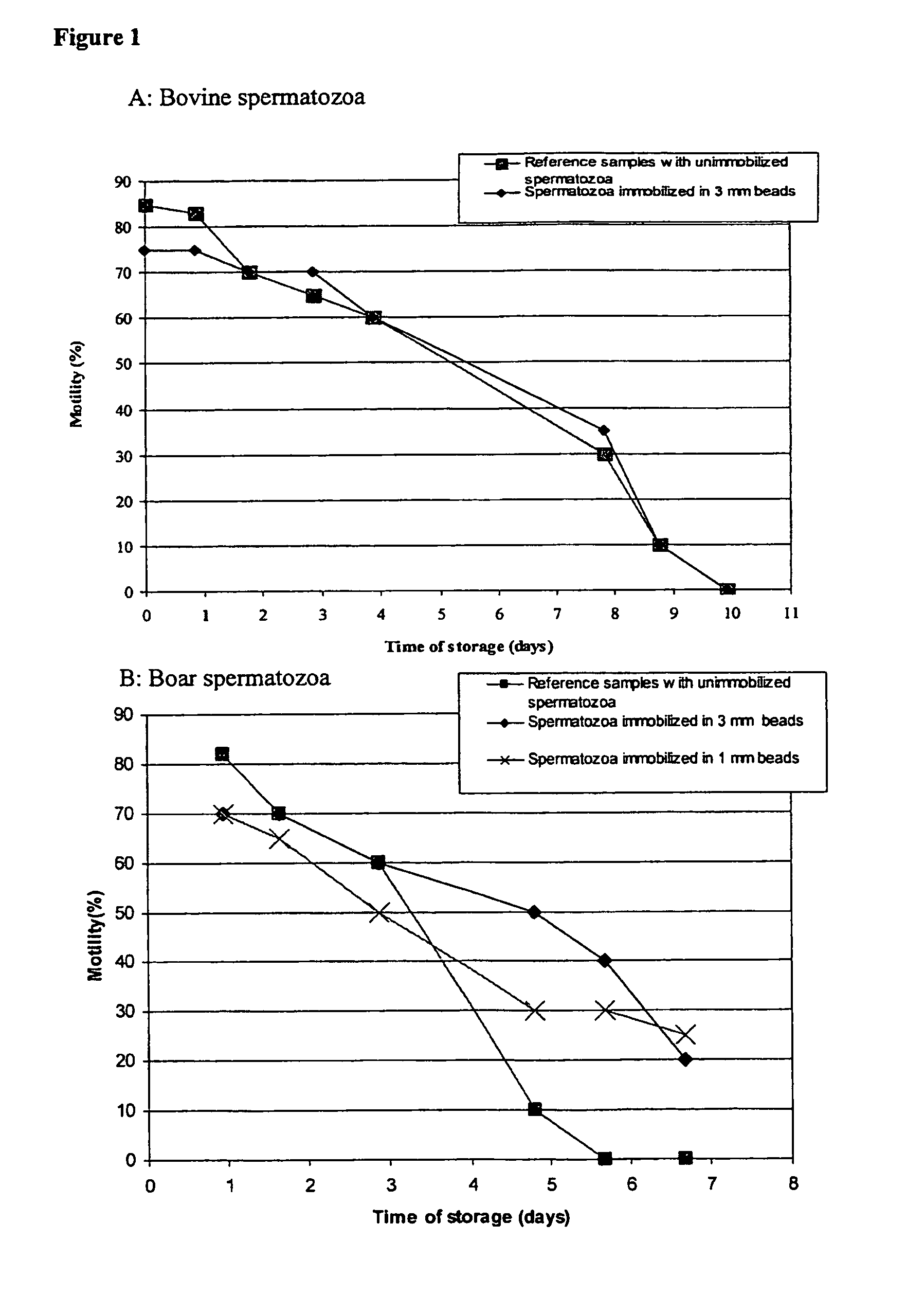
Figure 1 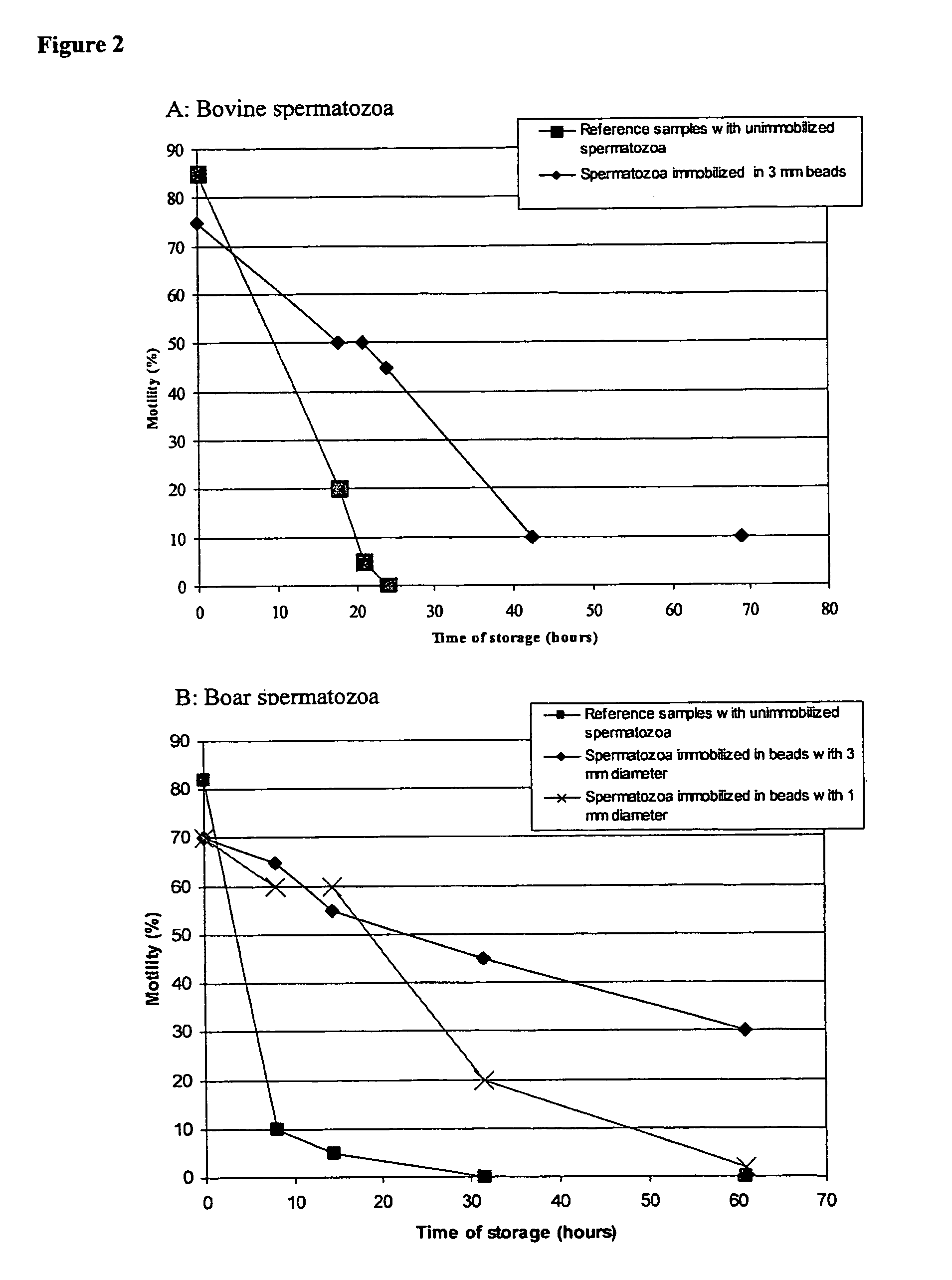
Figure 2 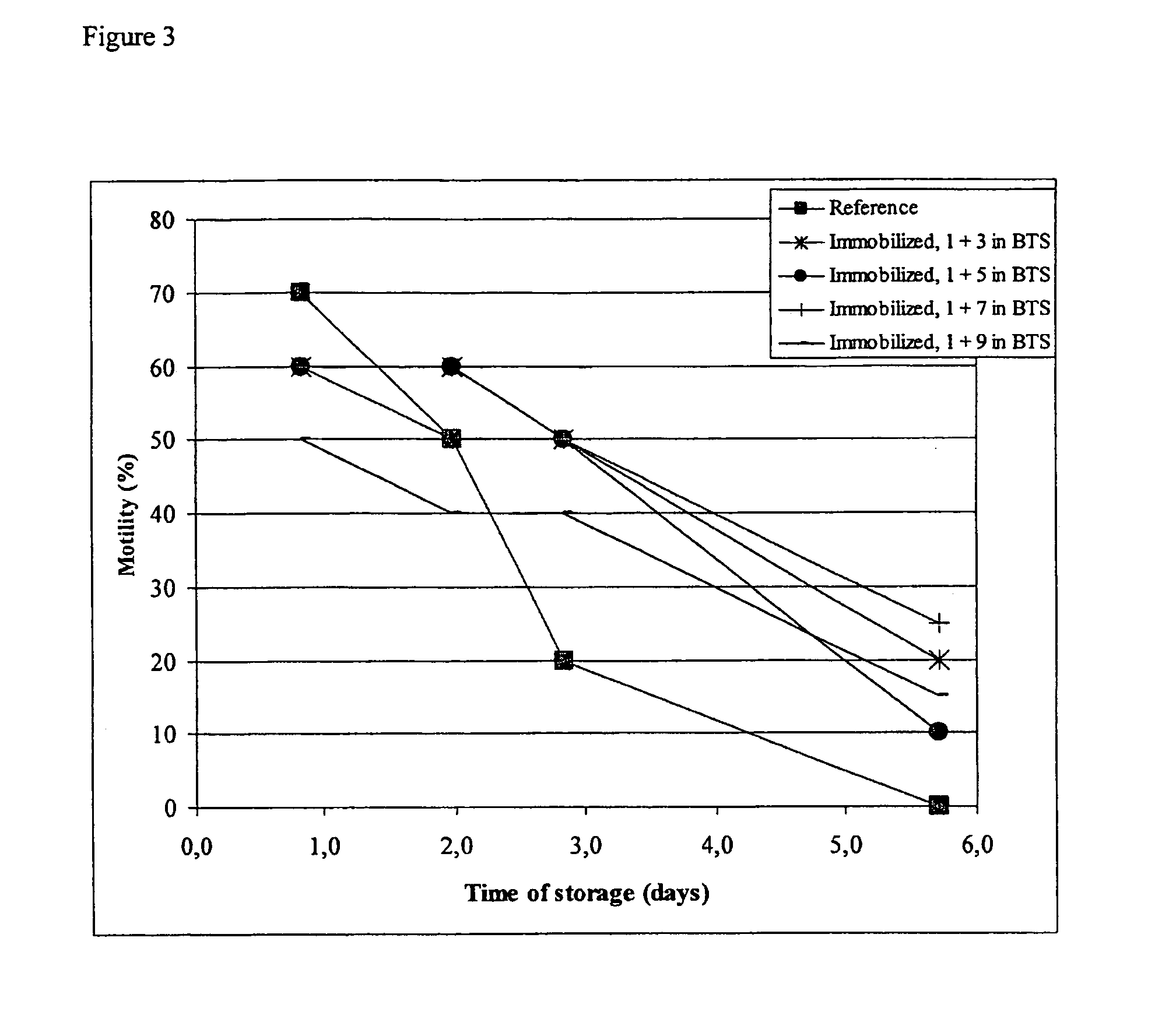
Figure 3
Abstract
Description
FIELD OF INVENTION
[0001] The present invention relates to biopolymer particles for preservation of spermatozoa. The present invention also relates to a method for preservation, storage and controlled delivery / release of spermatozoa, and the use of the biopolymer particles according to the present invention in breeding.BACKGROUND OF INVENTION
[0002] Artificial insemination (AI) is a technique wherein spermatozoa are placed into an animal's uterus or cervix by artificial means rather than by natural copulation. It is widely used as a method of mating, and in breeding of animals to propagate desirable characteristics, particularly in the case of farm animals such as cattle, swine, sheep, poultry and horses, but also in case of pets such as pedigree dogs, aquatic animals or endangered species.
[0003] Usually spermatozoa is collected, extended and then preserved by e.g. cryopreservation. The use of cryopreservation techniques presupposes that the spermatozoa from the specific species of anima...
Examples
example 1
Immobilizing Spermatozoa in Alginate
Materials at Methods
Materials
[0105]The following chemicals were used: CaCl2.H2O, K2HPO4, NaH2PO4, NaCl, and sodium citrate from Riedel de Haën (Seelze, Germany); glucose monohydrate from Norsk Medisinaldepot (Oslo, Norway); sodium alginate (PROTANAL LF 10 / 60) supplied from FMC Biopolymer A / S (Drammen, Norway);
Source of Spermatozoa
[0106]Bovine spermatozoa were collected at the Geno facility at Hallsteingård in Trondheim, Norway. The boar spermatozoa were collected at the Norsvin facility at Hamar, Norway. Bovine spermatozoa were diluted 1+2 in milk extender shortly after ejaculation. Boar spermatozoa were diluted 1+4 in TRI X-CELL™ (IMV Technologies, L'Aigle Cedex, France). This dilution nor the choice of dilution buffers is not critical for the immobilization procedure or the long term survival of the spermatozoa after immobilization but is merely done in order to facilitate storage until the spermatozoa could be further processed.
Buffer Solutions...
example 2
Energy Consumption of Immobilized Spermatozoa
[0133]Without being restricted to one specific theory, it is believed that immobilization of spermatozoa results in reduced energy consumption by the spermatozoa, and that this is beneficial as regards shelf life and their fertilization capacity.
[0134]Thus, to investigate this theory, bovine spermatozoa were immobilized in alginate beads at a concentration of approximately 150×106 spermatozoa / ml and added to 2 times the bead volume of milk dilution buffer. Reference samples with freely suspended spermatozoa were prepared from the same ejaculate containing the same total concentration of spermatozoa per total volume in milk dilution buffer. The samples were made anaerobic by a flushing with N2 prior to storage at 20° C. Samples of the milk dilution buffer were taken during the storage period and the productions of lactate from the spermatozoa in the samples were measured by HPLC. The results are presented in table 3:
[0135]
TABLE 3Lactate pr...
example 3
Immobilization of Semen from Silver Fox (Vulpes Vulpes)
[0136]Mixed semen of good quality from three adult silver fox (Vulpes vulpes) males was diluted in EDTA extender to 228×106 sperm cells per ml and transported to the laboratory. Three hours after collection and dilution, an aliquot of the semen was centrifuged at 2000 rpm for 10 min. The sediment was mixed with alginate (LF10 / 60) and beads were formed as described in this patent application. The beads were stored in modified Biladyl at 18° C. The remaining semen was stored in EDTA at 18° C. as control.
[0137]The beads were dissolved after 48 hours. Both the dissolved semen and the control semen were heated to 35° C. for 20 minutes before evaluation of motility as percent motile sperm was performed by phase microscopy at 10× and 25× magnification on a heating plate at 38° C.
[0138]
TABLE 4Motility of immobilised stored and notimmobilised (control) silver fox semen.Motility onMotility after storagearrivalfor 48 hrsControl semen75%45-...