
Non-aqueous electrolyte secondary battery
A non-aqueous electrolyte and secondary battery technology, applied in non-aqueous electrolyte batteries, secondary batteries, battery electrodes, etc., can solve the problems of reducing battery rate characteristics, reducing battery rate characteristics, hindering lithium ion conduction, etc., and achieving rate characteristics The effect of less decrease in the amount and excellent preservation characteristics
Patent Information
- Authority / Receiving Office
- CN · China
- Patent Type
- Applications(China)
- Current Assignee / Owner
- Publication Date
- 2009-11-11
- Estimated Expiration
- Not applicable · inactive patent
Smart Images
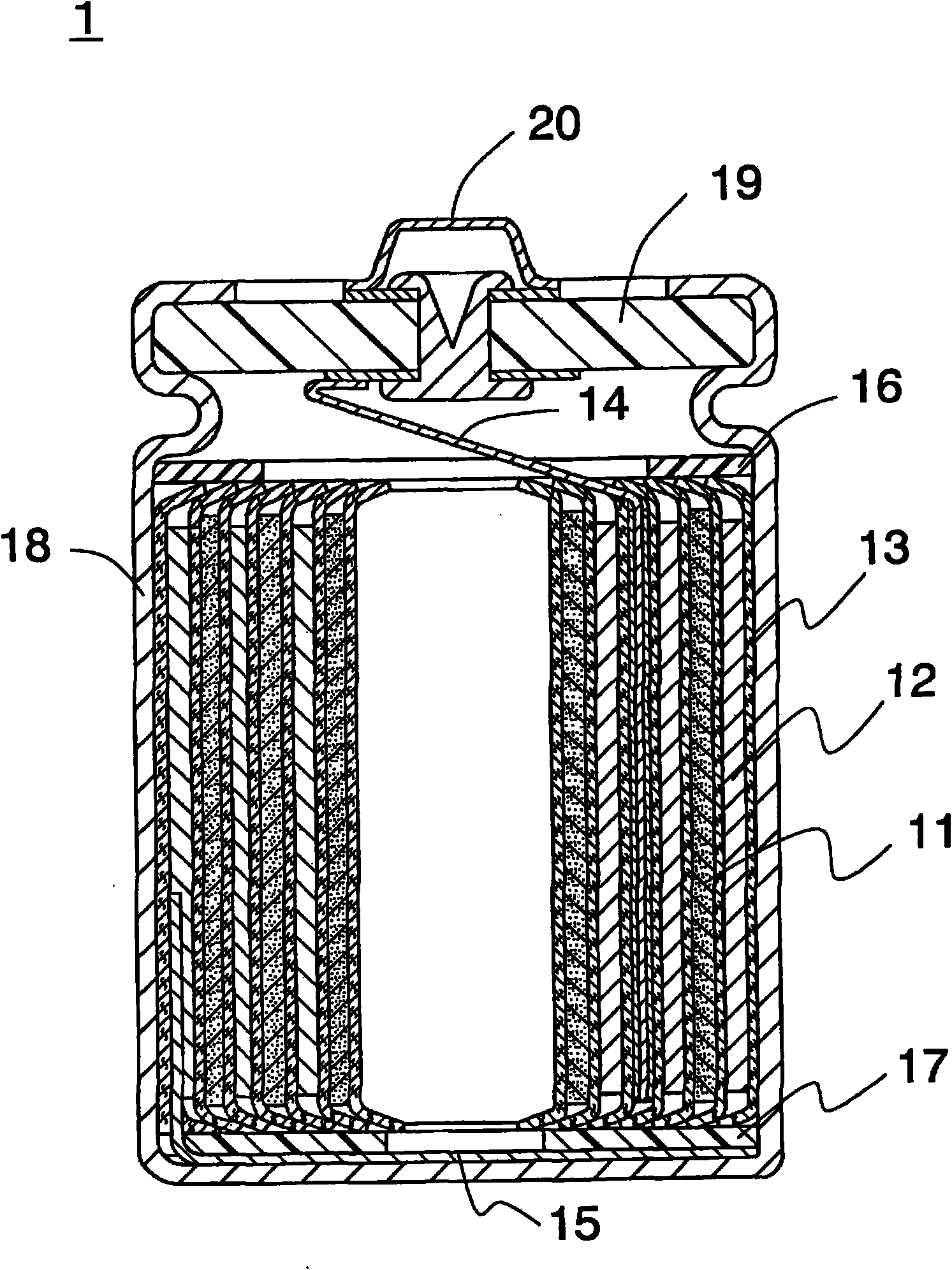
Figure 1 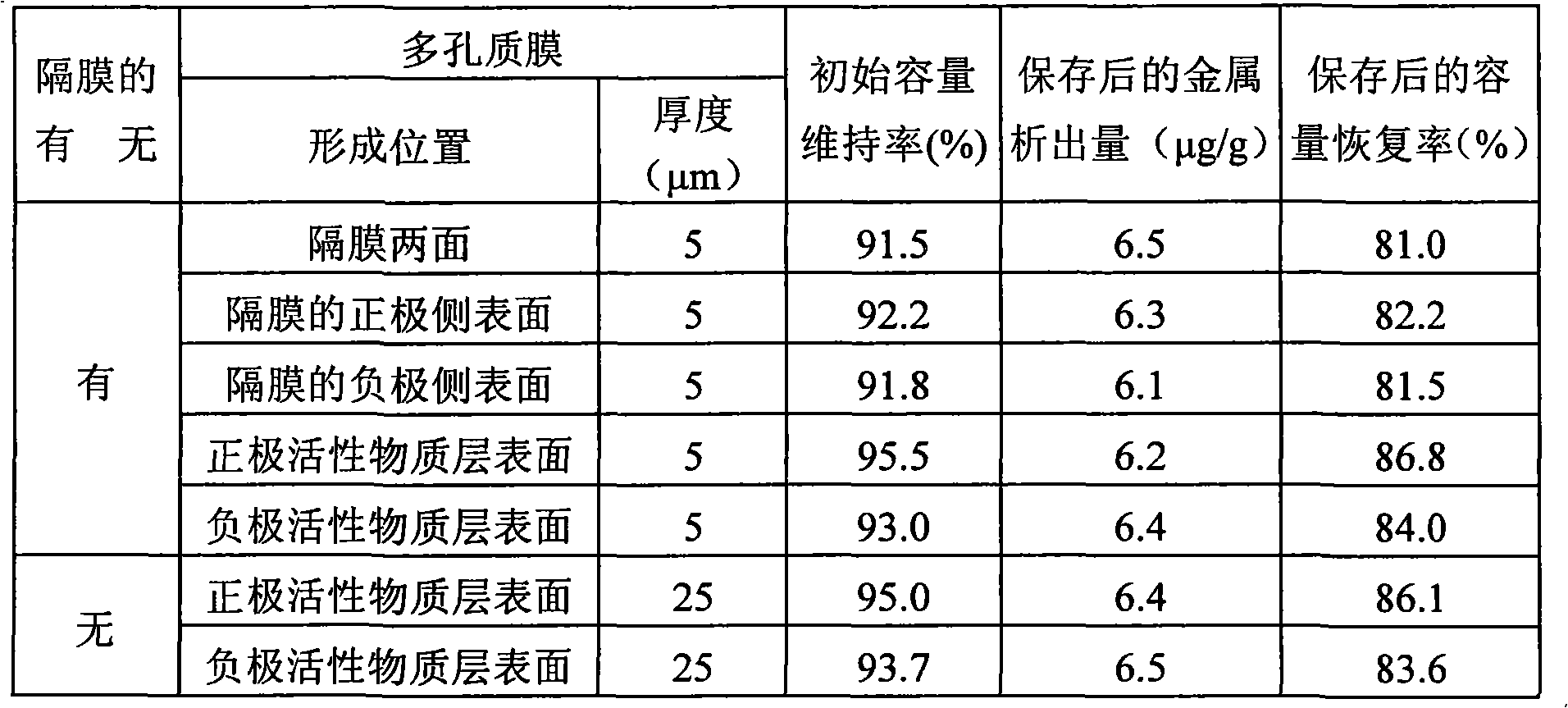
Figure 2 
Figure 3
Abstract
Description
technical field
[0001] The present invention relates to a nonaqueous electrolyte secondary battery. More specifically, the present invention mainly relates to improvement of storage characteristics of non-aqueous electrolyte secondary batteries. Background technique
[0002] Non-aqueous electrolyte secondary batteries, especially lithium ion secondary batteries, can obtain high voltage and have high energy density, so research is flourishing. In non-aqueous electrolyte secondary batteries, the positive electrode active material usually uses LiCoO 2 and other transition metal oxides. In addition, carbon materials are generally used as the negative electrode active material. As the separator, a porous sheet made of polyethylene, polypropylene, or the like is generally used.
[0003] A nonaqueous electrolyte generally contains a nonaqueous solvent and a lithium salt dissolved therein. As the nonaqueous solvent, cyclic carbonates, chain carbonates, cyclic carboxylates, and ...
Examples
Embodiment 1
[0088] (1) Preparation of non-aqueous electrolyte
[0089] Dissolving LiPF in sulfolane 6 , to a concentration of 1 mol / L. To the obtained solution, 1,3-propane sultone (hereinafter abbreviated as "PRS") was added in a ratio of 2 parts by weight to 100 parts by weight of sulfolane to prepare a nonaqueous electrolyte.
[0090] (2) Diaphragm
[0091] As the separator, a polyethylene microporous sheet (manufactured by Asahi Kasei Chemical Co., Ltd.) with a thickness of 20 μm was used.
[0092] (3) Production of positive electrode
[0093] Mix 85 parts by weight of lithium cobalt oxide powder (positive electrode active material, the median particle size based on volume is 10 μm, produced by Tanaka Chemical Research Institute), 10 parts by weight of acetylene black (conductive agent, Electrochemical Industry Co., Ltd. Production), 5 parts by weight of polyvinylidene fluoride resin (binder, produced by Kureha) and 40 parts by weight of dehydrated N-methyl-2-pyrrolidone (NMP, dis...
Embodiment 2
[0111] Not at the positive electrode, but on the surface of the negative electrode active material layer on both sides of the negative electrode, a porous film containing an inorganic oxide is formed, except that, in the same manner as in Example 1, a cylindrical nonaqueous electrolyte secondary electrode of the present invention is produced. battery and was evaluated. The results are shown in Table 1.
Embodiment 3
[0127] As shown in Table 2, except that the presence or absence of the separator, the formation position of the porous film containing the inorganic oxide, and the film thickness of the porous film were changed, the cylindrical non-conductive film of the present invention was produced in the same manner as in Example 1. Aqueous electrolyte secondary batteries were evaluated. The results are shown in Table 2 together.
[0128]In addition, in this embodiment, the positive electrode active material layer and the negative electrode active material layer are respectively formed on both surfaces in the thickness direction of the positive electrode and the negative electrode. Therefore, in the item "Position of Porous Membrane" in Table 2, for example, "surface of positive electrode active material layer" means that porous membranes are formed on both surfaces of the positive electrode. In addition, in the "Position of Porous Membrane" and "Thickness of Porous Membrane" in Table 2, ...