
Junctional tourniquet
a tourniquet and junction technology, applied in the field of tourniquets, can solve the problems of difficult application to a fallen patient, inability to prevent the loosening of the pressure points, and the device is not suitable for the wound in the trunk/thigh junction
Patent Information
- Authority / Receiving Office
- US · United States
- Patent Type
- Patents(United States)
- Current Assignee / Owner
- Publication Date
- 2016-11-15
Smart Images
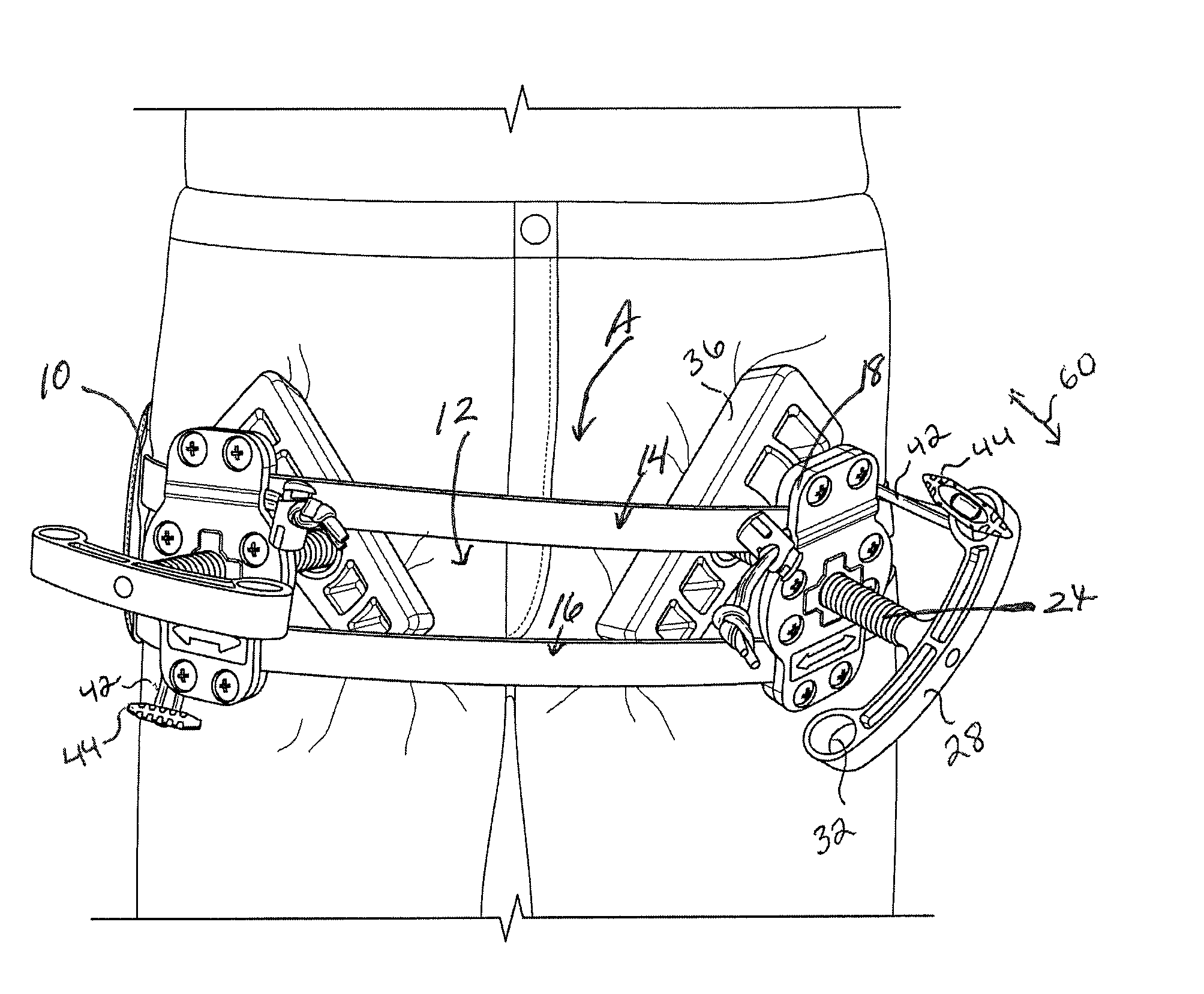
Figure 1 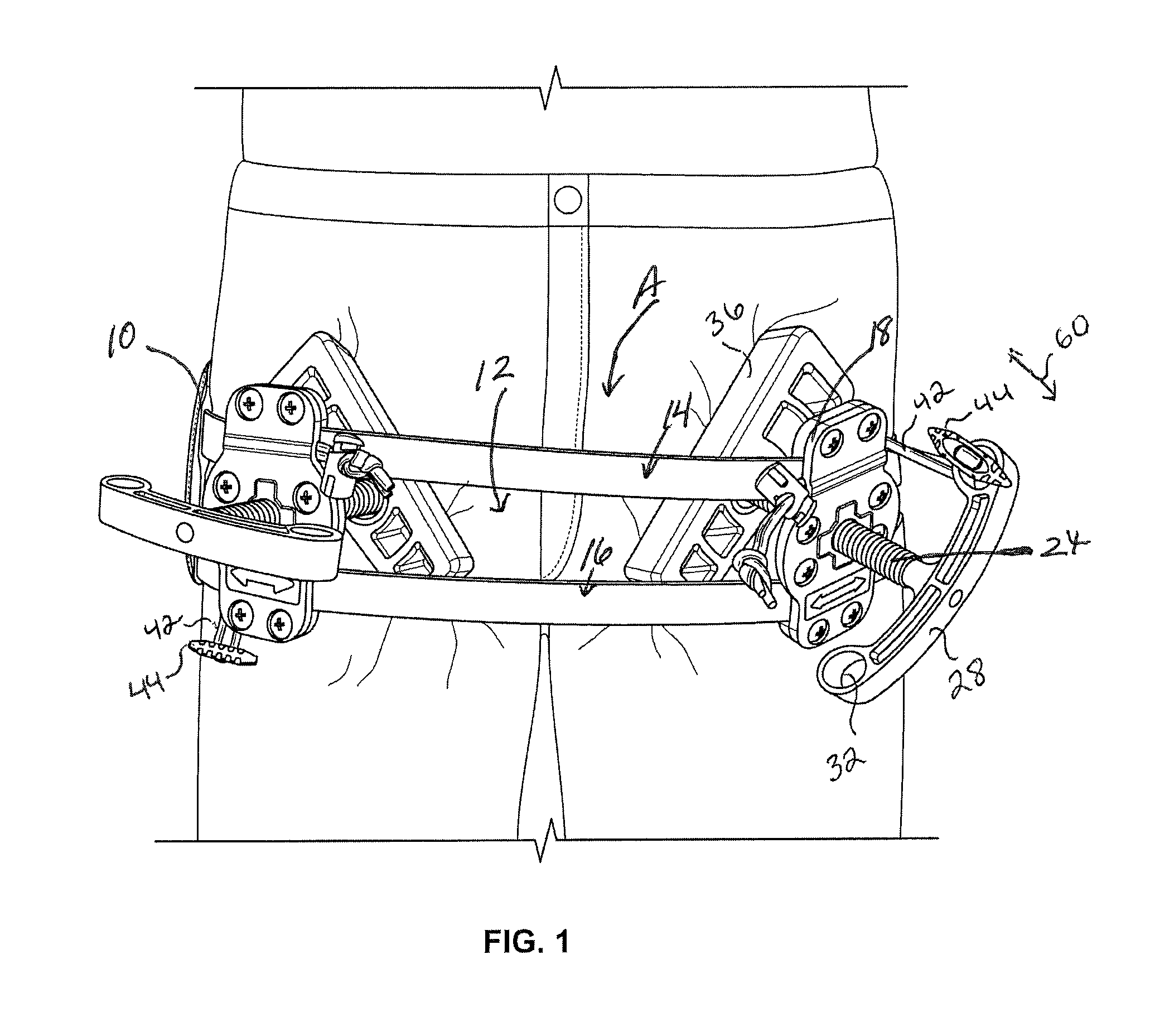
Figure 2 
Figure 3
Abstract
Description
CLAIM OF PRIORITY
[0001] This patent application claims priority on U.S. Patent Provisional Application Ser. No. 61 / 625,729 filed Apr. 18, 2012.FIELD OF THE INVENTION
[0002] This invention is directed to a tourniquet designed to apply pressure to wounds located in the junction between the trunk and thigh and more specifically, to a tourniquet having the ability to apply pressure circumferentially with discrete pressure points in the trunk / thigh junction.BACKGROUND OF THE INVENTION
[0003] Hemorrhage is one of the most common causes of preventable combat death in modern warfare. In response, efforts to create new and more effective and useful battlefield tourniquets has increased. For example, U.S. Pat. No. 4,469,099 is a Pneumatic Tourniquet described as a pneumatic tourniquet having an inflatable cuff, a pressurizing mechanism for pressurizing the cuff, a pressure relief mechanism for depressurizing the cuff, a pressure sensing mechanism for sensing the pressure to which the cuff is press...
Examples
Embodiment Construction
[0021]Referring to FIG. 1, the junctional tourniquet A is shown having a strap 10 encircling an individual. The strap include an opening 12 having an upper portion 14 and lower portion 16. The opening allows the base plates to be slidably attached to eh strap while also allowing the shaft to extend through the strap.
[0022]A first base plate 18 can include a top member 20 (FIG. 4) and a bottom member 22 that sandwiches the top and bottom portion of the strap allowing the base place to slide along the top and bottom portion of the strap to position the base plate above the location on the individual where compression is desired. The ability to position the base plates along the strap allows the compressive force to be placed in the proper location based upon the body type and injury and injury location of the individual. In one embodiment, the top member and the bottom member of the base plate are secured through a plurality of screws.
[0023]A shaft 24 is received in a base plate openi...