

Fuel or combustible substance composition comprising ammonia and at least one alkyne
The addition of C3 to C12 alkynes to ammonia-based fuels addresses the poor combustion performance of ammonia by reducing autoignition time and increasing flame speed, enhancing combustion efficiency and reducing energy consumption and CO2 emissions, providing a more effective and environmentally friendly fuel composition.
Patent Information
- Application Number
- PCT/FR2024/050481
- Authority / Receiving Office
- WO · WO
- Patent Type
- Applications
- Current Assignee / Owner
- Priority Date
- 2023-04-17
- Filing Date
- 2024-04-12
- Publication Date
- 2024-10-24
AI Technical Summary
Ammonia-based fuels exhibit poor combustion performance, including low flame speeds and high minimum ignition energy, which limits efficiency and increases energy consumption in combustion systems, and existing solutions like adding hydrogen or fossil fuels either require significant hydrogen reserves or generate CO2 emissions.
A fuel composition comprising ammonia and 0.01% to 20% by mass of C3 to C12 alkynes, which significantly reduces autoignition time, increases flame speed, and enhances combustion efficiency without the need for large hydrogen reserves or fossil fuels.
The addition of alkynes to ammonia-based fuels improves combustion performance, reducing energy consumption and environmental impact while maintaining low CO2 emissions, with minimal alkyne content being effective, and allowing for controlled combustion without detonations.
Smart Images

Figure IMGF000007_0001 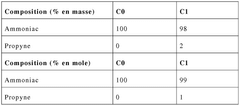
Figure IMGF000013_0001 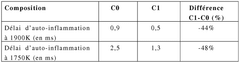
Figure IMGF000014_0001
Abstract
Description
[0001] DESCRIPTION
[0002] TITLE: Fuel or combustible composition comprising ammonia and at least one alkyne
[0003] The present invention relates to an ammonia (NH3)-based fuel or combustible composition comprising one or more alkyne(s). The invention also relates to the use of such a composition as a fuel or combustible for powering a combustion energy production system such as a heat engine or a boiler.
[0004] STATE OF THE PRIOR ART
[0005] In order to reduce greenhouse gas emissions generated by the combustion of hydrocarbon-based fuels, the international community is studying the use of alternative fuels with low carbon dioxide emissions. In this perspective, ammonia is considered an interesting solution, particularly for the transport sectors (especially maritime transport) and electricity generation in gas turbines.
[0006] Ammonia has multiple benefits, including but not limited to:
[0007] - It is a fully decarbonized fuel that can be produced using different technologies, including from hydrogen of renewable origin;
[0008] - Its combustion does not generate emissions of carbon dioxide CO2, sulfur gases (SOx), unburned hydrocarbons, or particles;
[0009] - It can be used in existing engines and heating devices, with minor adaptations.
[0010] However, a significant difficulty encountered so far lies in the poor combustion performance of ammonia when used in combustion systems. Indeed, tests carried out so far using mixtures of air and ammonia have shown low flame speeds and a high minimum ignition energy. These phenomena have a negative impact on combustion systems using ammonia as fuel. They limit combustion efficiency and reduce the operability ranges of the systems they supply (for example in the case of an engine: limitation of engine speed, limitation of the power output). They cause an increase in the energy consumption necessary to initiate combustion, and generate undesirable emissions of ammonia and nitrogen oxide in the exhaust.
[0011] One solution proposed in the prior art is to add gaseous hydrogen to the ammonia, either by direct addition (as described for example in the publication by Frigo S et al entitled “Further Insight into the Possibility to Fuel a SI Engine with Ammonia plus Hydrogen”, SAE Technical Paper Series. SAE International 400 Commonwealth Drive, Warrendale, PA, United States, 2014 or the publication by Mprch CS et al entitled “Ammonia / hydrogen mixtures in an SI-engine: Engine performance and analysis of a proposed fuel system”, Fuel 201 1, 90 (2): 854-64), or by cracking a portion of the ammonia into hydrogen as described for example in patent application US2017 / 348659.
[0012] The disadvantage of this solution is that it requires either the use of a large reserve of hydrogen in or near the ammonia-fueled system, or the costly installation of an in-line ammonia cracking system.
[0013] Other work has proposed the addition of methane or dimethyl ether (DME) to ammonia, or the addition of conventional fossil fuel carbon fractions such as diesel or gasoline. However, these additions generate CO2 emissions from the degradation of hydrocarbon fractions during combustion. In addition, it is desirable to be able to formulate fuel compositions and combustibles free of fossil bases.
[0014] Application WO 2021 / 030876 describes a fuel composition comprising a mixture of ammonia and an aqueous solution of sugar (in particular fructose, glucose or sucrose), which has better combustion properties. However, it is necessary to use sugars at significant levels, greater than 10% of the fuel composition, to obtain satisfactory results. The use of such compositions therefore represents a relatively high cost and increases CO2 emissions resulting from the degradation of sugars during combustion.
[0015] The present invention aims to remedy the problems described above, and in particular the problem of poor combustion performance of ammonia-based fuels.
[0016] The Applicant has now discovered that the addition to ammonia of a particular additive consisting of one or more alkynes makes it possible to achieve these objectives.
[0017] The present invention thus relates to a fuel or combustible composition comprising ammonia and from 0.01% to 20% by mass, relative to the total mass of the composition, of one or more alkyne(s) comprising from 3 to 12 carbon atoms.
[0018] This composition exhibits improved combustion performance, compared to ammonia-based fuel or combustible compositions.
[0019] In particular, the presence of the alkyne(s) in the composition makes it possible to significantly reduce the autoignition time, which is a good indicator of the chemical reactivity of the fuel / combustible and air mixture during the combustion process. The minimum ignition energy level is also reduced substantially. The flame speed is increased, which allows for good quality, controlled combustion without detonations. The combustion efficiency is also increased, which makes it possible to reduce the consumption of fuel or ammonia-based fuel, which leads to energy savings and a reduction in the environmental impact linked to the production and transport of the fuel / combustible.
[0020] The present invention does not require the use of significant quantities of alkyne, contents of the order of one tenth of a percent by mass being already very effective. The present invention also relates to the use of such a composition as fuel or as fuel in a device for producing energy by combustion such as in particular an internal combustion engine or a boiler.
[0021] The present invention finally relates to a method for producing energy comprising supplying a device for producing energy by combustion (such as in particular an internal combustion engine or a boiler) by means of a composition according to the invention.
[0022] Other objects, characteristics, aspects and advantages of the invention will appear even more clearly on reading the description which follows.
[0023] In what follows, and unless otherwise indicated, the limits of a domain of values are included in this domain, notably in the expressions "between" and "ranging from ... to ..."
[0024] Furthermore, the expressions "at least one" and "at least" used in this description are respectively equivalent to the expressions "one or more" and "greater than or equal to".
[0025] Finally, in a manner known per se, the term CN compound or group refers to a compound or group containing N carbon atoms in its chemical structure.
[0026] DETAILED DESCRIPTION
[0027] The composition of fuel or combustible
[0028] The composition according to the invention is based on ammonia, which is its main constituent.
[0029] Ammonia is a compound with the chemical formula NH3, which is known per se. It is therefore anhydrous ammonia and not aqueous ammonia, which is also known per se and refers to an aqueous solution of ammonia, the formula of which is generally noted as NH3.H2O, NH4OH, or aqueous NH3.
[0030] By "anhydrous ammonia" is meant that the ammonia does not comprise water in substantial content. However, the presence of water in low content (in particular less than or equal to 5% by mass) in the ammonia is not excluded from the scope of the invention. Water may, for example, be present in small quantities to reduce the risks of corrosion of the parts (in particular steel) in contact with the composition.
[0031] Preferably, the water content of the composition according to the invention is less than or equal to 5% by mass, more preferably less than or equal to 3% by mass, better still less than or equal to 2% by mass and better still less than or equal to 1% by mass, or even less than or equal to 0.5% by mass relative to the total mass of the composition.
[0032] The composition according to the invention may comprise ammonia in the liquid state, in the gaseous state, or in both of these states (in particular in the form of a liquid and gas equilibrium), depending on the temperature and pressure conditions at which it is found. In particular, at a pressure greater than 10 bar at room temperature or at a temperature lower than -33°C at room pressure, the ammonia is in the liquid state. This form is preferred.
[0033] Preferably, the ammonia is at least partly in the liquid state, and preferably completely in the liquid state.
[0034] The ammonia content of the composition is advantageously greater than or equal to 60% by mass, preferably greater than or equal to 70% by mass, more preferably greater than or equal to 80% by mass, even more preferably greater than or equal to 90% by mass and better still greater than or equal to 95% by mass, relative to the total mass of the composition.
[0035] Alkynes
[0036] The composition comprises at least one C3 to C12 alkyne.
[0037] As is known per se, an alkyne is a hydrocarbon comprising at least one triple bond between two consecutive carbon atoms.
[0038] The alkynes that can be used in the composition according to the invention are advantageously of formula C n H2n-2, with n an integer ranging from 3 to 12. Preferably, n ranges from 3 to 10, in particular from 3 to 8, more preferably from 3 to 6, and better still 3 or 4.
[0039] According to a preferred embodiment, the composition comprises one or more alkyne(s) chosen from:
[0040] - propyne, of formula:
[0041] HC - C _ C H3
[0042] - but- l -yne, of formula:
[0043] HC - C _ CH2CH3
[0044] - but-2-yne, of formula:
[0045] Propyne is particularly preferred.
[0046] The total content of the alkyne(s) is in the range from 0.01% to 20% by mass, relative to the total mass of the composition. Preferably, this content is in the range from 0.05 to 10% by mass, more preferably from 0.1 to 5% by mass, and better still from 0.5 to 3% by mass, relative to the total mass of the composition.
[0047] According to a preferred embodiment, the composition comprises one or more alkyne(s) chosen from propyne, but-1-yne and but-2-yne in a total content ranging from 0.01% to 20% by mass, preferably from 0.05 to 10% by mass, more preferably from 0.1 to 5% by mass, and better still from 0.5 to 3% by mass, relative to the total mass of the composition.
[0048] According to an equally preferred embodiment, the composition comprises propyne in a content ranging from 0.01% to 20% by mass, preferably from 0.05 to 10% by mass, more preferably from 0.1 to 5% by mass, and better still from 0.5 to 3% by mass, relative to the total mass of the composition.
[0049] Other compounds
[0050] The composition according to the invention may comprise one or more additional compounds, other than ammonia and C3 to C12 alkynes. It may thus comprise other bases, hydrocarbon or not, other than ammonia and alkynes, as well as additives.
[0051] For example, it may contain one or more additives consisting of organonitrate(s), and in particular one or more alkyl nitrates.
[0052] The alkyl nitrates which can be used in the composition according to the invention are advantageously chosen from the compounds of the following formula (I): R1 -NO3 (I) with Ri denoting an alkyl or cycloalkyl radical comprising from 1 to 12 carbon atoms.
[0053] Examples of alkyl nitrates include methyl nitrate, ethyl nitrate, propyl nitrate, isopropyl nitrate, butyl nitrates (including n-butyl nitrate, 1-methylpropyl nitrate, 2-methylpropyl nitrate, tert-butyl nitrate, cyclobutyl nitrate), pentyl nitrates (e.g. amyl nitrate, isoamyl nitrate, 2-amyl nitrate, 3-amyl nitrate), hexyl nitrate, heptyl nitrate, 2-heptyl nitrate, octyl nitrate, isooctyl nitrate, 2-ethylhexyl nitrate, nonyl nitrate, decyl nitrate, undecyl nitrate, dodecyl nitrate, cyclopentyl nitrate, cyclohexyl, methyl cyclohexyl nitrate, and mixtures of these compounds.
[0054] Isopropyl nitrate and 2-ethylhexyl nitrate are preferred, and 2-ethylhexyl nitrate is particularly preferred.
[0055] The alkyl nitrate(s) may be present in the composition according to the invention in a total content advantageously within the range from 0.005% (50 ppm) to 5% by mass, preferably from 0.01% (100 ppm) to 2% by mass, more preferably from 0.02% (200 ppm) to 1% by mass, relative to the total mass of the composition.
[0056] The composition according to the invention can be prepared by simply mixing these ingredients. It is stable during storage.
[0057] It may be prepared and stored in a tank for later use, or prepared extemporaneously (i.e. immediately before use), by mixing the ammonia and the alkyne(s) in the fuel intake circuit or the fuel in the combustion chamber.
[0058] The use
[0059] The composition according to the invention is useful as fuel or as combustible for powering any device used to produce energy by combustion.
[0060] According to a first embodiment, the composition according to the invention is used as fuel to power an internal combustion engine.
[0061] In this embodiment, according to a first advantageous variant, the composition according to the invention is used as fuel to power a gas turbine.
[0062] As is known per se, a gas turbine, also called a combustion turbine, is a thermodynamic rotating machine from the internal combustion engine family and which can be used for propulsion, electricity production, or as a stationary engine (for example to drive pumps, compressors, etc.).
[0063] According to a second equally advantageous variant, the composition according to the invention is used as fuel to power a piston engine.
[0064] In this variant, the composition is useful for powering any known piston engine, including on-board engines and stationary engines. The invention applies in particular to marine engines, heavy goods vehicles, construction machinery or agricultural machinery such as, for example, tractors, public transport vehicles (buses, trains, etc.) as well as to engines of light vehicles such as cars, engines used in air or space propulsion (airplanes, rockets), as well as to engines used in stationary industrial applications.
[0065] The piston engine can be chosen in particular from compression ignition engines or diesel engines, spark ignition engines (including gasoline engines, CNG or natural gas engines for vehicles and hydrogen engines), mixed fuel engines (in English “dual fuel”).
[0066] Preferably, the composition according to the invention is used to power a compression ignition engine or diesel engine. Particularly preferably, the compression ignition engine is a marine engine (i.e. an engine used for the propulsion of a ship).
[0067] The composition according to the invention can be advantageously used to fuel a compression ignition engine with mixed carburetion (also commonly called a “dual fuel” engine). In this use, the fuel composition according to the invention fuels the engine in combination with another fuel different from the latter, such as for example hydrogen and / or a hydrocarbon fuel, preferably a hydrocarbon fuel. By “hydrocarbon fuel”, in the present application is meant a fuel comprising at least 50% by mass of hydrocarbons. The hydrocarbon fuel can be chosen from fuels of petroleum origin and in particular diesel and fuel oils of varying weights, renewable fuels (for example but not limited to those derived from biomass), and mixtures of these two types of fuels.According to a preferred embodiment, the hydrocarbon fuel is chosen from fuels based on diesel and / or heavy fuel oils of petroleum origin (such as marine fuels), bio-sourced fuels and their mixtures.
[0068] The two fuels are injected in different proportions depending on the power required from the engine. The hydrocarbon fuel is advantageously injected into the engine in small quantities, to initiate combustion by self-ignition in a mixture with air. This injection is called pilot injection. The fuel according to the invention is injected in a mixture with air to fuel the combustion.
[0069] Mixed fuel engines are typically powered in the prior art by fuel combinations of diesel / gasoline, diesel / LPG, diesel / CNG, or diesel / ethanol. In the case of a marine engine, the mixed fuel engine is powered in particular by means of combinations of marine diesel or MGO (from the English "Marine GasOil") / natural gas, MGO / methanol, MGO / ammonia.
[0070] The use of a combination of hydrocarbon fuel and a fuel according to the invention having improved combustion performance makes it possible to significantly reduce the quantities of hydrocarbon fuel used for pilot injection, which makes it possible to reduce CO2 emissions, compared to the fuel combinations of the prior art.
[0071] In the case, for example, of a mixed fuel marine engine fueled by an MGO / ammonia type combination, the improvement in the reactivity of the ammonia-based fuel makes it possible to reduce the quantity of pilot injection of MGO into the combustion chamber to initiate combustion and thus reduce the CO2 emissions linked to this pilot injection.
[0072] Preferably, the composition according to the invention is used to power a mixed-fuel compression-ignition engine fitted to a ship (i.e. a mixed-fuel marine diesel engine).
[0073] According to a second embodiment, the composition according to the invention is used as fuel to supply an industrial boiler, such as for example those used to generate electrical or thermal energy.
[0074] The first embodiment is preferred. Particularly preferably, the composition according to the invention is used as fuel for powering a mixed-carburetion compression-ignition marine engine or a gas turbine (also called a combustion turbine).
[0075] The method
[0076] The energy production method according to the present invention comprises supplying a combustion energy production device with a fuel or combustible composition as described above. The energy production device may be chosen from any existing device, including, but not limited to, internal combustion engines and industrial boilers as described above.
[0077] Preferably, the power generation device is selected from compression ignition engines and gas turbines (or combustion turbines).
[0078] According to a first variant, the method according to the invention comprises supplying said energy production device with the composition according to the invention from a reservoir containing it.
[0079] According to a second embodiment, the method according to the invention comprises:
[0080] (1) a step of mixing ammonia and one or more C3 to C12 alkyne(s), in a content of 0.01% to 20% by mass relative to the total mass of the mixture; then
[0081] (2) injecting the mixture from step (1) into the combustion chamber of said energy production device.
[0082] The mixing step (1) can be carried out for example in the fuel intake circuit towards the combustion chamber, for example by injecting the alkyne(s) into the ammonia flow supplying the engine, upstream of the combustion chamber.
[0083] According to a preferred embodiment, the energy production device is a compression ignition engine with mixed carburetion (or “dual fuel” engine). In this embodiment, the method according to the invention comprises supplying the compression ignition engine with the fuel composition according to the invention and with another fuel different from the latter, preferably a hydrocarbon fuel as described above. The examples below are given by way of illustration of the invention, and should not be interpreted in such a way as to limit its scope.
[0084] EXAMPLES
[0085] Two fuel compositions were prepared from anhydrous ammonia (NH3) and propyne. The reference fuel denoted CO consists of ammonia, and the fuel C1 according to the invention contains 2% by mass of propyne. These compositions are detailed in Table 1 below.
[0086] Table 1
[0087] The following performances of these two fuels were evaluated: autoignition delay, flame speed and minimum ignition energy.
[0088] The test protocols and results obtained are detailed below.
[0089] Self-ignition time
[0090] The reactivity of a fuel composition can be characterized by the autoignition time, which in the present example was measured by means of a shock tube at different temperatures. In this example, the operating conditions of the shock tube were set to maintain a constant pressure of 2 bar (2.10 5Pa) as well as a constant temperature during each measurement. The richness of the different air-fuel mixtures is fixed at stoichiometry. The auto-ignition delay is determined by the time between the pressurization and temperature of the fuel mixture after the passage of the shock wave reflected by the bottom of the tube, and the instant of production of the emission signal of the excited radicals OH* measured using a detector set to a wavelength of 309nm.
[0091] For each temperature condition and composition, the autoignition time in the shock tube was determined.
[0092] Table 2 below details the results obtained.
[0093] Table 2
[0094] Composition C l provides very significant reductions in the autoignition time under both temperature conditions tested.
[0095] Flame speed and minimum ignition energy
[0096] Flame speed measurements at different temperatures and minimum ignition energy are performed using a shock tube similar to that used for autoignition delay measurement. Air is mixed with the fuel composition under test in stoichiometric proportion and then injected into the test section of a shock tube. The principle of propagation of an incident shock wave then reflected on the bottom of the tube allows the air-fuel mixture to be tested under the targeted thermodynamic conditions. A neodymium-doped yttrium-aluminum garnet (Nd-YAG) laser of adjustable power is focused inside the test section of the shock tube through optical windows on the side of the tube just after the reflected wave has passed.
[0097] The flame speed of the air-fuel mixture under the target thermodynamic conditions is measured by setting the laser pulse to 1000 nm. The development of the flame thus obtained is monitored by the Schlieren imaging technique using a Phantom v2012 camera equipped with a 50mm focal length lens. The analysis of the growth of the flame kernel diameter over time makes it possible to measure the flame speed of the air-fuel mixture under consideration.
[0098] The minimum ignition energy of the air-fuel mixture considered is measured at a temperature of 298K and a pressure of 1 atm (1.013. 10 5 Pa) by gradually increasing the energy delivered by the laser pulse from 1 mJ to 100 mJ. If the development of a flame kernel is observed, the experiment is repeated several times and the minimum ignition energy retained corresponds to the energy for which 3 consecutive ignitions are observed.
[0099] Table 3 below details the results obtained for flame speed.
[0100] Table 3 Composition C l provides a significant increase in flame speed under both temperature conditions tested. Table 4 below details the results obtained for the minimum ignition energy.
[0101] Table 4
[0102] Composition C l provides a significant reduction in minimum ignition energy.
Claims
CLAIMS 1. Fuel or combustible composition comprising ammonia and from 0.01% to 20% by mass, relative to the total mass of the composition, of one or more alkyne(s) comprising from 3 to 12 carbon atoms.
2. Composition according to the preceding claim, characterized in that the ammonia is in the liquid state, in the gaseous state, or in these two states, and preferably at least partly in the liquid state.
3. Composition according to any one of the preceding claims, characterized in that its ammonia content is greater than or equal to 60% by mass, preferably greater than or equal to 70% by mass, more preferably greater than or equal to 80% by mass, even more preferably greater than or equal to 90% by mass and better still greater than or equal to 95% by mass, relative to the total mass of the composition.
4. Composition according to any one of the preceding claims, characterized in that the alkyne(s) are of formula CnHin-2, with n an integer ranging from 3 to 12, in particular from 3 to 10, preferably from 3 to 8, more preferably from 3 to 6, and better still 3 or 4.
5. Composition according to any one of the preceding claims, characterized in that it comprises one or more alkyne(s) chosen from propyne, but-1-yne and but-2-yne, and preferably it comprises propyne.
6. Composition according to any one of the preceding claims, characterized in that the total content of the alkyne(s) is within the range from 0.05 to 10% by mass, preferably from 0.1 to 5% by mass, and more preferably from 0.5 to 3% by mass, relative to the total mass of the composition.
7. Use of a composition as defined in any one of the preceding claims as fuel or as combustible in a device for producing energy by combustion, preferably chosen from an internal combustion engine and a boiler such as an industrial boiler.
8. Use according to the preceding claim, as fuel for powering a gas turbine.
9. Use according to claim 7, as fuel for powering a piston engine, preferably chosen from compression ignition engines, spark ignition engines and mixed carburetion engines.
10. Use according to the preceding claim, characterized in that the piston engine is a compression ignition engine, preferably a mixed carburetion compression ignition engine.
11. Use according to the preceding claim, characterized in that the compression ignition engine is a marine engine.
12. Use according to one of claims 10 and 11, characterized in that said fuel composition supplies the engine in combination with a hydrocarbon fuel preferably chosen from fuels of petroleum origin, renewable fuels and mixtures of these two types of fuels; and more preferably chosen from fuels based on diesel of petroleum origin, biosourced fuels and their mixtures.
13. A method of producing energy comprising supplying a combustion energy producing device with a composition as defined in any one of claims 1 to 6.
14. Method according to the preceding claim, characterized in that the energy production device is chosen from compression ignition engines and gas turbines.
15. Method according to the preceding claim, characterized in that the energy production device is a compression ignition engine with mixed carburetion and in that it comprises supplying the engine with said fuel composition and with another fuel different from the latter, preferably a hydrocarbon fuel.
Citation Information
Patent Citations
Engine Fuel-Reforming Reactors, Systems, and Methods
US20170348659A1
An improved ammonia based fuel for engines
WO2021030876A1
Fuel for motor vehicles
US2357184A
Operation of thrust motors with high impulse and fuel for same
US2811431A