Carbon-negative Concrete: A Solution for Emission Reduction
OCT 10, 202510 MIN READ
Generate Your Research Report Instantly with AI Agent
Patsnap Eureka helps you evaluate technical feasibility & market potential.
Carbon-negative Concrete Background and Objectives
Concrete production is one of the most carbon-intensive industrial processes, accounting for approximately 8% of global CO2 emissions. This significant environmental impact has driven research into carbon-negative concrete technologies over the past two decades. Carbon-negative concrete represents a revolutionary approach that aims not only to reduce emissions but to actually sequester more carbon than is emitted during production, creating a net carbon sink rather than a source.
The evolution of concrete technology has progressed from traditional Portland cement-based formulations to low-carbon alternatives, and now to potentially carbon-negative solutions. This technological progression has been accelerated by increasing regulatory pressures, consumer demand for sustainable building materials, and corporate commitments to carbon neutrality across global supply chains.
Carbon-negative concrete technologies employ various mechanisms to achieve their environmental benefits, including alternative binding materials, carbon capture during curing processes, and the incorporation of industrial byproducts that would otherwise contribute to waste streams. These approaches represent a significant departure from conventional concrete manufacturing methods that have remained relatively unchanged for centuries.
The primary objective of carbon-negative concrete development is to transform the construction industry's environmental footprint while maintaining or enhancing the performance characteristics that make concrete the world's most widely used building material. This includes ensuring comparable strength, durability, workability, and cost-effectiveness to conventional concrete products.
Current research focuses on several promising pathways, including calcium silicate-based systems that actively absorb CO2 during curing, magnesium oxide-based cements that sequester carbon throughout their lifecycle, and geopolymer concretes that utilize industrial waste materials while significantly reducing emissions compared to traditional cement.
The technical challenges facing widespread adoption include scaling production processes, ensuring long-term performance under various environmental conditions, developing appropriate standards and testing protocols, and creating the necessary supply chains for novel raw materials. These challenges are being addressed through collaborative efforts between academic institutions, industry partners, and government research initiatives.
Market adoption objectives include achieving cost parity with conventional concrete products, establishing regulatory frameworks that recognize and incentivize carbon-negative building materials, and developing education and training programs for construction professionals to facilitate implementation of these new technologies.
The ultimate goal is to position carbon-negative concrete as a standard construction material within the next decade, potentially transforming the built environment from a major source of carbon emissions to a significant carbon sink, while supporting global efforts to mitigate climate change impacts.
The evolution of concrete technology has progressed from traditional Portland cement-based formulations to low-carbon alternatives, and now to potentially carbon-negative solutions. This technological progression has been accelerated by increasing regulatory pressures, consumer demand for sustainable building materials, and corporate commitments to carbon neutrality across global supply chains.
Carbon-negative concrete technologies employ various mechanisms to achieve their environmental benefits, including alternative binding materials, carbon capture during curing processes, and the incorporation of industrial byproducts that would otherwise contribute to waste streams. These approaches represent a significant departure from conventional concrete manufacturing methods that have remained relatively unchanged for centuries.
The primary objective of carbon-negative concrete development is to transform the construction industry's environmental footprint while maintaining or enhancing the performance characteristics that make concrete the world's most widely used building material. This includes ensuring comparable strength, durability, workability, and cost-effectiveness to conventional concrete products.
Current research focuses on several promising pathways, including calcium silicate-based systems that actively absorb CO2 during curing, magnesium oxide-based cements that sequester carbon throughout their lifecycle, and geopolymer concretes that utilize industrial waste materials while significantly reducing emissions compared to traditional cement.
The technical challenges facing widespread adoption include scaling production processes, ensuring long-term performance under various environmental conditions, developing appropriate standards and testing protocols, and creating the necessary supply chains for novel raw materials. These challenges are being addressed through collaborative efforts between academic institutions, industry partners, and government research initiatives.
Market adoption objectives include achieving cost parity with conventional concrete products, establishing regulatory frameworks that recognize and incentivize carbon-negative building materials, and developing education and training programs for construction professionals to facilitate implementation of these new technologies.
The ultimate goal is to position carbon-negative concrete as a standard construction material within the next decade, potentially transforming the built environment from a major source of carbon emissions to a significant carbon sink, while supporting global efforts to mitigate climate change impacts.
Market Demand Analysis for Sustainable Construction Materials
The global construction industry is witnessing a significant shift towards sustainable building materials, driven by increasing environmental concerns and regulatory pressures. The market for sustainable construction materials, particularly carbon-negative concrete, has experienced substantial growth in recent years. According to recent market research, the global green concrete market was valued at approximately $26.2 billion in 2021 and is projected to reach $65.8 billion by 2030, growing at a CAGR of 10.7% during the forecast period.
This growth is primarily fueled by stringent environmental regulations aimed at reducing carbon emissions in the construction sector, which accounts for nearly 40% of global CO2 emissions. The concrete industry alone is responsible for about 8% of global carbon emissions, making it a critical target for sustainability initiatives. Government policies promoting green building standards, such as LEED certification in the United States and similar programs worldwide, have created strong incentives for adopting carbon-negative concrete solutions.
Consumer demand patterns also indicate a growing preference for environmentally responsible construction materials. A survey conducted among major construction firms revealed that 73% of clients now specifically request sustainable building materials, up from 45% just five years ago. This shift in consumer behavior is particularly pronounced in developed markets across North America, Europe, and parts of Asia-Pacific, where environmental consciousness is increasingly influencing purchasing decisions.
The economic viability of carbon-negative concrete has improved significantly, narrowing the cost gap with traditional concrete. While sustainable alternatives were previously 15-20% more expensive than conventional concrete, technological advancements and economies of scale have reduced this premium to 5-10% in many markets. Moreover, lifecycle cost analyses demonstrate that buildings constructed with carbon-negative concrete often yield long-term savings through improved energy efficiency and reduced maintenance requirements.
Regional market analysis shows varying adoption rates, with Europe leading in market penetration at approximately 18%, followed by North America at 14% and Asia-Pacific at 9%. Developing regions present substantial growth opportunities, particularly as urbanization accelerates and infrastructure development intensifies. China and India, with their massive construction sectors, represent especially promising markets for sustainable concrete technologies.
Industry forecasts suggest that the market share of carbon-negative concrete could reach 25% of the global concrete market by 2035, representing a transformative shift in construction practices. This growth trajectory is supported by ongoing research and development efforts, increasing venture capital investments in green construction technologies, and the establishment of industry partnerships focused on scaling sustainable solutions.
This growth is primarily fueled by stringent environmental regulations aimed at reducing carbon emissions in the construction sector, which accounts for nearly 40% of global CO2 emissions. The concrete industry alone is responsible for about 8% of global carbon emissions, making it a critical target for sustainability initiatives. Government policies promoting green building standards, such as LEED certification in the United States and similar programs worldwide, have created strong incentives for adopting carbon-negative concrete solutions.
Consumer demand patterns also indicate a growing preference for environmentally responsible construction materials. A survey conducted among major construction firms revealed that 73% of clients now specifically request sustainable building materials, up from 45% just five years ago. This shift in consumer behavior is particularly pronounced in developed markets across North America, Europe, and parts of Asia-Pacific, where environmental consciousness is increasingly influencing purchasing decisions.
The economic viability of carbon-negative concrete has improved significantly, narrowing the cost gap with traditional concrete. While sustainable alternatives were previously 15-20% more expensive than conventional concrete, technological advancements and economies of scale have reduced this premium to 5-10% in many markets. Moreover, lifecycle cost analyses demonstrate that buildings constructed with carbon-negative concrete often yield long-term savings through improved energy efficiency and reduced maintenance requirements.
Regional market analysis shows varying adoption rates, with Europe leading in market penetration at approximately 18%, followed by North America at 14% and Asia-Pacific at 9%. Developing regions present substantial growth opportunities, particularly as urbanization accelerates and infrastructure development intensifies. China and India, with their massive construction sectors, represent especially promising markets for sustainable concrete technologies.
Industry forecasts suggest that the market share of carbon-negative concrete could reach 25% of the global concrete market by 2035, representing a transformative shift in construction practices. This growth trajectory is supported by ongoing research and development efforts, increasing venture capital investments in green construction technologies, and the establishment of industry partnerships focused on scaling sustainable solutions.
Current Status and Challenges in Carbon-negative Concrete Technology
Carbon-negative concrete technology has made significant strides globally, with various approaches being developed and tested across different regions. In North America, companies like CarbonCure and Solidia Technologies have pioneered CO2 injection methods that have reached commercial implementation stages. European research institutions, particularly in Scandinavia and Germany, lead in alternative binding materials research, while Asia-Pacific regions focus on industrial waste incorporation techniques.
Despite these advancements, carbon-negative concrete faces substantial technical challenges. The carbonation process, central to carbon sequestration in concrete, remains difficult to optimize at industrial scales. Current methods achieve variable CO2 absorption rates between 5-20% of theoretical maximums, with efficiency heavily dependent on curing conditions, mixture proportions, and processing parameters.
Material performance issues persist as a significant barrier. Carbon-negative formulations often exhibit reduced early-stage strength development, with some formulations showing 15-30% lower 7-day compressive strength compared to conventional concrete. Long-term durability concerns, particularly regarding freeze-thaw resistance and reinforcement protection, require additional research before widespread adoption can occur.
Scalability represents another critical challenge. Many promising technologies remain confined to laboratory settings or small-scale demonstrations. The transition to industrial production faces bottlenecks in specialized equipment requirements, process control complexity, and quality assurance protocols. Additionally, the geographical distribution of necessary raw materials (particularly supplementary cementitious materials like fly ash and slag) is uneven, creating supply chain vulnerabilities.
Regulatory frameworks and standardization lag behind technological development. Current building codes and material specifications in most countries do not adequately address carbon-negative concrete formulations, creating market entry barriers. The absence of standardized carbon accounting methodologies specific to these materials further complicates verification of environmental claims.
Economic viability remains questionable without policy support. Production costs typically exceed conventional concrete by 15-40%, depending on technology pathway and regional factors. While carbon pricing mechanisms could theoretically offset this premium, current carbon markets provide insufficient incentives in most regions. The capital investment required for retrofitting existing plants or building new specialized facilities presents additional financial hurdles for industry adoption.
Despite these advancements, carbon-negative concrete faces substantial technical challenges. The carbonation process, central to carbon sequestration in concrete, remains difficult to optimize at industrial scales. Current methods achieve variable CO2 absorption rates between 5-20% of theoretical maximums, with efficiency heavily dependent on curing conditions, mixture proportions, and processing parameters.
Material performance issues persist as a significant barrier. Carbon-negative formulations often exhibit reduced early-stage strength development, with some formulations showing 15-30% lower 7-day compressive strength compared to conventional concrete. Long-term durability concerns, particularly regarding freeze-thaw resistance and reinforcement protection, require additional research before widespread adoption can occur.
Scalability represents another critical challenge. Many promising technologies remain confined to laboratory settings or small-scale demonstrations. The transition to industrial production faces bottlenecks in specialized equipment requirements, process control complexity, and quality assurance protocols. Additionally, the geographical distribution of necessary raw materials (particularly supplementary cementitious materials like fly ash and slag) is uneven, creating supply chain vulnerabilities.
Regulatory frameworks and standardization lag behind technological development. Current building codes and material specifications in most countries do not adequately address carbon-negative concrete formulations, creating market entry barriers. The absence of standardized carbon accounting methodologies specific to these materials further complicates verification of environmental claims.
Economic viability remains questionable without policy support. Production costs typically exceed conventional concrete by 15-40%, depending on technology pathway and regional factors. While carbon pricing mechanisms could theoretically offset this premium, current carbon markets provide insufficient incentives in most regions. The capital investment required for retrofitting existing plants or building new specialized facilities presents additional financial hurdles for industry adoption.
Current Technical Solutions for Carbon-negative Concrete Production
01 Carbon capture and sequestration in concrete
Technologies that enable concrete to absorb and permanently store carbon dioxide during the curing process, transforming CO2 into stable calcium carbonate. This approach not only reduces the carbon footprint of concrete production but can potentially make concrete carbon-negative by sequestering more carbon than is emitted during manufacturing. These methods include specialized curing chambers, CO2-reactive additives, and innovative mixing techniques that enhance carbonation.- Carbon capture and sequestration in concrete: Technologies that enable concrete to absorb and permanently store carbon dioxide during the curing process, transforming CO2 into stable calcium carbonates within the concrete matrix. This approach not only reduces the carbon footprint of concrete production but can potentially make concrete carbon-negative by sequestering more CO2 than is emitted during manufacturing. These methods include specialized curing chambers, CO2-reactive additives, and innovative mixing techniques that enhance carbonation.
- Alternative cementitious materials and binders: Development of novel cement alternatives and supplementary cementitious materials that significantly reduce carbon emissions compared to traditional Portland cement. These include geopolymers, alkali-activated materials, magnesium-based cements, and various industrial byproducts like fly ash and slag. These alternative binders can reduce the carbon footprint of concrete by up to 80% while maintaining or even improving performance characteristics such as strength and durability.
- CO2 utilization in concrete manufacturing: Methods for utilizing captured carbon dioxide as a resource in concrete production processes. This includes technologies that inject CO2 into fresh concrete mixtures, use CO2 to cure precast concrete elements, or incorporate carbonated aggregates. These approaches convert waste CO2 into valuable construction materials, creating a circular carbon economy while producing stronger concrete with reduced environmental impact.
- Monitoring and verification systems for carbon reduction: Advanced systems and methodologies for accurately measuring, reporting, and verifying carbon reductions in concrete production. These include specialized sensors, data analytics platforms, and lifecycle assessment tools that quantify carbon sequestration and emission reductions. Such systems enable concrete producers to validate environmental claims, participate in carbon markets, and optimize their manufacturing processes for maximum carbon efficiency.
- Biomass and waste incorporation for carbon reduction: Integration of biomass materials and industrial waste products into concrete formulations to reduce carbon emissions. These approaches include incorporating biochar, agricultural residues, and other carbon-negative materials that store biogenic carbon. Additionally, techniques for using waste materials like plastic, glass, and construction debris as aggregates or fillers help reduce the embodied carbon of concrete while addressing waste management challenges.
02 Alternative cementitious materials and binders
Utilization of alternative materials to replace traditional Portland cement, which is responsible for significant CO2 emissions. These alternatives include geopolymers, alkali-activated materials, magnesium-based cements, and supplementary cementitious materials like fly ash, slag, and silica fume. These materials can reduce carbon emissions by up to 80% compared to conventional cement while maintaining or improving concrete performance characteristics.Expand Specific Solutions03 Biomass and waste incorporation in concrete
Integration of biomass and industrial waste products into concrete formulations to reduce carbon emissions. This approach includes using agricultural residues, wood waste, and other biogenic materials as partial replacements for cement or aggregates. These materials often have already sequestered carbon during their growth phase, and their incorporation into concrete prevents the release of this carbon while reducing the need for carbon-intensive raw materials.Expand Specific Solutions04 Energy-efficient concrete production methods
Innovative manufacturing processes that significantly reduce energy consumption and associated carbon emissions in concrete production. These methods include low-temperature clinker formation, electric kiln technologies, hydrogen-based heating systems, and advanced grinding techniques. By reducing the thermal energy required for cement production, these technologies directly address one of the largest sources of carbon emissions in the concrete industry.Expand Specific Solutions05 Carbon accounting and monitoring systems for concrete
Advanced systems for measuring, tracking, and verifying carbon emissions and reductions throughout the concrete lifecycle. These technologies include embedded sensors, blockchain-based tracking, life cycle assessment tools, and real-time monitoring systems that provide accurate data on carbon footprints. Such systems enable concrete producers to optimize their processes for carbon reduction, validate carbon credits, and demonstrate compliance with environmental regulations.Expand Specific Solutions
Key Industry Players in Carbon-negative Concrete Development
The carbon-negative concrete market is in its early growth phase, characterized by increasing innovation and strategic investments as the construction industry seeks to reduce its substantial carbon footprint. The global market for green cement is projected to reach $50-60 billion by 2030, driven by stringent emissions regulations and sustainability goals. Technologically, the field shows varying maturity levels across different approaches. Leading players include established cement manufacturers like Lafarge and Taiheiyo Cement, who are integrating carbon capture technologies, alongside innovative startups such as Solidia Technologies and Carbon Limit Co., which are developing novel binding materials and carbon sequestration processes. Research institutions including Colorado School of Mines and Cambridge Enterprise are advancing fundamental technologies, while major construction firms like Kajima Corporation are implementing these solutions at scale, creating a diverse competitive landscape poised for significant growth.
Solidia Technologies, Inc.
Technical Solution: Solidia Technologies has developed a revolutionary carbon-negative concrete solution that fundamentally alters the chemistry of cement. Their patented process replaces traditional Ordinary Portland Cement (OPC) with Solidia Cement™, which requires lower kiln temperatures during manufacturing (1200°C vs 1450°C for OPC), reducing CO2 emissions by up to 30%. The innovation continues in the curing process, where instead of using water, Solidia concrete products cure through carbonation - actively absorbing CO2. This dual approach allows their concrete to sequester approximately 240-400 kg of CO2 per ton of cement used. Their technology can be implemented in existing concrete manufacturing facilities with minimal modifications, making adoption more feasible for industry players. Solidia's products have demonstrated comparable or superior performance characteristics to traditional concrete, including higher early strength development and reduced efflorescence.
Strengths: Achieves carbon reduction through both manufacturing and curing processes; compatible with existing infrastructure; produces higher early strength concrete. Weaknesses: Requires CO2 supply for curing process; limited track record in large-scale infrastructure projects; potential higher initial implementation costs compared to traditional methods.
Lafarge SA
Technical Solution: Lafarge has pioneered several carbon-negative concrete technologies, most notably their ECOPact and DYNAMax solutions. Their approach combines multiple strategies: (1) Clinker substitution with supplementary cementitious materials (SCMs) like calcined clay, fly ash, and ground granulated blast furnace slag, reducing the carbon-intensive clinker content by up to 50%; (2) Carbon capture utilization and storage (CCUS) technology at production facilities, with their Edmonton plant in Canada capturing approximately 1 ton of CO2 per day; (3) Novel concrete formulations incorporating CO2-absorbing aggregates; and (4) Optimization of concrete mix designs using artificial intelligence to reduce cement content while maintaining performance specifications. Lafarge has also developed Ductal®, an ultra-high-performance concrete that allows for thinner structural elements, reducing overall material usage by up to 75% compared to conventional concrete, further decreasing the carbon footprint of construction projects.
Strengths: Comprehensive approach combining multiple carbon reduction strategies; global scale allows for rapid deployment of innovations; strong R&D capabilities with numerous patents. Weaknesses: Some solutions remain in pilot phases; high implementation costs for CCUS technology; variable availability of SCMs in different regions may limit consistent application globally.
Core Patents and Innovations in CO2 Sequestration for Concrete
Cementitious materials and methods of making and using same
PatentPendingUS20250042811A1
Innovation
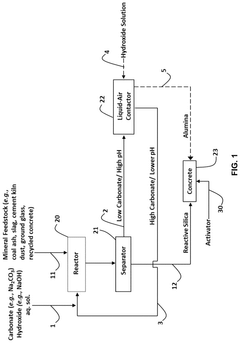
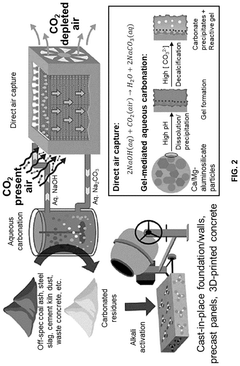
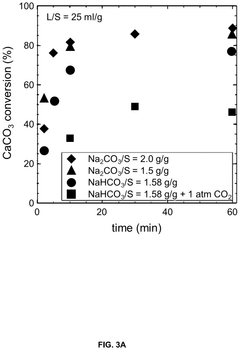
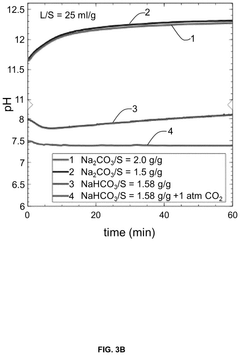
- A carbon mineralization-based direct-air capture process is used to produce carbon-negative cementitious materials by capturing CO2 from the air through an aqueous carbonation cycle, enhancing the pozzolanic reactivity of industrial mineral wastes, and incorporating the captured CO2 as solid carbonate in the concrete.
Negative-carbon cement (NC2) production
PatentWO2024059483A1
Innovation
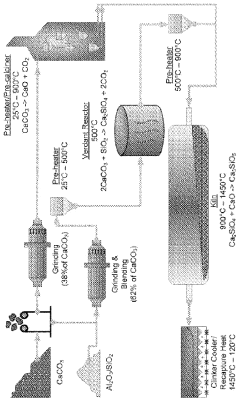
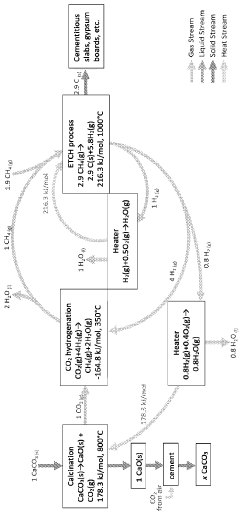
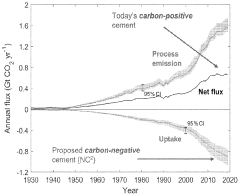
- A process and system that calcines calcium carbonate to produce calcium oxide and carbon dioxide, which is then reacted with hydrogen gas to produce methane and water, followed by pyrolysis to convert methane into solid carbon, with the produced hydrogen gas used to offset energy needs in the process, thereby reducing carbon emissions.
Regulatory Framework and Carbon Credit Opportunities
The global regulatory landscape for carbon-negative concrete is rapidly evolving, creating both compliance requirements and economic opportunities. The Paris Agreement has established a framework that encourages nations to implement carbon reduction strategies across all industries, with construction and concrete production being significant focus areas. In the European Union, the Emissions Trading System (ETS) has expanded to include cement production, imposing carbon pricing mechanisms that incentivize the adoption of carbon-negative alternatives. Similarly, the United States has introduced tax incentives through the Inflation Reduction Act that specifically rewards carbon capture and utilization in building materials.
Regional carbon pricing mechanisms vary significantly, with prices ranging from $5 to $130 per ton of CO2 equivalent. This price variability creates different economic thresholds for carbon-negative concrete adoption across markets. Notably, jurisdictions with higher carbon prices, such as Sweden and Switzerland, have seen accelerated development and implementation of carbon-negative concrete technologies.
Building codes and standards are being revised globally to accommodate and promote low-carbon construction materials. The International Building Code and ASTM International have developed specific provisions for alternative concrete formulations, while maintaining stringent safety and performance requirements. These regulatory adaptations are essential for market acceptance and widespread adoption of carbon-negative concrete solutions.
Carbon credit opportunities represent a significant economic incentive for carbon-negative concrete producers. The voluntary carbon market has grown exponentially, reaching $2 billion in 2022, with projections suggesting a $50 billion market by 2030. Carbon-negative concrete projects can generate high-quality carbon credits that command premium prices due to their permanence and measurability. Several methodologies for quantifying carbon sequestration in concrete have been approved by major carbon registries, including Verra and Gold Standard.
Corporate sustainability commitments are driving demand for carbon credits from construction materials, with many Fortune 500 companies pledging to achieve net-zero emissions in their supply chains. This creates a robust market for carbon credits generated through carbon-negative concrete production. Innovative financing mechanisms, such as carbon credit futures and advance market commitments, are emerging to provide upfront capital for scaling carbon-negative concrete technologies.
Regulatory harmonization remains a challenge, with inconsistent standards across jurisdictions creating market fragmentation. However, international initiatives like the Industrial Deep Decarbonization Initiative are working to establish common frameworks for embodied carbon accounting in construction materials, which will facilitate global market development for carbon-negative concrete solutions.
Regional carbon pricing mechanisms vary significantly, with prices ranging from $5 to $130 per ton of CO2 equivalent. This price variability creates different economic thresholds for carbon-negative concrete adoption across markets. Notably, jurisdictions with higher carbon prices, such as Sweden and Switzerland, have seen accelerated development and implementation of carbon-negative concrete technologies.
Building codes and standards are being revised globally to accommodate and promote low-carbon construction materials. The International Building Code and ASTM International have developed specific provisions for alternative concrete formulations, while maintaining stringent safety and performance requirements. These regulatory adaptations are essential for market acceptance and widespread adoption of carbon-negative concrete solutions.
Carbon credit opportunities represent a significant economic incentive for carbon-negative concrete producers. The voluntary carbon market has grown exponentially, reaching $2 billion in 2022, with projections suggesting a $50 billion market by 2030. Carbon-negative concrete projects can generate high-quality carbon credits that command premium prices due to their permanence and measurability. Several methodologies for quantifying carbon sequestration in concrete have been approved by major carbon registries, including Verra and Gold Standard.
Corporate sustainability commitments are driving demand for carbon credits from construction materials, with many Fortune 500 companies pledging to achieve net-zero emissions in their supply chains. This creates a robust market for carbon credits generated through carbon-negative concrete production. Innovative financing mechanisms, such as carbon credit futures and advance market commitments, are emerging to provide upfront capital for scaling carbon-negative concrete technologies.
Regulatory harmonization remains a challenge, with inconsistent standards across jurisdictions creating market fragmentation. However, international initiatives like the Industrial Deep Decarbonization Initiative are working to establish common frameworks for embodied carbon accounting in construction materials, which will facilitate global market development for carbon-negative concrete solutions.
Life Cycle Assessment of Carbon-negative Concrete Solutions
Life Cycle Assessment (LCA) provides a comprehensive framework for evaluating the environmental impacts of carbon-negative concrete solutions across their entire existence. This methodology examines impacts from raw material extraction through manufacturing, transportation, use, and end-of-life disposal or recycling. For carbon-negative concrete, LCA reveals significant advantages compared to traditional Portland cement concrete, particularly in greenhouse gas emissions reduction.
The assessment begins with the raw material phase, where carbon-negative concrete demonstrates substantial benefits through the incorporation of industrial byproducts like fly ash, slag, and silica fume. These materials, which would otherwise require disposal, reduce the need for energy-intensive clinker production. Additionally, innovative carbon capture technologies integrated into the manufacturing process actively sequester CO2, transforming concrete from a carbon source to a carbon sink.
During the production phase, LCA studies indicate that carbon-negative concrete typically requires 30-60% less energy than conventional concrete manufacturing. This reduction stems from lower calcination temperatures and the elimination of certain energy-intensive steps in the traditional cement production process. The incorporation of CO2 curing techniques further enhances carbon sequestration capabilities while simultaneously improving concrete strength properties.
Transportation impacts vary significantly based on local availability of materials. However, as carbon-negative concrete technologies gain wider adoption, regional production facilities are emerging, reducing transportation distances and associated emissions. Some carbon-negative solutions utilize locally available waste materials, further minimizing transportation-related environmental impacts.
In the use phase, carbon-negative concrete demonstrates comparable or superior durability to traditional concrete, potentially extending service life by 20-30%. This longevity reduces the need for replacement and rehabilitation, decreasing lifecycle emissions. Additionally, certain carbon-negative formulations continue to absorb CO2 throughout their service life, enhancing their carbon sequestration potential over decades.
End-of-life considerations reveal that carbon-negative concrete can be recycled similarly to conventional concrete, with crushed material serving as aggregate in new concrete or as fill material. Some advanced carbon-negative formulations are designed for enhanced recyclability, further reducing lifecycle impacts.
Comprehensive LCA studies indicate that leading carbon-negative concrete solutions can achieve net carbon reductions of 100-300 kg CO2 per cubic meter of concrete, compared to emissions of 300-400 kg CO2 per cubic meter for traditional concrete. This transformation represents a potential 200-700 kg CO2 swing per cubic meter, offering a revolutionary approach to addressing the construction industry's carbon footprint.
The assessment begins with the raw material phase, where carbon-negative concrete demonstrates substantial benefits through the incorporation of industrial byproducts like fly ash, slag, and silica fume. These materials, which would otherwise require disposal, reduce the need for energy-intensive clinker production. Additionally, innovative carbon capture technologies integrated into the manufacturing process actively sequester CO2, transforming concrete from a carbon source to a carbon sink.
During the production phase, LCA studies indicate that carbon-negative concrete typically requires 30-60% less energy than conventional concrete manufacturing. This reduction stems from lower calcination temperatures and the elimination of certain energy-intensive steps in the traditional cement production process. The incorporation of CO2 curing techniques further enhances carbon sequestration capabilities while simultaneously improving concrete strength properties.
Transportation impacts vary significantly based on local availability of materials. However, as carbon-negative concrete technologies gain wider adoption, regional production facilities are emerging, reducing transportation distances and associated emissions. Some carbon-negative solutions utilize locally available waste materials, further minimizing transportation-related environmental impacts.
In the use phase, carbon-negative concrete demonstrates comparable or superior durability to traditional concrete, potentially extending service life by 20-30%. This longevity reduces the need for replacement and rehabilitation, decreasing lifecycle emissions. Additionally, certain carbon-negative formulations continue to absorb CO2 throughout their service life, enhancing their carbon sequestration potential over decades.
End-of-life considerations reveal that carbon-negative concrete can be recycled similarly to conventional concrete, with crushed material serving as aggregate in new concrete or as fill material. Some advanced carbon-negative formulations are designed for enhanced recyclability, further reducing lifecycle impacts.
Comprehensive LCA studies indicate that leading carbon-negative concrete solutions can achieve net carbon reductions of 100-300 kg CO2 per cubic meter of concrete, compared to emissions of 300-400 kg CO2 per cubic meter for traditional concrete. This transformation represents a potential 200-700 kg CO2 swing per cubic meter, offering a revolutionary approach to addressing the construction industry's carbon footprint.
Unlock deeper insights with Patsnap Eureka Quick Research — get a full tech report to explore trends and direct your research. Try now!
Generate Your Research Report Instantly with AI Agent
Supercharge your innovation with Patsnap Eureka AI Agent Platform!