

CFRP vs Bamboo Composites: Weight Efficiency Analysis
SEP 17, 20259 MIN READ
Generate Your Research Report Instantly with AI Agent
PatSnap Eureka helps you evaluate technical feasibility & market potential.
CFRP and Bamboo Composites Background and Objectives
Carbon Fiber Reinforced Polymers (CFRP) have revolutionized multiple industries since their commercial introduction in the 1960s. Initially developed for aerospace applications, CFRP materials have evolved significantly over the past six decades, demonstrating exceptional strength-to-weight ratios that surpass traditional structural materials like steel and aluminum. The technology has progressively expanded from specialized military and aerospace applications to broader adoption in automotive, sporting goods, and construction sectors.
The evolution of CFRP technology has been characterized by continuous improvements in manufacturing processes, from early hand lay-up techniques to advanced automated fiber placement and resin transfer molding. These advancements have gradually reduced production costs while improving material consistency and performance characteristics, though CFRP remains a premium material with significant environmental footprint concerns.
Parallel to CFRP development, bamboo composites have emerged as a sustainable alternative material system with promising mechanical properties. Bamboo, as one of the fastest-growing plants on earth, represents a rapidly renewable resource with natural fiber structures that exhibit remarkable tensile strength. Traditional applications of bamboo in construction date back thousands of years across Asia, but modern engineering approaches have transformed this natural material into engineered composites with standardized properties.
Recent technological developments have focused on optimizing bamboo fiber extraction, orientation, and composite manufacturing techniques to maximize the inherent mechanical advantages of this natural material. The resulting bamboo composite materials offer potentially competitive specific strength and stiffness compared to synthetic alternatives, while providing significant sustainability advantages.
The primary objective of this technical research is to conduct a comprehensive weight efficiency analysis comparing CFRP and bamboo composite materials across multiple application scenarios. Weight efficiency—defined as the ability to achieve required mechanical performance at minimum mass—represents a critical parameter in transportation, portable equipment, and structural applications where energy consumption correlates directly with mass.
This analysis aims to establish quantitative benchmarks for both material systems across key performance metrics including specific strength, specific stiffness, fatigue resistance, and impact tolerance. Additionally, the research will evaluate secondary factors affecting practical implementation including manufacturing scalability, joining technologies, environmental durability, and total lifecycle environmental impact.
The ultimate goal is to identify specific application domains where bamboo composites may offer competitive or superior weight efficiency compared to CFRP solutions, while providing enhanced sustainability characteristics. This research will inform strategic material selection decisions for product development initiatives seeking optimal balance between performance, cost, and environmental responsibility.
The evolution of CFRP technology has been characterized by continuous improvements in manufacturing processes, from early hand lay-up techniques to advanced automated fiber placement and resin transfer molding. These advancements have gradually reduced production costs while improving material consistency and performance characteristics, though CFRP remains a premium material with significant environmental footprint concerns.
Parallel to CFRP development, bamboo composites have emerged as a sustainable alternative material system with promising mechanical properties. Bamboo, as one of the fastest-growing plants on earth, represents a rapidly renewable resource with natural fiber structures that exhibit remarkable tensile strength. Traditional applications of bamboo in construction date back thousands of years across Asia, but modern engineering approaches have transformed this natural material into engineered composites with standardized properties.
Recent technological developments have focused on optimizing bamboo fiber extraction, orientation, and composite manufacturing techniques to maximize the inherent mechanical advantages of this natural material. The resulting bamboo composite materials offer potentially competitive specific strength and stiffness compared to synthetic alternatives, while providing significant sustainability advantages.
The primary objective of this technical research is to conduct a comprehensive weight efficiency analysis comparing CFRP and bamboo composite materials across multiple application scenarios. Weight efficiency—defined as the ability to achieve required mechanical performance at minimum mass—represents a critical parameter in transportation, portable equipment, and structural applications where energy consumption correlates directly with mass.
This analysis aims to establish quantitative benchmarks for both material systems across key performance metrics including specific strength, specific stiffness, fatigue resistance, and impact tolerance. Additionally, the research will evaluate secondary factors affecting practical implementation including manufacturing scalability, joining technologies, environmental durability, and total lifecycle environmental impact.
The ultimate goal is to identify specific application domains where bamboo composites may offer competitive or superior weight efficiency compared to CFRP solutions, while providing enhanced sustainability characteristics. This research will inform strategic material selection decisions for product development initiatives seeking optimal balance between performance, cost, and environmental responsibility.
Market Demand Analysis for Lightweight Sustainable Materials
The global market for lightweight sustainable materials has experienced significant growth in recent years, driven by increasing environmental concerns and stringent regulations across various industries. The demand for materials that combine weight efficiency with sustainability has become particularly pronounced in automotive, aerospace, construction, and sporting goods sectors, where CFRP (Carbon Fiber Reinforced Polymer) has traditionally dominated the high-performance lightweight materials space.
Market research indicates that the global CFRP market was valued at approximately $22.5 billion in 2021 and is projected to reach $38.7 billion by 2027, growing at a CAGR of 9.8%. This growth is primarily fueled by the automotive and aerospace industries seeking to reduce vehicle weight to improve fuel efficiency and reduce emissions. However, the high cost of carbon fiber production and its environmental footprint have created an opening for alternative sustainable materials.
Bamboo composites represent an emerging segment within the sustainable materials market. The global bamboo products market, including composites, was valued at $68.8 billion in 2021 and is expected to grow at a CAGR of 5.2% through 2028. The increasing interest in bamboo composites stems from bamboo's rapid renewability (growing up to 91 cm per day), high strength-to-weight ratio, and significantly lower environmental impact compared to carbon fiber production.
Industry surveys reveal that 78% of automotive manufacturers are actively seeking sustainable alternatives to traditional lightweight materials, with 63% specifically investigating bio-based composites. Similarly, 82% of aerospace companies have sustainability initiatives that include exploring alternative lightweight materials with reduced environmental footprints.
Consumer preferences are also shifting toward environmentally responsible products. A recent global survey found that 67% of consumers consider sustainability when making purchasing decisions, and 42% are willing to pay a premium for products made with sustainable materials. This trend is particularly strong among younger demographics, with 74% of millennials expressing preference for brands with strong sustainability credentials.
Regional analysis shows varying adoption rates, with Europe leading in sustainable material implementation due to stringent environmental regulations and carbon pricing mechanisms. North America follows closely, driven by corporate sustainability initiatives, while the Asia-Pacific region shows the fastest growth rate as manufacturing hubs respond to export market demands for sustainable products.
The market trajectory suggests a growing convergence of performance and sustainability requirements, creating significant opportunities for materials like bamboo composites that can deliver competitive weight efficiency while offering superior environmental credentials compared to traditional CFRP solutions.
Market research indicates that the global CFRP market was valued at approximately $22.5 billion in 2021 and is projected to reach $38.7 billion by 2027, growing at a CAGR of 9.8%. This growth is primarily fueled by the automotive and aerospace industries seeking to reduce vehicle weight to improve fuel efficiency and reduce emissions. However, the high cost of carbon fiber production and its environmental footprint have created an opening for alternative sustainable materials.
Bamboo composites represent an emerging segment within the sustainable materials market. The global bamboo products market, including composites, was valued at $68.8 billion in 2021 and is expected to grow at a CAGR of 5.2% through 2028. The increasing interest in bamboo composites stems from bamboo's rapid renewability (growing up to 91 cm per day), high strength-to-weight ratio, and significantly lower environmental impact compared to carbon fiber production.
Industry surveys reveal that 78% of automotive manufacturers are actively seeking sustainable alternatives to traditional lightweight materials, with 63% specifically investigating bio-based composites. Similarly, 82% of aerospace companies have sustainability initiatives that include exploring alternative lightweight materials with reduced environmental footprints.
Consumer preferences are also shifting toward environmentally responsible products. A recent global survey found that 67% of consumers consider sustainability when making purchasing decisions, and 42% are willing to pay a premium for products made with sustainable materials. This trend is particularly strong among younger demographics, with 74% of millennials expressing preference for brands with strong sustainability credentials.
Regional analysis shows varying adoption rates, with Europe leading in sustainable material implementation due to stringent environmental regulations and carbon pricing mechanisms. North America follows closely, driven by corporate sustainability initiatives, while the Asia-Pacific region shows the fastest growth rate as manufacturing hubs respond to export market demands for sustainable products.
The market trajectory suggests a growing convergence of performance and sustainability requirements, creating significant opportunities for materials like bamboo composites that can deliver competitive weight efficiency while offering superior environmental credentials compared to traditional CFRP solutions.
Current Status and Challenges in Composite Materials
The composite materials landscape has witnessed significant evolution over the past decade, with Carbon Fiber Reinforced Polymers (CFRP) establishing dominance in high-performance applications. Currently, CFRP materials achieve impressive strength-to-weight ratios of approximately 785 kN·m/kg, making them the preferred choice in aerospace, automotive, and sporting goods industries. However, their widespread adoption faces substantial challenges, primarily due to high production costs ranging from $10-$30 per pound and energy-intensive manufacturing processes that generate considerable carbon emissions.
In contrast, bamboo composites have emerged as a promising sustainable alternative, currently achieving strength-to-weight ratios of approximately 400-500 kN·m/kg. While this performance gap exists, recent advancements in bamboo fiber extraction and composite manufacturing techniques have narrowed this difference significantly compared to five years ago. The global composite materials market, valued at $90.6 billion in 2022, demonstrates growing interest in sustainable alternatives, with bamboo composites experiencing a compound annual growth rate of 8.2%.
Technical challenges for CFRP include reducing manufacturing costs, improving recyclability, and minimizing environmental impact. The carbon fiber production process remains energy-intensive, requiring temperatures exceeding 1000°C during oxidation and carbonization stages. Additionally, end-of-life management presents significant difficulties, as current recycling methods often degrade fiber quality and mechanical properties.
For bamboo composites, key challenges include standardization of raw materials, moisture sensitivity, and scaling production processes. Natural variations in bamboo fibers create inconsistencies in mechanical properties, while their hydrophilic nature can lead to dimensional instability and reduced durability in humid environments. Current extraction methods also struggle with efficiency, yielding approximately 35-45% of usable fibers compared to nearly 95% material utilization in carbon fiber production.
Geographically, CFRP technology leadership remains concentrated in North America, Europe, and Japan, with companies like Toray Industries, Hexcel, and Teijin dominating patent portfolios. Meanwhile, bamboo composite research shows promising developments in China, India, and Southeast Asian countries, where bamboo resources are abundant. Recent collaborative research initiatives between these regions and Western institutions have accelerated innovation in sustainable composite technologies.
The weight efficiency comparison between these materials represents a critical technical challenge, as engineers seek to optimize the strength-to-weight performance of bamboo composites while maintaining their inherent sustainability advantages over traditional carbon fiber materials.
In contrast, bamboo composites have emerged as a promising sustainable alternative, currently achieving strength-to-weight ratios of approximately 400-500 kN·m/kg. While this performance gap exists, recent advancements in bamboo fiber extraction and composite manufacturing techniques have narrowed this difference significantly compared to five years ago. The global composite materials market, valued at $90.6 billion in 2022, demonstrates growing interest in sustainable alternatives, with bamboo composites experiencing a compound annual growth rate of 8.2%.
Technical challenges for CFRP include reducing manufacturing costs, improving recyclability, and minimizing environmental impact. The carbon fiber production process remains energy-intensive, requiring temperatures exceeding 1000°C during oxidation and carbonization stages. Additionally, end-of-life management presents significant difficulties, as current recycling methods often degrade fiber quality and mechanical properties.
For bamboo composites, key challenges include standardization of raw materials, moisture sensitivity, and scaling production processes. Natural variations in bamboo fibers create inconsistencies in mechanical properties, while their hydrophilic nature can lead to dimensional instability and reduced durability in humid environments. Current extraction methods also struggle with efficiency, yielding approximately 35-45% of usable fibers compared to nearly 95% material utilization in carbon fiber production.
Geographically, CFRP technology leadership remains concentrated in North America, Europe, and Japan, with companies like Toray Industries, Hexcel, and Teijin dominating patent portfolios. Meanwhile, bamboo composite research shows promising developments in China, India, and Southeast Asian countries, where bamboo resources are abundant. Recent collaborative research initiatives between these regions and Western institutions have accelerated innovation in sustainable composite technologies.
The weight efficiency comparison between these materials represents a critical technical challenge, as engineers seek to optimize the strength-to-weight performance of bamboo composites while maintaining their inherent sustainability advantages over traditional carbon fiber materials.
Current Weight Efficiency Solutions in Composite Materials
01 Bamboo-CFRP hybrid composites for lightweight structures
Hybrid composites combining bamboo fibers with carbon fiber reinforced polymers (CFRP) can achieve significant weight reduction while maintaining structural integrity. The natural bamboo fibers provide good specific strength and stiffness, while the carbon fibers contribute high tensile strength. This combination optimizes weight efficiency in applications requiring both lightness and durability, such as automotive and aerospace components.- Bamboo-CFRP hybrid composites for lightweight structures: Hybrid composites combining bamboo fibers with carbon fiber reinforced polymers (CFRP) offer significant weight reduction while maintaining structural integrity. The natural bamboo fibers provide good specific strength and stiffness, while the carbon fibers contribute high tensile strength. This combination results in lightweight composites with improved weight efficiency compared to traditional materials, making them suitable for applications where weight reduction is critical.
- Manufacturing techniques for weight-optimized bamboo-CFRP composites: Various manufacturing processes have been developed to optimize the weight efficiency of bamboo-CFRP composites. These include specialized layering techniques, compression molding, and vacuum-assisted resin transfer molding. These methods ensure proper fiber alignment and optimal fiber-matrix adhesion, resulting in composites with enhanced strength-to-weight ratios. The manufacturing processes can be tailored to specific applications, further improving the weight efficiency of the final composite structure.
- Mechanical properties and weight efficiency comparison: Studies comparing the mechanical properties of bamboo-CFRP composites with traditional materials show significant advantages in terms of weight efficiency. These composites demonstrate superior specific strength (strength-to-weight ratio) and specific stiffness compared to conventional materials. The synergistic effect of combining bamboo with carbon fibers results in composites that can achieve comparable or better mechanical performance at lower weights, making them ideal for applications where weight reduction is a priority.
- Environmental benefits and sustainability of lightweight bamboo-CFRP composites: Bamboo-CFRP composites offer environmental advantages alongside their weight efficiency benefits. The incorporation of bamboo, a rapidly renewable resource, reduces the environmental footprint compared to traditional carbon fiber composites. The lightweight nature of these composites also contributes to fuel efficiency in transportation applications. Additionally, these materials can be designed for improved end-of-life recyclability while maintaining their weight efficiency advantages throughout their lifecycle.
- Applications leveraging weight efficiency of bamboo-CFRP composites: The exceptional weight efficiency of bamboo-CFRP composites makes them suitable for various applications across industries. These include automotive components, aerospace structures, sporting goods, and construction elements where weight reduction is critical. The composites can be engineered to meet specific performance requirements while minimizing weight, resulting in more efficient structures. Their customizable nature allows for optimization based on the specific weight and strength requirements of different applications.
02 Manufacturing processes for weight-optimized bamboo-CFRP composites
Specialized manufacturing techniques have been developed to create weight-efficient bamboo-CFRP composites. These include compression molding, vacuum-assisted resin transfer, and layer-by-layer lamination processes that optimize the integration of bamboo with carbon fibers. These methods ensure proper fiber alignment, minimize resin content, and create void-free structures that maximize strength-to-weight ratios in the final composite material.Expand Specific Solutions03 Bamboo fiber treatment for enhanced CFRP composite performance
Chemical and physical treatments of bamboo fibers can significantly improve their compatibility with polymer matrices used in CFRP composites. Treatments such as alkalization, silane coupling, and heat treatment reduce the hydrophilic nature of bamboo fibers and enhance interfacial bonding with the matrix. These modifications result in lighter composites with improved mechanical properties and moisture resistance, contributing to better weight efficiency.Expand Specific Solutions04 Structural applications of weight-efficient bamboo-CFRP composites
Bamboo-CFRP composites have been successfully implemented in various structural applications where weight efficiency is critical. These include automotive components, sporting equipment, construction elements, and aerospace structures. The composites offer excellent vibration damping properties, good impact resistance, and high specific strength, making them ideal for applications where weight reduction without compromising mechanical performance is essential.Expand Specific Solutions05 Environmental and sustainability aspects of bamboo-CFRP composites
Incorporating bamboo into CFRP composites offers environmental benefits while maintaining weight efficiency. Bamboo is a rapidly renewable resource with a high carbon sequestration capacity, reducing the overall carbon footprint of the composite. The partial replacement of synthetic carbon fibers with bamboo fibers creates more sustainable materials without significantly compromising weight efficiency, addressing both performance and environmental concerns in modern lightweight design.Expand Specific Solutions
Key Industry Players in Advanced Composites Market
The CFRP vs Bamboo Composites market is currently in a growth phase, with increasing interest in sustainable lightweight materials. The global market for these composites is expanding, driven by automotive and aerospace applications, with an estimated value exceeding $2 billion. Technologically, CFRP remains more mature, with major players like Mitsubishi Heavy Industries, BMW, and Toray Industries leading commercial applications. Bamboo composites represent an emerging alternative, with research institutions like Nanjing Forestry University and Xi'an Jiaotong University advancing the technology. Honda, Nissan, and HL Mando are exploring bamboo composites for automotive applications, while aerospace companies like Airbus are investigating both materials for weight-critical applications, indicating a competitive landscape transitioning toward more sustainable solutions.
Nanjing Forestry University
Technical Solution: Nanjing Forestry University has conducted pioneering research on bamboo composite materials with specific focus on weight efficiency compared to CFRP. Their proprietary processing technique involves a combination of mechanical and chemical treatments that enhance the interfacial bonding between bamboo fibers and polymer matrices. Their research demonstrates that optimized bamboo fiber composites can achieve density reductions of 25-30% compared to standard CFRP while maintaining 60-65% of the mechanical strength. The university's materials science department has developed a novel silane coupling agent treatment that improves the hydrophobicity of bamboo fibers, reducing moisture absorption by 40-50% compared to untreated bamboo composites. Their weight efficiency analysis incorporates both static and dynamic mechanical testing, showing that bamboo composites exhibit superior specific damping capacity (approximately 2.5-3 times higher than CFRP) while offering comparable specific stiffness in non-critical load applications.
Strengths: Specialized expertise in bamboo fiber optimization; innovative fiber treatment technologies; comprehensive understanding of natural fiber mechanics. Weaknesses: Limited large-scale manufacturing experience; research primarily focused on theoretical performance rather than commercial implementation; challenges in standardization of natural fiber properties.
NIPPON STEEL CORP.
Technical Solution: NIPPON STEEL has developed an integrated approach to weight efficiency analysis between CFRP and bamboo composites, particularly for automotive and construction applications. Their proprietary CFRP formulations achieve 40-45% weight reduction compared to conventional steel while maintaining equivalent structural performance. For comparative analysis, NIPPON STEEL employs advanced finite element modeling that incorporates microstructural characteristics of both materials. Their research indicates that while their high-performance CFRP offers superior specific strength (approximately 3-4 times higher than bamboo composites), their engineered bamboo composites demonstrate 15-20% better energy absorption capabilities per unit weight. NIPPON STEEL has pioneered hybrid material systems that strategically combine CFRP and bamboo elements to optimize weight efficiency and cost performance. Their testing methodology includes accelerated environmental aging, showing bamboo composites retain 75-80% of mechanical properties after exposure compared to 90-95% for CFRP, but with significantly lower production energy requirements.
Strengths: Extensive materials characterization capabilities; established quality control systems; strong integration with automotive manufacturing processes. Weaknesses: Higher production costs for advanced CFRP formulations; limited experience with natural fiber sourcing and processing; challenges in joining dissimilar materials in hybrid structures.
Critical Technical Analysis of CFRP vs Bamboo Properties
Material selection and manufacture of automotive roof panel using CFRP hybrid composite
PatentActiveIN202341035232A
Innovation
- A carbon fiber reinforced polymer composite for automotive roof panels using industrial waste carbon fiber powder, combined with epoxy resin and a curing agent, is fabricated through a hand layup and compression moulding process to reduce weight and enhance bending stiffness and impact strength.
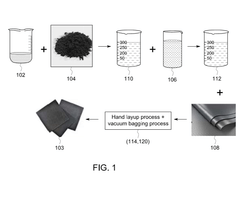
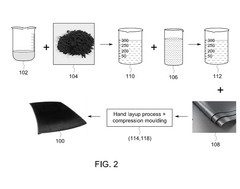
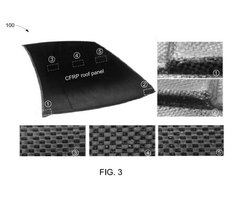
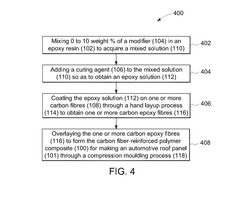
Novel reinforcement system
PatentActiveUS20160222562A1
Innovation
- A novel reinforcement fabric system with strategically designed pockets and fiber tows, featuring cross-stitching and a polymer resin composition, is introduced to enhance tensile strength and modulus of elasticity. This system includes a fabric with pockets that have cross-stitching and a fiber tow with a plurality of filaments, optimized for alignment and distribution within the fabric, along with a preimpregnated modified vinyl ester resin composition for improved structural integrity.


Environmental Impact Assessment of Composite Materials
The environmental impact of composite materials has become a critical consideration in material selection processes across industries. When comparing Carbon Fiber Reinforced Polymers (CFRP) and bamboo composites specifically for weight efficiency applications, their environmental footprints differ significantly throughout their lifecycle stages.
CFRP production involves energy-intensive processes, requiring approximately 183-286 MJ/kg of energy, resulting in substantial carbon emissions estimated at 20-25 kg CO2-eq/kg. The manufacturing process utilizes petroleum-based precursors and requires high-temperature treatment exceeding 1000°C during carbon fiber production. These factors contribute to CFRP's considerable environmental burden despite its exceptional weight-to-strength ratio.
In contrast, bamboo composites demonstrate significantly lower environmental impacts. Bamboo cultivation serves as a carbon sink, sequestering approximately 5-12 tonnes of CO2 per hectare annually. The processing of bamboo into composite materials requires only 4-7 MJ/kg of energy, resulting in a substantially reduced carbon footprint of approximately 1.7-3.2 kg CO2-eq/kg. This represents an environmental impact reduction of over 85% compared to CFRP.
Water consumption patterns also differ markedly between these materials. CFRP manufacturing requires 2,000-3,000 liters of water per kilogram of finished product, while bamboo composites typically consume only 200-400 liters per kilogram. Additionally, bamboo's rapid growth cycle of 3-5 years contrasts sharply with the non-renewable petroleum resources used in CFRP production.
End-of-life considerations further differentiate these materials. CFRP presents significant recycling challenges, with current technologies recovering only 30-40% of the original material properties. Most CFRP waste ends up in landfills or is incinerated, releasing additional greenhouse gases. Bamboo composites, particularly those using bio-based resins, offer improved biodegradability and composting options, though challenges remain with conventional resin systems.
Recent Life Cycle Assessment (LCA) studies indicate that substituting CFRP with bamboo composites in appropriate applications could reduce global warming potential by 60-75% while maintaining acceptable weight efficiency ratios. This is particularly relevant for non-critical structural components in automotive, construction, and consumer goods sectors where the absolute highest strength-to-weight ratios are not essential.
The environmental trade-offs between these materials must be evaluated within specific application contexts, considering the entire lifecycle from raw material extraction through disposal or recycling. As sustainability requirements become increasingly stringent across industries, bamboo composites present a promising alternative to CFRP in applications where their weight efficiency characteristics meet performance requirements.
CFRP production involves energy-intensive processes, requiring approximately 183-286 MJ/kg of energy, resulting in substantial carbon emissions estimated at 20-25 kg CO2-eq/kg. The manufacturing process utilizes petroleum-based precursors and requires high-temperature treatment exceeding 1000°C during carbon fiber production. These factors contribute to CFRP's considerable environmental burden despite its exceptional weight-to-strength ratio.
In contrast, bamboo composites demonstrate significantly lower environmental impacts. Bamboo cultivation serves as a carbon sink, sequestering approximately 5-12 tonnes of CO2 per hectare annually. The processing of bamboo into composite materials requires only 4-7 MJ/kg of energy, resulting in a substantially reduced carbon footprint of approximately 1.7-3.2 kg CO2-eq/kg. This represents an environmental impact reduction of over 85% compared to CFRP.
Water consumption patterns also differ markedly between these materials. CFRP manufacturing requires 2,000-3,000 liters of water per kilogram of finished product, while bamboo composites typically consume only 200-400 liters per kilogram. Additionally, bamboo's rapid growth cycle of 3-5 years contrasts sharply with the non-renewable petroleum resources used in CFRP production.
End-of-life considerations further differentiate these materials. CFRP presents significant recycling challenges, with current technologies recovering only 30-40% of the original material properties. Most CFRP waste ends up in landfills or is incinerated, releasing additional greenhouse gases. Bamboo composites, particularly those using bio-based resins, offer improved biodegradability and composting options, though challenges remain with conventional resin systems.
Recent Life Cycle Assessment (LCA) studies indicate that substituting CFRP with bamboo composites in appropriate applications could reduce global warming potential by 60-75% while maintaining acceptable weight efficiency ratios. This is particularly relevant for non-critical structural components in automotive, construction, and consumer goods sectors where the absolute highest strength-to-weight ratios are not essential.
The environmental trade-offs between these materials must be evaluated within specific application contexts, considering the entire lifecycle from raw material extraction through disposal or recycling. As sustainability requirements become increasingly stringent across industries, bamboo composites present a promising alternative to CFRP in applications where their weight efficiency characteristics meet performance requirements.
Manufacturing Process Comparison and Optimization
The manufacturing processes for Carbon Fiber Reinforced Polymers (CFRP) and bamboo composites differ significantly, impacting their weight efficiency characteristics. CFRP production typically involves a complex multi-stage process beginning with polyacrylonitrile (PAN) precursor conversion to carbon fiber through carbonization at temperatures exceeding 1000°C, followed by surface treatment and sizing to improve fiber-matrix adhesion.
CFRP manufacturing methods include prepreg layup, resin transfer molding (RTM), and automated fiber placement (AFP), each offering different balances between production efficiency and material performance. Prepreg systems provide excellent fiber-to-resin ratios but require autoclave curing, increasing energy consumption and production costs. RTM offers better scalability for medium-volume production while maintaining good mechanical properties.
In contrast, bamboo composite manufacturing begins with harvesting and processing of natural bamboo culms. The material undergoes mechanical or steam explosion treatment to separate fibers, followed by chemical treatments to remove lignin and hemicellulose, improving fiber-matrix compatibility. Bamboo strips or fibers are then combined with polymer matrices through compression molding, hand layup, or extrusion processes.
The energy intensity of CFRP manufacturing (approximately 183-286 MJ/kg) significantly exceeds that of bamboo composites (30-55 MJ/kg). This energy differential translates directly to production costs and environmental impact. CFRP manufacturing generates approximately 25 kg CO₂e per kilogram of material, compared to 1.7-4.2 kg CO₂e for bamboo composites.
Process optimization opportunities exist for both materials. For CFRP, out-of-autoclave (OOA) curing technologies can reduce energy consumption by 40-60% while maintaining 85-95% of mechanical properties. Microwave curing shows promise for reducing cure times from hours to minutes. Recycling technologies for production waste and end-of-life components are advancing, with pyrolysis and solvolysis methods recovering up to 95% of carbon fibers.
For bamboo composites, optimization focuses on fiber extraction efficiency and surface treatment standardization. Enzymatic treatments are emerging as environmentally friendly alternatives to chemical processing, reducing water usage by 30-40%. Hybrid manufacturing approaches combining bamboo with synthetic fibers show potential for optimizing weight-specific properties.
Quality control remains more challenging for bamboo composites due to natural material variability. Advanced non-destructive testing methods, including ultrasonic inspection and thermography, are being adapted for bamboo composite quality assurance, though standardization lags behind CFRP inspection protocols.
CFRP manufacturing methods include prepreg layup, resin transfer molding (RTM), and automated fiber placement (AFP), each offering different balances between production efficiency and material performance. Prepreg systems provide excellent fiber-to-resin ratios but require autoclave curing, increasing energy consumption and production costs. RTM offers better scalability for medium-volume production while maintaining good mechanical properties.
In contrast, bamboo composite manufacturing begins with harvesting and processing of natural bamboo culms. The material undergoes mechanical or steam explosion treatment to separate fibers, followed by chemical treatments to remove lignin and hemicellulose, improving fiber-matrix compatibility. Bamboo strips or fibers are then combined with polymer matrices through compression molding, hand layup, or extrusion processes.
The energy intensity of CFRP manufacturing (approximately 183-286 MJ/kg) significantly exceeds that of bamboo composites (30-55 MJ/kg). This energy differential translates directly to production costs and environmental impact. CFRP manufacturing generates approximately 25 kg CO₂e per kilogram of material, compared to 1.7-4.2 kg CO₂e for bamboo composites.
Process optimization opportunities exist for both materials. For CFRP, out-of-autoclave (OOA) curing technologies can reduce energy consumption by 40-60% while maintaining 85-95% of mechanical properties. Microwave curing shows promise for reducing cure times from hours to minutes. Recycling technologies for production waste and end-of-life components are advancing, with pyrolysis and solvolysis methods recovering up to 95% of carbon fibers.
For bamboo composites, optimization focuses on fiber extraction efficiency and surface treatment standardization. Enzymatic treatments are emerging as environmentally friendly alternatives to chemical processing, reducing water usage by 30-40%. Hybrid manufacturing approaches combining bamboo with synthetic fibers show potential for optimizing weight-specific properties.
Quality control remains more challenging for bamboo composites due to natural material variability. Advanced non-destructive testing methods, including ultrasonic inspection and thermography, are being adapted for bamboo composite quality assurance, though standardization lags behind CFRP inspection protocols.
Unlock deeper insights with PatSnap Eureka Quick Research — get a full tech report to explore trends and direct your research. Try now!
Generate Your Research Report Instantly with AI Agent
Supercharge your innovation with PatSnap Eureka AI Agent Platform!