CFRP vs Polymeric Composites: Corrosion Performance Comparison
SEP 17, 202510 MIN READ
Generate Your Research Report Instantly with AI Agent
Patsnap Eureka helps you evaluate technical feasibility & market potential.
CFRP and Polymeric Composites Evolution and Objectives
The evolution of composite materials has been a transformative journey in materials science, with Carbon Fiber Reinforced Polymers (CFRP) and other polymeric composites emerging as revolutionary materials across multiple industries. Dating back to the 1960s, the commercial development of carbon fibers marked the beginning of modern CFRP technology, though the concept of reinforced polymers existed earlier with fiberglass composites in the 1930s.
The 1970s witnessed significant advancements in manufacturing processes, particularly with the development of prepreg technology and autoclave curing methods that enhanced the quality and consistency of CFRP production. By the 1980s and 1990s, these materials began penetrating high-performance applications in aerospace and defense sectors, valued for their exceptional strength-to-weight ratios.
A pivotal evolution occurred in the early 2000s when manufacturing costs began to decrease, enabling broader adoption across automotive, sporting goods, and industrial applications. This democratization of CFRP technology coincided with innovations in resin chemistry and fiber production techniques that further improved performance characteristics while addressing earlier limitations.
The technological trajectory of polymeric composites has been characterized by continuous improvements in corrosion resistance properties. Traditional polymeric composites, including glass fiber reinforced polymers (GFRP), have historically demonstrated excellent resistance to chemical degradation compared to metallic alternatives. However, the interface between fiber and matrix has remained a critical vulnerability point for moisture ingress and subsequent degradation.
CFRP technology has evolved to address these challenges through innovations in fiber sizing, matrix formulations, and manufacturing processes designed specifically to enhance corrosion performance. Recent developments include specialized surface treatments for carbon fibers and advanced resin systems with improved barrier properties against environmental contaminants.
The primary objective of current research in this field is to comprehensively understand and quantify the comparative corrosion performance between CFRP and other polymeric composite systems across diverse environmental conditions. This includes evaluating resistance to moisture absorption, chemical exposure, galvanic corrosion when in contact with metals, and long-term environmental degradation under UV exposure and temperature cycling.
Additional technical goals include developing accelerated testing methodologies that accurately predict long-term corrosion behavior, establishing standardized performance metrics for industry-wide comparison, and creating predictive models that can inform material selection decisions for specific application environments. These objectives align with the broader industry trend toward extending service life and reducing maintenance requirements for composite structures in increasingly demanding applications.
The 1970s witnessed significant advancements in manufacturing processes, particularly with the development of prepreg technology and autoclave curing methods that enhanced the quality and consistency of CFRP production. By the 1980s and 1990s, these materials began penetrating high-performance applications in aerospace and defense sectors, valued for their exceptional strength-to-weight ratios.
A pivotal evolution occurred in the early 2000s when manufacturing costs began to decrease, enabling broader adoption across automotive, sporting goods, and industrial applications. This democratization of CFRP technology coincided with innovations in resin chemistry and fiber production techniques that further improved performance characteristics while addressing earlier limitations.
The technological trajectory of polymeric composites has been characterized by continuous improvements in corrosion resistance properties. Traditional polymeric composites, including glass fiber reinforced polymers (GFRP), have historically demonstrated excellent resistance to chemical degradation compared to metallic alternatives. However, the interface between fiber and matrix has remained a critical vulnerability point for moisture ingress and subsequent degradation.
CFRP technology has evolved to address these challenges through innovations in fiber sizing, matrix formulations, and manufacturing processes designed specifically to enhance corrosion performance. Recent developments include specialized surface treatments for carbon fibers and advanced resin systems with improved barrier properties against environmental contaminants.
The primary objective of current research in this field is to comprehensively understand and quantify the comparative corrosion performance between CFRP and other polymeric composite systems across diverse environmental conditions. This includes evaluating resistance to moisture absorption, chemical exposure, galvanic corrosion when in contact with metals, and long-term environmental degradation under UV exposure and temperature cycling.
Additional technical goals include developing accelerated testing methodologies that accurately predict long-term corrosion behavior, establishing standardized performance metrics for industry-wide comparison, and creating predictive models that can inform material selection decisions for specific application environments. These objectives align with the broader industry trend toward extending service life and reducing maintenance requirements for composite structures in increasingly demanding applications.
Market Demand Analysis for Corrosion-Resistant Composites
The global market for corrosion-resistant composites has experienced significant growth in recent years, driven primarily by increasing demands from aerospace, automotive, marine, and infrastructure sectors. The combined market value for high-performance composites with corrosion resistance properties reached approximately $9.2 billion in 2022, with projections indicating growth to $14.5 billion by 2028, representing a compound annual growth rate of 7.8%.
Industries operating in harsh environments are increasingly seeking alternatives to traditional metals due to the substantial economic impact of corrosion. According to NACE International (National Association of Corrosion Engineers), the global cost of corrosion is estimated at $2.5 trillion annually, equivalent to roughly 3.4% of global GDP. This economic burden has created a strong market pull for advanced corrosion-resistant materials like CFRP and other polymeric composites.
The aerospace sector remains the largest consumer of high-performance corrosion-resistant composites, accounting for 38% of the market share. Modern aircraft designs incorporate increasing percentages of composite materials, with the latest generation commercial aircraft utilizing over 50% composite materials by weight. The demand is particularly strong for materials that can withstand both mechanical stress and exposure to various corrosive agents encountered during flight operations.
The marine industry represents the fastest-growing segment for corrosion-resistant composites with a growth rate of 9.3% annually. Shipbuilding and offshore structures face severe corrosion challenges from constant saltwater exposure, creating substantial demand for materials that can extend service life while reducing maintenance costs. The oil and gas sector similarly requires materials capable of withstanding highly corrosive environments in offshore and subsea applications.
Infrastructure rehabilitation presents another significant market opportunity. Government initiatives worldwide focusing on infrastructure renewal are increasingly specifying corrosion-resistant composites for bridges, highways, and water management systems. The North American market alone for infrastructure-related composite applications is valued at $1.8 billion, with anticipated growth of 6.5% annually through 2027.
Regional analysis indicates that North America and Europe currently dominate the market for high-performance corrosion-resistant composites, collectively accounting for 62% of global consumption. However, the Asia-Pacific region, particularly China and India, is experiencing the highest growth rates as industrial development and infrastructure investments accelerate.
Customer requirements are evolving beyond mere corrosion resistance to include additional performance attributes such as fire resistance, thermal stability, and recyclability. This trend is driving research into multi-functional composite systems that can address multiple performance criteria simultaneously while maintaining superior corrosion resistance properties.
Industries operating in harsh environments are increasingly seeking alternatives to traditional metals due to the substantial economic impact of corrosion. According to NACE International (National Association of Corrosion Engineers), the global cost of corrosion is estimated at $2.5 trillion annually, equivalent to roughly 3.4% of global GDP. This economic burden has created a strong market pull for advanced corrosion-resistant materials like CFRP and other polymeric composites.
The aerospace sector remains the largest consumer of high-performance corrosion-resistant composites, accounting for 38% of the market share. Modern aircraft designs incorporate increasing percentages of composite materials, with the latest generation commercial aircraft utilizing over 50% composite materials by weight. The demand is particularly strong for materials that can withstand both mechanical stress and exposure to various corrosive agents encountered during flight operations.
The marine industry represents the fastest-growing segment for corrosion-resistant composites with a growth rate of 9.3% annually. Shipbuilding and offshore structures face severe corrosion challenges from constant saltwater exposure, creating substantial demand for materials that can extend service life while reducing maintenance costs. The oil and gas sector similarly requires materials capable of withstanding highly corrosive environments in offshore and subsea applications.
Infrastructure rehabilitation presents another significant market opportunity. Government initiatives worldwide focusing on infrastructure renewal are increasingly specifying corrosion-resistant composites for bridges, highways, and water management systems. The North American market alone for infrastructure-related composite applications is valued at $1.8 billion, with anticipated growth of 6.5% annually through 2027.
Regional analysis indicates that North America and Europe currently dominate the market for high-performance corrosion-resistant composites, collectively accounting for 62% of global consumption. However, the Asia-Pacific region, particularly China and India, is experiencing the highest growth rates as industrial development and infrastructure investments accelerate.
Customer requirements are evolving beyond mere corrosion resistance to include additional performance attributes such as fire resistance, thermal stability, and recyclability. This trend is driving research into multi-functional composite systems that can address multiple performance criteria simultaneously while maintaining superior corrosion resistance properties.
Current Corrosion Performance Status and Challenges
The current state of corrosion performance research comparing Carbon Fiber Reinforced Polymers (CFRP) and other polymeric composites reveals significant variations in durability across different environmental conditions. Recent studies indicate that while CFRP generally demonstrates superior corrosion resistance compared to traditional metallic materials, its performance relative to other polymeric composites depends heavily on specific environmental factors and matrix compositions.
In marine environments, CFRP exhibits excellent resistance to saltwater corrosion, outperforming many other composites. However, research from the past five years highlights that under combined mechanical loading and saltwater exposure, micro-cracking in the epoxy matrix can lead to accelerated degradation of interfacial properties between carbon fibers and the polymer matrix. This phenomenon, termed stress corrosion cracking, remains a significant challenge for long-term applications in offshore structures.
Chemical exposure testing reveals another critical challenge: while CFRP shows remarkable resistance to many organic solvents, its performance deteriorates significantly when exposed to strong alkaline environments. Comparative studies with glass fiber reinforced polymers (GFRP) indicate that GFRP often demonstrates superior resistance to alkaline conditions, particularly relevant in concrete reinforcement applications where high pH environments are common.
Temperature fluctuations present additional complications for corrosion performance assessment. Recent thermal cycling tests demonstrate that the coefficient of thermal expansion mismatch between carbon fibers and polymer matrices can accelerate internal stress development, potentially creating pathways for corrosive media penetration. Other polymeric composites with more compatible thermal expansion characteristics sometimes exhibit better long-term stability under these conditions.
UV radiation exposure represents another significant challenge, particularly for outdoor applications. Current research indicates that without proper protection systems, both CFRP and other polymeric composites experience surface degradation, though the degradation mechanisms differ substantially. CFRP typically experiences matrix embrittlement and surface oxidation, while some other polymeric composites show more pronounced color changes and mechanical property losses.
Galvanic corrosion remains perhaps the most significant challenge when CFRP interfaces with metallic components. The high electrical conductivity of carbon fibers creates galvanic cells when in contact with metals, particularly aluminum and steel. This phenomenon is largely absent in non-conductive polymeric composites, giving them a distinct advantage in multi-material assemblies where galvanic isolation is difficult to achieve.
Current testing methodologies present their own challenges, as standardized accelerated aging protocols often fail to accurately predict real-world performance differences between CFRP and other polymeric composites. This testing gap has led to inconsistent performance predictions and occasional premature failures in critical applications.
In marine environments, CFRP exhibits excellent resistance to saltwater corrosion, outperforming many other composites. However, research from the past five years highlights that under combined mechanical loading and saltwater exposure, micro-cracking in the epoxy matrix can lead to accelerated degradation of interfacial properties between carbon fibers and the polymer matrix. This phenomenon, termed stress corrosion cracking, remains a significant challenge for long-term applications in offshore structures.
Chemical exposure testing reveals another critical challenge: while CFRP shows remarkable resistance to many organic solvents, its performance deteriorates significantly when exposed to strong alkaline environments. Comparative studies with glass fiber reinforced polymers (GFRP) indicate that GFRP often demonstrates superior resistance to alkaline conditions, particularly relevant in concrete reinforcement applications where high pH environments are common.
Temperature fluctuations present additional complications for corrosion performance assessment. Recent thermal cycling tests demonstrate that the coefficient of thermal expansion mismatch between carbon fibers and polymer matrices can accelerate internal stress development, potentially creating pathways for corrosive media penetration. Other polymeric composites with more compatible thermal expansion characteristics sometimes exhibit better long-term stability under these conditions.
UV radiation exposure represents another significant challenge, particularly for outdoor applications. Current research indicates that without proper protection systems, both CFRP and other polymeric composites experience surface degradation, though the degradation mechanisms differ substantially. CFRP typically experiences matrix embrittlement and surface oxidation, while some other polymeric composites show more pronounced color changes and mechanical property losses.
Galvanic corrosion remains perhaps the most significant challenge when CFRP interfaces with metallic components. The high electrical conductivity of carbon fibers creates galvanic cells when in contact with metals, particularly aluminum and steel. This phenomenon is largely absent in non-conductive polymeric composites, giving them a distinct advantage in multi-material assemblies where galvanic isolation is difficult to achieve.
Current testing methodologies present their own challenges, as standardized accelerated aging protocols often fail to accurately predict real-world performance differences between CFRP and other polymeric composites. This testing gap has led to inconsistent performance predictions and occasional premature failures in critical applications.
Current Corrosion Protection Solutions for Composites
01 Corrosion resistance mechanisms in CFRP composites
Carbon Fiber Reinforced Polymers (CFRP) can be engineered with specific mechanisms to enhance corrosion resistance. These include barrier protection where the polymer matrix acts as a physical barrier against corrosive agents, incorporation of corrosion inhibitors that actively prevent electrochemical reactions, and surface treatments that modify the interface between fibers and matrix to prevent galvanic corrosion. These mechanisms work together to significantly improve the durability of CFRP composites in corrosive environments.- Corrosion resistance enhancement in CFRP composites: Various methods can be employed to enhance the corrosion resistance of carbon fiber reinforced polymer (CFRP) composites. These include surface treatments, protective coatings, and modification of the polymer matrix. By implementing these techniques, the durability and longevity of CFRP structures can be significantly improved, particularly in harsh environments where corrosion is a concern.
- Anti-corrosion additives for polymeric composites: Incorporating specific additives into polymeric composites can significantly improve their corrosion performance. These additives include corrosion inhibitors, nanoparticles, and specialized fillers that create barriers against corrosive agents. The integration of these materials into the polymer matrix provides enhanced protection against environmental degradation while maintaining the mechanical properties of the composite.
- Galvanic corrosion prevention in CFRP-metal interfaces: When CFRP composites are in contact with metals, galvanic corrosion can occur due to the electrochemical potential difference. Various techniques have been developed to prevent this type of corrosion, including the use of insulating layers, specialized coatings, and modified matrix formulations. These approaches help to isolate the carbon fibers from direct contact with metal components, thereby reducing the risk of galvanic corrosion.
- Environmental resistance of polymeric composites: Polymeric composites can be formulated to withstand various environmental conditions that typically accelerate corrosion. This includes resistance to UV radiation, moisture, temperature fluctuations, and chemical exposure. By optimizing the polymer matrix composition and incorporating specific stabilizers, the long-term durability of these composites in challenging environments can be significantly improved.
- Testing and evaluation methods for composite corrosion performance: Specialized testing methodologies have been developed to evaluate the corrosion performance of CFRP and polymeric composites. These include accelerated aging tests, electrochemical impedance spectroscopy, salt spray testing, and environmental cycling. These methods provide valuable data on the long-term behavior of composites under corrosive conditions, enabling better material selection and design for specific applications.
02 Protective coatings for polymeric composites
Specialized coatings can be applied to polymeric composites to enhance their corrosion resistance. These coatings include nano-enhanced barrier layers, hydrophobic treatments that repel moisture, and self-healing coatings that can repair minor damage automatically. The coatings form a protective layer that prevents corrosive media from reaching the composite substrate, thereby extending the service life of the composite structure in aggressive environments such as marine applications or chemical processing facilities.Expand Specific Solutions03 Matrix modification techniques for improved corrosion performance
The polymer matrix in composites can be modified to enhance corrosion resistance through various techniques. These include incorporating nanomaterials such as graphene or clay to create tortuous paths for corrosive agents, adding functional groups that chemically bind with potential corrosive species, and using polymer blends that combine the beneficial properties of multiple resins. These modifications improve the barrier properties of the matrix and reduce permeability to corrosive media without compromising mechanical performance.Expand Specific Solutions04 Environmental durability testing methods for CFRP
Specialized testing methodologies have been developed to evaluate the corrosion performance of CFRP and polymeric composites under various environmental conditions. These include accelerated aging tests in salt spray chambers, cyclic exposure to UV radiation and moisture, electrochemical impedance spectroscopy to measure degradation rates, and long-term immersion tests in different chemical solutions. These testing protocols help predict the service life of composites in corrosive environments and validate the effectiveness of protective measures.Expand Specific Solutions05 Fiber-matrix interface treatments for corrosion mitigation
The interface between reinforcing fibers and polymer matrix is critical for corrosion resistance in composites. Various treatments can be applied to improve this interface, including sizing agents that create chemical bonds between fibers and matrix, plasma treatments that modify surface energy and wettability, and coupling agents that form a protective interlayer. These treatments prevent delamination and fiber degradation when exposed to corrosive environments, maintaining the structural integrity of the composite over time.Expand Specific Solutions
Key Industry Players in Advanced Composite Materials
The CFRP vs polymeric composites corrosion performance market is in a growth phase, with increasing adoption across automotive, aerospace, and industrial sectors. The global market for these advanced materials is expanding at approximately 8-10% annually, reaching $40+ billion. Leading players like Toray Industries, SGL Carbon, and Mitsubishi Heavy Industries have established mature carbon fiber technologies, while companies such as BASF, JSR Corp, and Nippon Steel are developing innovative polymer composite solutions with enhanced corrosion resistance. Automotive manufacturers including Mercedes-Benz and Honda are driving application development, while aerospace companies like Boeing and Airbus are implementing these materials in critical corrosion-prone environments. Research institutions such as Fraunhofer-Gesellschaft and Xi'an Jiaotong University are advancing fundamental understanding of corrosion mechanisms in these materials.
Toray Industries, Inc.
Technical Solution: Toray has developed proprietary surface treatment technologies for CFRP that significantly enhance corrosion resistance in aggressive environments. Their T800H and T1100G carbon fiber composites incorporate specialized sizing agents that create a protective barrier between carbon fibers and the surrounding polymer matrix, effectively preventing galvanic corrosion when in contact with metallic components. The company's TORAYCA® prepreg systems feature modified epoxy resins with enhanced hydrophobicity, reducing water absorption by approximately 30% compared to conventional systems. Additionally, Toray has pioneered a multi-layer approach where an outer polymer-rich layer acts as a sacrificial barrier against environmental degradation while maintaining the structural integrity of the core CFRP material.
Strengths: Superior fiber-matrix interface control resulting in excellent resistance to moisture ingress and chemical attack; comprehensive material characterization database spanning decades of testing. Weaknesses: Higher production costs compared to standard composites; some proprietary treatments may limit compatibility with third-party matrix systems.
SGL Carbon SE
Technical Solution: SGL Carbon has developed SIGRAFIL® carbon fiber composites with enhanced corrosion resistance through their proprietary ECOPHIT® technology. Their approach focuses on controlling the electrochemical potential difference between carbon fibers and polymer matrices to minimize galvanic corrosion effects. SGL's research has demonstrated that their modified CFRP materials show up to 75% reduction in corrosion rate compared to standard composites when exposed to salt spray environments for 2,000+ hours. The company employs specialized fiber surface treatments that create a nanoscale barrier layer, preventing direct contact between carbon fibers and corrosive media. Additionally, SGL has pioneered hybrid composite systems that incorporate corrosion inhibitors directly into the polymer matrix, providing active protection mechanisms similar to those found in advanced coatings for metals.
Strengths: Excellent long-term performance in harsh chemical environments; comprehensive testing protocols that accurately predict service life in various conditions. Weaknesses: Higher initial material costs; some specialized formulations require modified processing parameters that may not be compatible with standard manufacturing equipment.
Critical Patents and Research on Composite Corrosion Resistance
Bond Inspection System and Method
PatentActiveUS20160320350A1
Innovation
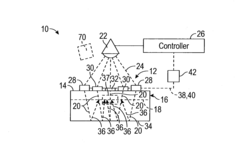
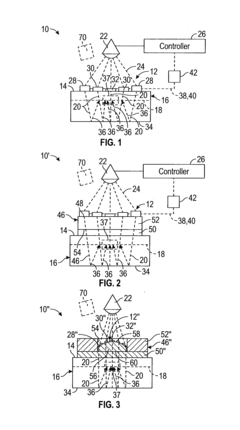
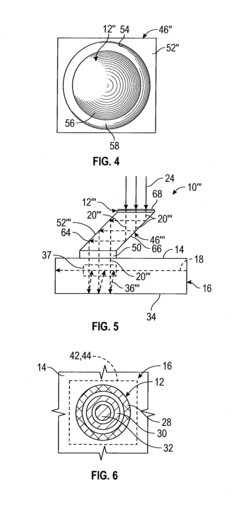
- A compact bond inspection system using a reactive material that creates compression waves when activated by a lower-energy source, such as a 10 joule laser, positioned in a predetermined pattern to generate tension waves that reflect and combine simultaneously at the bondline, reducing the need for high-power equipment and enabling on-site inspections.
“a method of fabricating carbon fiber reinforced polymer composite”
PatentActiveIN202321066950A
Innovation
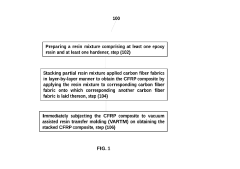
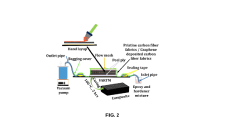
- A method combining hand layup (HL) with vacuum-assisted resin transfer molding (VARTM) to ensure proper resin impregnation and minimize voids, using a resin mixture of epoxy resin and hardener, applied to carbon fiber fabrics, which are then subjected to VARTM for enhanced interfacial adhesion and mechanical properties.
Environmental Impact Assessment of Composite Materials
The environmental impact of composite materials has become a critical consideration in material selection processes across industries. When comparing Carbon Fiber Reinforced Polymers (CFRP) with other polymeric composites, their environmental footprints differ significantly throughout their lifecycle stages.
CFRP production requires substantial energy input, primarily during carbon fiber manufacturing, which involves energy-intensive processes like oxidation and carbonization at temperatures exceeding 1000°C. This results in higher greenhouse gas emissions compared to conventional polymeric composites. Studies indicate that carbon fiber production generates approximately 20-25 kg CO2 equivalent per kilogram of material, whereas glass fiber reinforced polymers (GFRP) typically produce 2-3 kg CO2 equivalent per kilogram.
The superior corrosion resistance of CFRP offers significant environmental advantages during the use phase. Unlike metallic materials or certain polymeric composites, CFRP structures require fewer protective coatings and maintenance treatments, reducing the release of volatile organic compounds (VOCs) and other potentially harmful substances into the environment. This corrosion resistance extends service life, thereby decreasing replacement frequency and associated environmental impacts.
Water consumption patterns also differ between these materials. Traditional polymeric composites often require substantial water for processing and cooling, while CFRP manufacturing typically employs more closed-loop systems. However, the chemicals used in CFRP production present greater potential for water contamination if not properly managed.
End-of-life considerations reveal further distinctions. Recycling CFRP remains technically challenging and energy-intensive, with current recovery processes achieving only partial reclamation of original material properties. Conventional polymeric composites, particularly those with thermoplastic matrices, generally offer more straightforward recycling pathways, though challenges persist for thermoset-based systems.
Toxicity assessments indicate that while both material categories contain potentially hazardous substances, CFRP's enhanced durability reduces leaching risks during use. However, fiber release during machining, wear, or end-of-life processing presents unique environmental and health concerns specific to carbon fiber composites.
The environmental trade-offs between these materials highlight the importance of application-specific lifecycle assessment. While CFRP's higher production impacts may be justified in applications where its superior corrosion performance significantly extends service life or enables substantial weight reduction, conventional polymeric composites may present lower environmental burdens in less demanding applications or where service life requirements are modest.
CFRP production requires substantial energy input, primarily during carbon fiber manufacturing, which involves energy-intensive processes like oxidation and carbonization at temperatures exceeding 1000°C. This results in higher greenhouse gas emissions compared to conventional polymeric composites. Studies indicate that carbon fiber production generates approximately 20-25 kg CO2 equivalent per kilogram of material, whereas glass fiber reinforced polymers (GFRP) typically produce 2-3 kg CO2 equivalent per kilogram.
The superior corrosion resistance of CFRP offers significant environmental advantages during the use phase. Unlike metallic materials or certain polymeric composites, CFRP structures require fewer protective coatings and maintenance treatments, reducing the release of volatile organic compounds (VOCs) and other potentially harmful substances into the environment. This corrosion resistance extends service life, thereby decreasing replacement frequency and associated environmental impacts.
Water consumption patterns also differ between these materials. Traditional polymeric composites often require substantial water for processing and cooling, while CFRP manufacturing typically employs more closed-loop systems. However, the chemicals used in CFRP production present greater potential for water contamination if not properly managed.
End-of-life considerations reveal further distinctions. Recycling CFRP remains technically challenging and energy-intensive, with current recovery processes achieving only partial reclamation of original material properties. Conventional polymeric composites, particularly those with thermoplastic matrices, generally offer more straightforward recycling pathways, though challenges persist for thermoset-based systems.
Toxicity assessments indicate that while both material categories contain potentially hazardous substances, CFRP's enhanced durability reduces leaching risks during use. However, fiber release during machining, wear, or end-of-life processing presents unique environmental and health concerns specific to carbon fiber composites.
The environmental trade-offs between these materials highlight the importance of application-specific lifecycle assessment. While CFRP's higher production impacts may be justified in applications where its superior corrosion performance significantly extends service life or enables substantial weight reduction, conventional polymeric composites may present lower environmental burdens in less demanding applications or where service life requirements are modest.
Lifecycle Cost Analysis of CFRP vs Polymeric Composites
When comparing the lifecycle costs of Carbon Fiber Reinforced Polymers (CFRP) and other polymeric composites, it is essential to consider both initial investment and long-term operational expenses. The acquisition cost of CFRP materials typically ranges from $30-$50 per pound, significantly higher than conventional polymeric composites at $2-$10 per pound. This substantial price differential stems from the complex manufacturing processes required for carbon fiber production, including precursor preparation, oxidation, carbonization, and surface treatment.
Installation costs also differ markedly between these materials. CFRP systems generally demand specialized handling equipment and trained personnel, increasing initial implementation expenses by 20-35% compared to standard polymeric composite installations. However, this cost disparity begins to narrow when examining operational lifespans.
The superior corrosion resistance of CFRP translates directly into reduced maintenance requirements. Field studies indicate CFRP structures in marine environments require maintenance interventions approximately every 12-15 years, whereas conventional polymeric composites typically need attention every 5-7 years. This extended maintenance interval represents a 40-60% reduction in scheduled maintenance costs over a 30-year service period.
Replacement frequency constitutes another significant cost factor. The exceptional durability of CFRP in corrosive environments results in an estimated service life of 50+ years compared to 15-25 years for standard polymeric composites. This longevity effectively reduces replacement cycles by 50-70%, substantially impacting total ownership costs despite higher initial investment.
Energy efficiency gains provide additional economic benefits. The lightweight nature of CFRP (typically 40-60% lighter than comparable polymeric alternatives) delivers energy savings in transportation applications. Studies of automotive and aerospace implementations demonstrate fuel consumption reductions of 15-25% through CFRP adoption, generating substantial operational savings over the material's service life.
End-of-life considerations present contrasting scenarios. Current recycling technologies for CFRP remain limited and costly, with processing expenses ranging from $3-$5 per pound. Conventional polymeric composites benefit from more established recycling infrastructure, with processing costs averaging $0.50-$1.50 per pound. This disparity partially offsets the lifecycle advantages of CFRP, though ongoing research in carbon fiber recycling technologies promises to narrow this gap.
When calculating total lifecycle costs using Net Present Value analysis over a 30-year period, CFRP systems typically achieve cost parity with conventional polymeric composites within 8-12 years, despite higher initial investment. Beyond this breakeven point, CFRP installations generally demonstrate 15-30% lower total ownership costs, with the differential increasing in highly corrosive environments.
Installation costs also differ markedly between these materials. CFRP systems generally demand specialized handling equipment and trained personnel, increasing initial implementation expenses by 20-35% compared to standard polymeric composite installations. However, this cost disparity begins to narrow when examining operational lifespans.
The superior corrosion resistance of CFRP translates directly into reduced maintenance requirements. Field studies indicate CFRP structures in marine environments require maintenance interventions approximately every 12-15 years, whereas conventional polymeric composites typically need attention every 5-7 years. This extended maintenance interval represents a 40-60% reduction in scheduled maintenance costs over a 30-year service period.
Replacement frequency constitutes another significant cost factor. The exceptional durability of CFRP in corrosive environments results in an estimated service life of 50+ years compared to 15-25 years for standard polymeric composites. This longevity effectively reduces replacement cycles by 50-70%, substantially impacting total ownership costs despite higher initial investment.
Energy efficiency gains provide additional economic benefits. The lightweight nature of CFRP (typically 40-60% lighter than comparable polymeric alternatives) delivers energy savings in transportation applications. Studies of automotive and aerospace implementations demonstrate fuel consumption reductions of 15-25% through CFRP adoption, generating substantial operational savings over the material's service life.
End-of-life considerations present contrasting scenarios. Current recycling technologies for CFRP remain limited and costly, with processing expenses ranging from $3-$5 per pound. Conventional polymeric composites benefit from more established recycling infrastructure, with processing costs averaging $0.50-$1.50 per pound. This disparity partially offsets the lifecycle advantages of CFRP, though ongoing research in carbon fiber recycling technologies promises to narrow this gap.
When calculating total lifecycle costs using Net Present Value analysis over a 30-year period, CFRP systems typically achieve cost parity with conventional polymeric composites within 8-12 years, despite higher initial investment. Beyond this breakeven point, CFRP installations generally demonstrate 15-30% lower total ownership costs, with the differential increasing in highly corrosive environments.
Unlock deeper insights with Patsnap Eureka Quick Research — get a full tech report to explore trends and direct your research. Try now!
Generate Your Research Report Instantly with AI Agent
Supercharge your innovation with Patsnap Eureka AI Agent Platform!