

Comparative Study: Amorphous Metals vs Crystalline Alloys
OCT 11, 20259 MIN READ
Generate Your Research Report Instantly with AI Agent
PatSnap Eureka helps you evaluate technical feasibility & market potential.
Amorphous Metals Evolution and Research Objectives
Amorphous metals, also known as metallic glasses, represent a revolutionary class of materials that defy conventional metallurgical principles. Unlike traditional crystalline alloys with ordered atomic arrangements, amorphous metals exhibit a non-crystalline, disordered atomic structure similar to that of glass. This fundamental structural difference emerged as a significant research focus in the 1960s when the first amorphous metal alloy was successfully produced through rapid solidification techniques.
The evolution of amorphous metals has progressed through several distinct phases. Initially, these materials could only be produced as thin ribbons or powders due to the extremely high cooling rates required to prevent crystallization. The 1980s marked a turning point with the development of bulk metallic glasses (BMGs), which could be formed at much lower cooling rates, enabling the production of thicker samples and expanding potential applications.
Recent decades have witnessed remarkable advancements in composition design and processing techniques. Researchers have identified specific alloy systems with superior glass-forming ability, including zirconium, palladium, and iron-based compositions. These developments have facilitated the production of amorphous metals with dimensions exceeding several centimeters, dramatically expanding their practical utility.
The unique atomic structure of amorphous metals confers exceptional properties that distinguish them from their crystalline counterparts. These include superior mechanical strength, enhanced elastic limits, excellent corrosion resistance, and unique magnetic characteristics. However, their widespread adoption faces challenges related to brittleness, processing difficulties, and higher production costs compared to conventional alloys.
This comparative study aims to systematically analyze the fundamental differences between amorphous metals and crystalline alloys across multiple dimensions. Our primary research objectives include: establishing a comprehensive property comparison framework; identifying application domains where amorphous metals offer decisive advantages; evaluating current manufacturing limitations and potential solutions; and forecasting technological breakthroughs that could accelerate commercial adoption.
Additionally, we seek to explore emerging hybrid materials that combine amorphous and crystalline phases to leverage the advantages of both structural paradigms. By examining these composite approaches, we aim to identify pathways for overcoming the inherent limitations of purely amorphous structures while maintaining their beneficial properties.
The findings from this research will inform strategic decisions regarding investment in amorphous metal technologies and guide future R&D efforts toward the most promising application areas and processing innovations.
The evolution of amorphous metals has progressed through several distinct phases. Initially, these materials could only be produced as thin ribbons or powders due to the extremely high cooling rates required to prevent crystallization. The 1980s marked a turning point with the development of bulk metallic glasses (BMGs), which could be formed at much lower cooling rates, enabling the production of thicker samples and expanding potential applications.
Recent decades have witnessed remarkable advancements in composition design and processing techniques. Researchers have identified specific alloy systems with superior glass-forming ability, including zirconium, palladium, and iron-based compositions. These developments have facilitated the production of amorphous metals with dimensions exceeding several centimeters, dramatically expanding their practical utility.
The unique atomic structure of amorphous metals confers exceptional properties that distinguish them from their crystalline counterparts. These include superior mechanical strength, enhanced elastic limits, excellent corrosion resistance, and unique magnetic characteristics. However, their widespread adoption faces challenges related to brittleness, processing difficulties, and higher production costs compared to conventional alloys.
This comparative study aims to systematically analyze the fundamental differences between amorphous metals and crystalline alloys across multiple dimensions. Our primary research objectives include: establishing a comprehensive property comparison framework; identifying application domains where amorphous metals offer decisive advantages; evaluating current manufacturing limitations and potential solutions; and forecasting technological breakthroughs that could accelerate commercial adoption.
Additionally, we seek to explore emerging hybrid materials that combine amorphous and crystalline phases to leverage the advantages of both structural paradigms. By examining these composite approaches, we aim to identify pathways for overcoming the inherent limitations of purely amorphous structures while maintaining their beneficial properties.
The findings from this research will inform strategic decisions regarding investment in amorphous metal technologies and guide future R&D efforts toward the most promising application areas and processing innovations.
Market Applications and Demand Analysis
The market for amorphous metals, also known as metallic glasses, has been experiencing significant growth in recent years, driven by their unique properties that offer advantages over traditional crystalline alloys in specific applications. The global amorphous metals market was valued at approximately 1.5 billion USD in 2022 and is projected to grow at a compound annual growth rate of 7.8% through 2030, reflecting increasing industrial adoption.
Electronics and electrical equipment represent the largest application segment for amorphous metals, accounting for roughly 40% of market demand. The superior magnetic properties of iron-based amorphous alloys make them ideal for transformer cores, where they reduce energy losses by up to 80% compared to conventional silicon steel. This efficiency gain has created substantial demand in power distribution networks, particularly as energy conservation becomes a global priority.
Aerospace and defense sectors have emerged as high-value markets for both amorphous metals and advanced crystalline alloys. The exceptional strength-to-weight ratios of titanium-based amorphous alloys are particularly valued for structural components in aircraft and spacecraft. Meanwhile, specialized crystalline superalloys remain dominant in jet engine applications due to their superior high-temperature performance.
Medical device manufacturing represents a rapidly growing application area, especially for zirconium-based amorphous metals. Their biocompatibility, corrosion resistance, and non-magnetic properties make them excellent candidates for implantable devices and surgical instruments. Market analysis indicates a 12% annual growth rate in this segment, outpacing the overall market.
Consumer electronics manufacturers are increasingly incorporating amorphous metals into smartphone frames, wearable devices, and sports equipment, leveraging their exceptional elasticity and scratch resistance. This sector is expected to drive significant volume growth as manufacturing processes become more cost-effective.
Industrial machinery applications favor crystalline alloys for their predictable performance characteristics and established supply chains. However, amorphous metal bearings and wear-resistant coatings are gaining traction due to their superior hardness and friction properties, which can extend component lifespans by 200-300%.
Regional market analysis reveals that Asia-Pacific dominates global demand for both amorphous and crystalline alloys, accounting for approximately 45% of consumption, followed by North America (25%) and Europe (20%). China's industrial modernization initiatives and Japan's advanced manufacturing sector are particularly significant drivers in the amorphous metals segment.
The price premium for amorphous metals remains a limiting factor for broader adoption, with costs typically 30-50% higher than comparable crystalline alloys. However, this gap is narrowing as production technologies mature and economies of scale improve, suggesting potential for accelerated market penetration in the coming decade.
Electronics and electrical equipment represent the largest application segment for amorphous metals, accounting for roughly 40% of market demand. The superior magnetic properties of iron-based amorphous alloys make them ideal for transformer cores, where they reduce energy losses by up to 80% compared to conventional silicon steel. This efficiency gain has created substantial demand in power distribution networks, particularly as energy conservation becomes a global priority.
Aerospace and defense sectors have emerged as high-value markets for both amorphous metals and advanced crystalline alloys. The exceptional strength-to-weight ratios of titanium-based amorphous alloys are particularly valued for structural components in aircraft and spacecraft. Meanwhile, specialized crystalline superalloys remain dominant in jet engine applications due to their superior high-temperature performance.
Medical device manufacturing represents a rapidly growing application area, especially for zirconium-based amorphous metals. Their biocompatibility, corrosion resistance, and non-magnetic properties make them excellent candidates for implantable devices and surgical instruments. Market analysis indicates a 12% annual growth rate in this segment, outpacing the overall market.
Consumer electronics manufacturers are increasingly incorporating amorphous metals into smartphone frames, wearable devices, and sports equipment, leveraging their exceptional elasticity and scratch resistance. This sector is expected to drive significant volume growth as manufacturing processes become more cost-effective.
Industrial machinery applications favor crystalline alloys for their predictable performance characteristics and established supply chains. However, amorphous metal bearings and wear-resistant coatings are gaining traction due to their superior hardness and friction properties, which can extend component lifespans by 200-300%.
Regional market analysis reveals that Asia-Pacific dominates global demand for both amorphous and crystalline alloys, accounting for approximately 45% of consumption, followed by North America (25%) and Europe (20%). China's industrial modernization initiatives and Japan's advanced manufacturing sector are particularly significant drivers in the amorphous metals segment.
The price premium for amorphous metals remains a limiting factor for broader adoption, with costs typically 30-50% higher than comparable crystalline alloys. However, this gap is narrowing as production technologies mature and economies of scale improve, suggesting potential for accelerated market penetration in the coming decade.
Current State and Technical Barriers
Amorphous metals, also known as metallic glasses, represent a significant departure from conventional crystalline alloys in terms of atomic structure and properties. Currently, the global research landscape for amorphous metals is experiencing rapid growth, with major advancements occurring in North America, Europe, and East Asia, particularly in Japan, China, and South Korea. The market for these materials has expanded beyond initial niche applications into broader industrial sectors, including aerospace, medical devices, and consumer electronics.
The fundamental technical distinction between amorphous metals and crystalline alloys lies in their atomic arrangement. While crystalline alloys possess long-range atomic order with regular, repeating patterns, amorphous metals exhibit a disordered, non-crystalline structure similar to frozen liquids. This structural difference results in unique mechanical, magnetic, and chemical properties that have attracted significant research interest.
Despite promising developments, several critical technical barriers impede the widespread adoption of amorphous metals. The most significant challenge remains the size limitation in bulk metallic glass production. Current manufacturing capabilities typically restrict dimensions to centimeters rather than meters, limiting potential applications. This size constraint stems from the critical cooling rates required to prevent crystallization during solidification, typically exceeding 10^6 K/s for many compositions.
Another major obstacle involves the inherent brittleness of many amorphous metal compositions, particularly under tensile loading conditions. While these materials often exhibit exceptional strength and hardness, their limited ductility and toughness restrict their use in structural applications where failure tolerance is essential. Recent research has focused on developing composite structures and novel compositions to address this limitation.
Manufacturing scalability presents additional challenges. Current production methods, including melt spinning, suction casting, and selective laser melting, face difficulties in consistently producing defect-free amorphous structures at commercially viable scales. Process control parameters remain highly sensitive, with narrow processing windows that complicate quality control and reproducibility.
Crystalline alloys, by contrast, benefit from centuries of metallurgical development and established manufacturing infrastructure. Their well-understood behavior, predictable properties, and mature processing technologies give them significant advantages in many applications. However, they typically cannot match the specific strength, wear resistance, or corrosion resistance of their amorphous counterparts.
The cost differential between amorphous metals and conventional crystalline alloys remains substantial, with amorphous variants often commanding premium prices due to specialized processing requirements and limited production volumes. This economic barrier has confined amorphous metals primarily to high-value applications where their unique properties justify the additional expense.
The fundamental technical distinction between amorphous metals and crystalline alloys lies in their atomic arrangement. While crystalline alloys possess long-range atomic order with regular, repeating patterns, amorphous metals exhibit a disordered, non-crystalline structure similar to frozen liquids. This structural difference results in unique mechanical, magnetic, and chemical properties that have attracted significant research interest.
Despite promising developments, several critical technical barriers impede the widespread adoption of amorphous metals. The most significant challenge remains the size limitation in bulk metallic glass production. Current manufacturing capabilities typically restrict dimensions to centimeters rather than meters, limiting potential applications. This size constraint stems from the critical cooling rates required to prevent crystallization during solidification, typically exceeding 10^6 K/s for many compositions.
Another major obstacle involves the inherent brittleness of many amorphous metal compositions, particularly under tensile loading conditions. While these materials often exhibit exceptional strength and hardness, their limited ductility and toughness restrict their use in structural applications where failure tolerance is essential. Recent research has focused on developing composite structures and novel compositions to address this limitation.
Manufacturing scalability presents additional challenges. Current production methods, including melt spinning, suction casting, and selective laser melting, face difficulties in consistently producing defect-free amorphous structures at commercially viable scales. Process control parameters remain highly sensitive, with narrow processing windows that complicate quality control and reproducibility.
Crystalline alloys, by contrast, benefit from centuries of metallurgical development and established manufacturing infrastructure. Their well-understood behavior, predictable properties, and mature processing technologies give them significant advantages in many applications. However, they typically cannot match the specific strength, wear resistance, or corrosion resistance of their amorphous counterparts.
The cost differential between amorphous metals and conventional crystalline alloys remains substantial, with amorphous variants often commanding premium prices due to specialized processing requirements and limited production volumes. This economic barrier has confined amorphous metals primarily to high-value applications where their unique properties justify the additional expense.
Comparative Properties and Manufacturing Methods
01 Manufacturing processes for amorphous metals
Various manufacturing processes can be employed to produce amorphous metals, including rapid solidification techniques that prevent crystallization. These methods involve cooling molten metal at extremely high rates to bypass crystal formation, resulting in a disordered atomic structure. Techniques such as melt spinning, gas atomization, and splat quenching are commonly used to achieve the necessary cooling rates. The processing parameters must be carefully controlled to maintain the amorphous structure throughout the material.- Manufacturing processes for amorphous metals: Various manufacturing processes can be employed to produce amorphous metals, including rapid solidification techniques that prevent crystallization. These methods involve cooling molten metal at extremely high rates to bypass crystal formation, resulting in a disordered atomic structure. Techniques include melt spinning, splat quenching, and gas atomization, which enable the production of amorphous metal ribbons, sheets, or powders with unique mechanical and magnetic properties compared to their crystalline counterparts.
- Bulk metallic glasses and their applications: Bulk metallic glasses (BMGs) are amorphous metal alloys that can be produced in thicker sections than traditional amorphous metals. These materials exhibit exceptional strength, hardness, corrosion resistance, and unique elastic properties. BMGs find applications in various fields including electronics, medical devices, sporting goods, and aerospace components. Their ability to be precision-cast into complex shapes without shrinkage makes them particularly valuable for manufacturing high-performance parts.
- Crystallization control in metal alloys: Controlling the crystallization process in metal alloys is crucial for achieving desired material properties. This involves manipulating cooling rates, adding nucleating agents or inhibitors, and applying external fields during solidification. Techniques such as annealing, deformation processing, and controlled heat treatment can be used to modify the crystalline structure of alloys. The ability to control grain size, orientation, and distribution significantly impacts mechanical properties including strength, ductility, and corrosion resistance.
- Nanocrystalline and partially crystallized amorphous alloys: Nanocrystalline materials represent an intermediate state between fully amorphous and conventional crystalline structures, containing crystalline regions at the nanometer scale embedded within an amorphous matrix. These materials can be produced by controlled crystallization of amorphous precursors or through specialized processing techniques. The combination of amorphous and nanocrystalline phases often results in superior magnetic properties, enhanced mechanical strength, and improved thermal stability compared to either fully amorphous or fully crystalline counterparts.
- Novel compositions for specialized applications: Innovative alloy compositions have been developed for specific applications that leverage the unique properties of amorphous and crystalline structures. These include iron-based amorphous alloys for transformer cores with reduced energy losses, zirconium-based bulk metallic glasses for biomedical implants, and aluminum-based amorphous alloys for lightweight structural components. The careful selection of alloying elements and processing conditions enables tailoring of electrical, magnetic, mechanical, and chemical properties to meet specialized requirements in industries ranging from electronics to aerospace.
02 Composition and properties of bulk metallic glasses
Bulk metallic glasses (BMGs) are amorphous metal alloys with specific compositions that allow them to form glassy structures at relatively lower cooling rates. These materials typically contain multiple elements with significant atomic size differences, which creates complexity in the atomic structure and inhibits crystallization. BMGs exhibit exceptional mechanical properties including high strength, hardness, elastic limit, and corrosion resistance. The absence of grain boundaries contributes to their unique combination of properties that differ significantly from their crystalline counterparts.Expand Specific Solutions03 Crystallization behavior and thermal stability
The transformation from amorphous to crystalline states in metallic alloys involves complex nucleation and growth processes. Amorphous metals exist in a metastable state and can crystallize when exposed to sufficient thermal energy. The crystallization temperature and kinetics depend on the alloy composition and thermal history. Understanding and controlling this transformation is crucial for applications requiring either thermal stability of the amorphous structure or controlled crystallization to achieve specific properties. Various techniques including differential scanning calorimetry and X-ray diffraction are used to study these transformations.Expand Specific Solutions04 Applications of amorphous and nanocrystalline alloys
Amorphous and nanocrystalline alloys find applications across various industries due to their unique properties. In electronics, they serve as magnetic cores in transformers and inductors due to their low core losses and high permeability. In medical fields, their biocompatibility and corrosion resistance make them suitable for implants. Their high strength-to-weight ratio benefits aerospace and defense applications. Additionally, their wear resistance properties are valuable for cutting tools and protective coatings. Partially crystallized amorphous alloys (nanocrystalline materials) often offer an optimal balance of properties for specific applications.Expand Specific Solutions05 Surface treatments and composite structures
Surface treatments and the development of composite structures involving amorphous metals enhance their functionality and application range. Techniques such as laser surface treatment, shot peening, and coating processes can modify the surface properties of amorphous metals or create amorphous layers on conventional materials. These treatments can improve wear resistance, corrosion protection, and mechanical properties. Composite structures combining amorphous and crystalline phases offer tailored property combinations that cannot be achieved with single-phase materials, enabling optimization for specific applications while overcoming inherent limitations of purely amorphous metals.Expand Specific Solutions
Leading Manufacturers and Research Institutions
The amorphous metals versus crystalline alloys market is in a growth phase, with increasing applications across automotive, electronics, and aerospace industries. The global market size for amorphous metals is projected to expand significantly due to their superior mechanical properties and corrosion resistance. Technologically, research institutions like MIT, Caltech, and Zhejiang University are advancing fundamental understanding, while companies demonstrate varying maturity levels. Apple and BYD lead in commercial applications, with Liquidmetal Technologies (via Crucible Intellectual Property) specializing in bulk metallic glasses. Amorphyx is pioneering amorphous metal applications in electronics, while traditional metallurgical companies like Baker Hughes and Schaeffler are incorporating these materials into existing product lines.
California Institute of Technology
Technical Solution: Caltech has established itself as a leader in amorphous metals research through its Materials Science department. Their researchers have developed innovative processing techniques for creating bulk metallic glasses (BMGs) with critical cooling rates orders of magnitude lower than conventional rapid quenching methods. This breakthrough has enabled the production of amorphous metal components with thicknesses exceeding several centimeters. Caltech's work has focused on zirconium and palladium-based alloy systems that demonstrate exceptional glass-forming ability. Their research has revealed unique deformation mechanisms in amorphous metals, particularly the formation and propagation of shear bands that control mechanical failure. Caltech scientists have pioneered the development of metallic glass composites that incorporate crystalline phases within an amorphous matrix, creating materials with both high strength and improved ductility. These composites show strain hardening behavior not typically found in monolithic amorphous alloys, with fracture toughness values reaching 200 MPa·m^(1/2), comparable to some high-performance crystalline alloys.
Strengths: Pioneering research in bulk metallic glass formation; development of composite structures that overcome traditional brittleness limitations; strong focus on understanding fundamental deformation mechanisms. Weaknesses: Some alloy systems studied contain expensive elements limiting commercial viability; scaling production to industrial levels remains challenging; processing parameters require precise control.
Crucible Intellectual Property LLC
Technical Solution: Crucible Intellectual Property has pioneered bulk metallic glass (BMG) technology, developing proprietary amorphous metal alloys with exceptional mechanical properties. Their patented manufacturing process creates materials with a disordered atomic structure that eliminates grain boundaries found in crystalline alloys. This results in materials with superior strength-to-weight ratios (up to 3x stronger than titanium), excellent elastic properties, and enhanced corrosion resistance. Crucible's technology enables precision casting of complex net shapes with minimal post-processing, as amorphous metals can be processed in a manner similar to plastics when heated above their glass transition temperature but below crystallization temperature. Their Liquidmetal® alloys demonstrate significantly higher yield strength (approximately 1900 MPa compared to 1375 MPa for titanium alloys) while maintaining excellent wear resistance and dimensional stability.
Strengths: Superior mechanical properties including exceptional hardness, elasticity, and wear resistance; ability to be precision cast into complex shapes with minimal post-processing; excellent corrosion resistance. Weaknesses: Higher production costs compared to conventional alloys; size limitations for fully amorphous components; challenges in joining and welding techniques.
Key Patents and Scientific Breakthroughs
Amorphous metal hot electron transistor
PatentActiveUS20200259008A1
Innovation
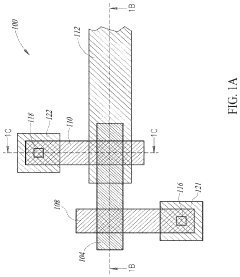
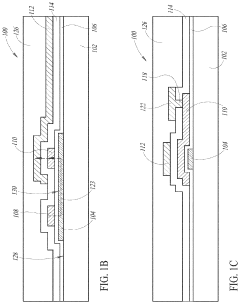
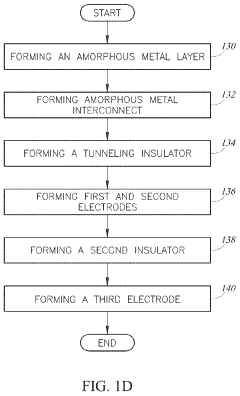
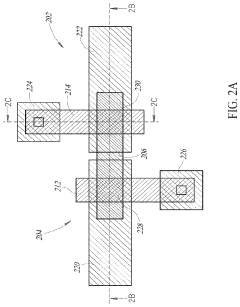
- A co-planar amorphous hot electron transistor design with emitter and base electrodes in the same upper layer, separated by a gap, allowing for two-way Fowler-Nordheim tunneling and independent control of hot electron generation and collection, which is extended to a three-terminal device with adjustable I-V performance characteristics without modifying the tunneling dielectric.
Amorphous metal alloy having high tensile strength and electrical resistivity
PatentActiveUS7771545B2
Innovation
- Development of amorphous metal alloys with specific compositions, such as (Co1-aFea)100-b-c-dCrbTcXd, incorporating elements like Cr, Mn, Mo, V, B, and Si, which enhance electrical resistivity and tensile strength by increasing structural disorder and preventing shear band formation, resulting in wires with high tensile strength and electrical resistivity.
Material Performance Testing Standards
The standardization of performance testing for amorphous metals and crystalline alloys is essential for reliable material comparison and selection in engineering applications. ASTM International has developed specific testing protocols for both material types, with ASTM E2546 addressing mechanical characterization of amorphous metals and ASTM E8/E8M covering tensile testing applicable to crystalline alloys. These standards ensure consistent measurement of key properties including tensile strength, yield point, and elongation.
ISO standards complement ASTM protocols, with ISO 6892 providing comprehensive guidelines for ambient temperature tensile testing of metallic materials. For hardness evaluation, Vickers (ASTM E384) and nanoindentation (ASTM E2546) methods are particularly valuable for amorphous metals due to their unique mechanical response, while Rockwell testing (ASTM E18) remains standard for crystalline alloys.
Fatigue performance testing follows ASTM E466 for direct stress testing and ASTM E606 for strain-controlled testing, with specialized considerations required for amorphous metals due to their distinct fatigue behavior. Thermal property assessment adheres to ASTM E1269 for specific heat capacity and ASTM E1461 for thermal diffusivity measurements, critical for understanding thermal stability differences between these material classes.
Corrosion resistance testing standards include ASTM G31 for immersion testing and ASTM G5 for potentiodynamic polarization measurements. These are particularly important when comparing amorphous metals' superior corrosion resistance against traditional crystalline alloys in aggressive environments. The electrochemical impedance spectroscopy method (ASTM G106) provides deeper insights into corrosion mechanisms for both material types.
Magnetic property characterization follows ASTM A773 guidelines, with specialized procedures for soft magnetic amorphous metals that exhibit unique magnetic behavior compared to crystalline counterparts. For structural analysis, X-ray diffraction techniques (ASTM E975) are fundamental for confirming the amorphous structure versus crystalline ordering, while transmission electron microscopy protocols help visualize nanoscale structural differences.
Recent developments in testing standards include new methodologies specifically designed for additive manufacturing of both amorphous and crystalline materials, addressing the unique challenges in evaluating layer-by-layer fabricated components. Additionally, emerging standards are beginning to incorporate computational modeling approaches to predict material performance, particularly valuable for amorphous metals where traditional structure-property relationships may not apply.
ISO standards complement ASTM protocols, with ISO 6892 providing comprehensive guidelines for ambient temperature tensile testing of metallic materials. For hardness evaluation, Vickers (ASTM E384) and nanoindentation (ASTM E2546) methods are particularly valuable for amorphous metals due to their unique mechanical response, while Rockwell testing (ASTM E18) remains standard for crystalline alloys.
Fatigue performance testing follows ASTM E466 for direct stress testing and ASTM E606 for strain-controlled testing, with specialized considerations required for amorphous metals due to their distinct fatigue behavior. Thermal property assessment adheres to ASTM E1269 for specific heat capacity and ASTM E1461 for thermal diffusivity measurements, critical for understanding thermal stability differences between these material classes.
Corrosion resistance testing standards include ASTM G31 for immersion testing and ASTM G5 for potentiodynamic polarization measurements. These are particularly important when comparing amorphous metals' superior corrosion resistance against traditional crystalline alloys in aggressive environments. The electrochemical impedance spectroscopy method (ASTM G106) provides deeper insights into corrosion mechanisms for both material types.
Magnetic property characterization follows ASTM A773 guidelines, with specialized procedures for soft magnetic amorphous metals that exhibit unique magnetic behavior compared to crystalline counterparts. For structural analysis, X-ray diffraction techniques (ASTM E975) are fundamental for confirming the amorphous structure versus crystalline ordering, while transmission electron microscopy protocols help visualize nanoscale structural differences.
Recent developments in testing standards include new methodologies specifically designed for additive manufacturing of both amorphous and crystalline materials, addressing the unique challenges in evaluating layer-by-layer fabricated components. Additionally, emerging standards are beginning to incorporate computational modeling approaches to predict material performance, particularly valuable for amorphous metals where traditional structure-property relationships may not apply.
Environmental Impact and Sustainability Considerations
The environmental footprint of materials production and usage has become a critical consideration in modern manufacturing and engineering. When comparing amorphous metals (metallic glasses) with traditional crystalline alloys, several significant sustainability differences emerge. Amorphous metals typically require rapid cooling during production, which can be energy-intensive, potentially increasing their carbon footprint compared to conventional alloy manufacturing processes. However, this initial energy investment may be offset by their superior performance characteristics over the product lifecycle.
The production of amorphous metals often requires fewer raw materials due to their enhanced mechanical properties, which allows for thinner cross-sections and lighter components. This material efficiency translates to reduced resource extraction and associated environmental impacts. Additionally, the exceptional corrosion resistance of many amorphous metal compositions significantly extends product lifespan, reducing the frequency of replacement and the corresponding environmental burden of manufacturing replacement parts.
Recyclability presents another important sustainability dimension. Crystalline alloys have well-established recycling streams in most industrial economies, with high recovery rates. Amorphous metals, while theoretically recyclable, currently lack dedicated recycling infrastructure due to their relatively limited commercial deployment. This gap represents a sustainability challenge that requires attention as amorphous metal applications expand.
Life cycle assessment (LCA) studies comparing specific applications show that amorphous metal components often demonstrate lower environmental impact during the use phase. For instance, amorphous metal transformers exhibit reduced energy losses compared to silicon steel alternatives, resulting in significant energy savings over operational lifetimes that can exceed 30 years. Similarly, amorphous-based cutting tools maintain their edge longer, reducing the frequency of replacement and associated material consumption.
The absence of grain boundaries in amorphous structures eliminates the need for certain alloying elements used in crystalline materials to strengthen grain boundaries. This can reduce dependence on rare or environmentally problematic elements, though amorphous formulations may introduce other specialty elements with their own sustainability considerations. The net environmental benefit depends heavily on specific compositions and applications.
Looking forward, advancements in manufacturing technologies for amorphous metals, particularly those reducing energy requirements for production, could significantly improve their sustainability profile. The development of specialized recycling processes for amorphous metals represents another opportunity to enhance their environmental credentials, potentially closing the sustainability gap with more established crystalline alloys.
The production of amorphous metals often requires fewer raw materials due to their enhanced mechanical properties, which allows for thinner cross-sections and lighter components. This material efficiency translates to reduced resource extraction and associated environmental impacts. Additionally, the exceptional corrosion resistance of many amorphous metal compositions significantly extends product lifespan, reducing the frequency of replacement and the corresponding environmental burden of manufacturing replacement parts.
Recyclability presents another important sustainability dimension. Crystalline alloys have well-established recycling streams in most industrial economies, with high recovery rates. Amorphous metals, while theoretically recyclable, currently lack dedicated recycling infrastructure due to their relatively limited commercial deployment. This gap represents a sustainability challenge that requires attention as amorphous metal applications expand.
Life cycle assessment (LCA) studies comparing specific applications show that amorphous metal components often demonstrate lower environmental impact during the use phase. For instance, amorphous metal transformers exhibit reduced energy losses compared to silicon steel alternatives, resulting in significant energy savings over operational lifetimes that can exceed 30 years. Similarly, amorphous-based cutting tools maintain their edge longer, reducing the frequency of replacement and associated material consumption.
The absence of grain boundaries in amorphous structures eliminates the need for certain alloying elements used in crystalline materials to strengthen grain boundaries. This can reduce dependence on rare or environmentally problematic elements, though amorphous formulations may introduce other specialty elements with their own sustainability considerations. The net environmental benefit depends heavily on specific compositions and applications.
Looking forward, advancements in manufacturing technologies for amorphous metals, particularly those reducing energy requirements for production, could significantly improve their sustainability profile. The development of specialized recycling processes for amorphous metals represents another opportunity to enhance their environmental credentials, potentially closing the sustainability gap with more established crystalline alloys.
Unlock deeper insights with PatSnap Eureka Quick Research — get a full tech report to explore trends and direct your research. Try now!
Generate Your Research Report Instantly with AI Agent
Supercharge your innovation with PatSnap Eureka AI Agent Platform!